
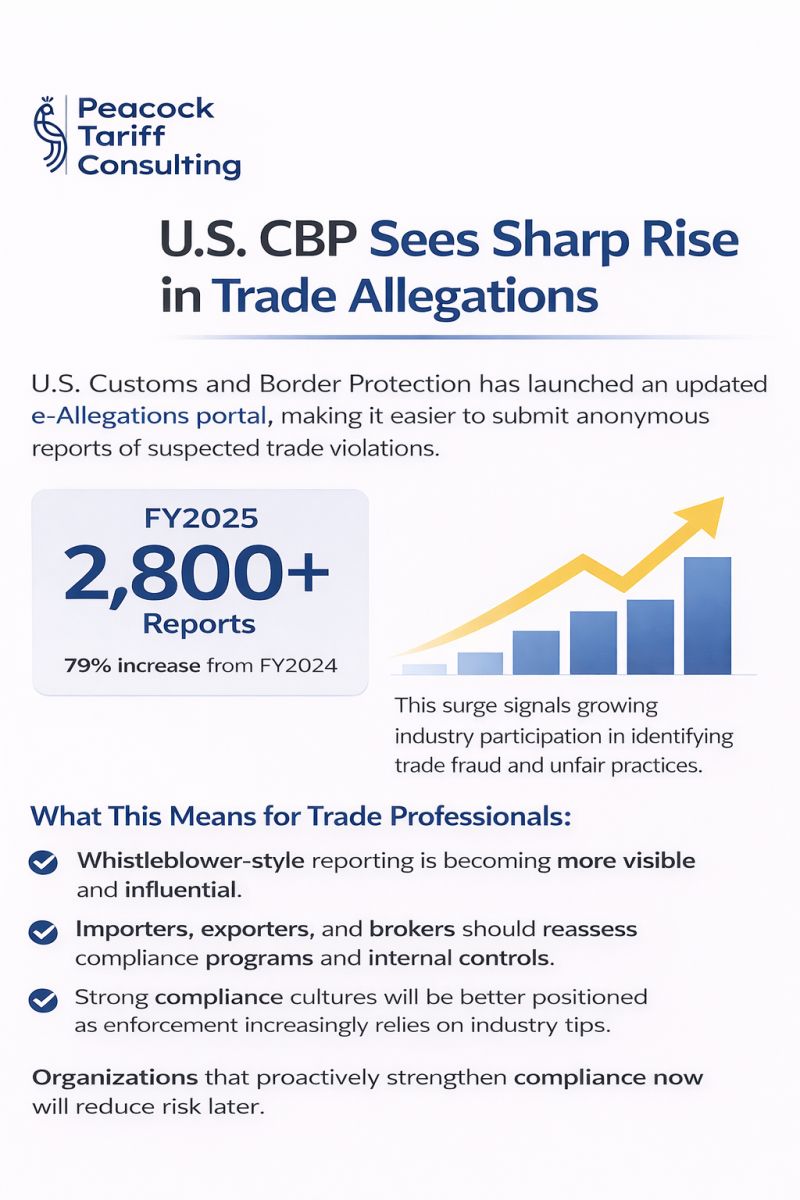
The Enforcement Environment Has Fundamentally Shifted
A 79% surge in CBP trade allegations represents a dramatic escalation in enforcement activity that importers cannot afford to ignore. The 2,800-plus anonymous tips hitting CBP this year reflect not only increased regulatory scrutiny but also a reporting environment where competitors, employees, and industry participants have become de facto enforcement agents.
This enforcement surge coincides with CBP’s expanded resources and mandate to investigate tariff classification disputes, valuation issues, and country-of-origin claims. The volume of allegations now flowing into CBP far exceeds the agency’s historical capacity, forcing prioritization decisions that will determine which cases receive intensive investigation and which proceed through accelerated or administrative penalty determination.
Understanding the Penalty Escalation Ladder
CBP’s violation penalty framework establishes three distinct categories that determine remedial severity. Each category carries exponentially higher financial consequences, transforming what might appear as minor documentation oversights into significant financial exposure.
Negligence violations-those involving failure to exercise reasonable care-can reach two times lost duties. These violations typically involve missing documentation, incomplete entry information, or classification errors that suggest carelessness rather than intentional misrepresentation. Gross negligence violations, showing reckless disregard for legal obligations, can reach four times lost duties. Fraud violations, involving intentional misrepresentation or concealment of material facts, can reach full domestic value of the merchandise.
- Negligence: penalties up to 2x lost duties for careless documentation or errors
- Gross negligence: penalties up to 4x lost duties for reckless disregard of compliance obligations
- Fraud: penalties up to full domestic value for intentional misrepresentation or concealment
Forced Labor and Safety Considerations: Six-Figure Penalties
Beyond traditional tariff compliance allegations, CBP enforcement now encompasses forced labor determinations and safety regulation violations. These categories carry distinct penalty structures operating outside the standard negligence-to-fraud framework. A single forced labor finding or safety violation can generate six-figure penalties regardless of the merchandise value involved.
The Uyghur Forced Labor Prevention Act (UFPLA) compliance burden has shifted decisively toward importers. CBP presumes merchandise from certain regions or producers involves forced labor unless importers present affirmative evidence of supply chain integrity. The documentation requirements are extensive, the verification burden is on importers, and penalties for inadequate due diligence are severe and per-shipment cumulative.
- Forced labor violation penalties: substantial statutory amounts per violation
- Safety regulation penalties: six-figure exposure for non-compliance
- Per-shipment assessment model creates cumulative liability exposure
Why Documentation Weakness Has Become Financially Dangerous
In the current enforcement environment, weak documentation creates exposure to multiple penalty theories simultaneously. A single shipment with incomplete country-of-origin information might face classification penalties under negligence theory while also triggering forced labor inquiry exposure. The same deficiency could support both CBP administrative action and private litigation risk.
Documentation weaknesses now translate directly into financial vulnerability because CBP has the evidence-gathering capacity and enforcement resources to identify deficiencies, the legal framework to assess penalties for them, and the administrative authority to act without necessarily obtaining court involvement. The margin for error has collapsed. Documentation that was once considered adequate may now expose importers to administrative action under theories that did not exist when those practices were established.
The Tight, Defensible Compliance Standard as Safe Haven
In response to this enforcement escalation, only tight, defensible compliance structures offer genuine protection. This standard requires documentation that demonstrates not merely compliance with technical requirements but active, documented due diligence appropriate to the risk profile of each transaction.
Tight compliance involves contemporaneous documentation of supplier verification, country-of-origin investigation, and classification analysis. It requires retention systems that preserve evidence of the reasoned judgment applied to each entry. It mandates regular internal audits, documented compliance procedures, and training records that establish institutional commitment to legal obligations. For importers sourcing from higher-risk regions or product categories, tight compliance extends to supply chain audits, facility inspections, and worker interviews that provide affirmative evidence of absence of forced labor or safety violations.
- Contemporaneous documentation of classification analysis and supporting rationale
- Documented supplier verification and country-of-origin investigation procedures
- Retention systems preserving evidence of entry decision-making
- Regular internal audits with documented findings and corrective actions
Implementation Priorities for Importers
Importers operating in this enforcement environment must prioritize implementation of documentation systems that create defensibility. This involves moving beyond compliance as a regulatory obligation to compliance as a competitive advantage secured through documented diligence.
Priority actions include: establishing written classification procedures reflecting current tariff law; implementing supplier verification protocols documenting country-of-origin investigation; creating entry-level documentation templates that require explicit analysis of classification and valuation decisions; maintaining audit files supporting all entry-level decisions; and implementing management review procedures that flag transactions presenting higher compliance risk. For importers with significant transaction volumes, this may require dedicated compliance personnel and technology infrastructure designed to support defensible entry documentation.