
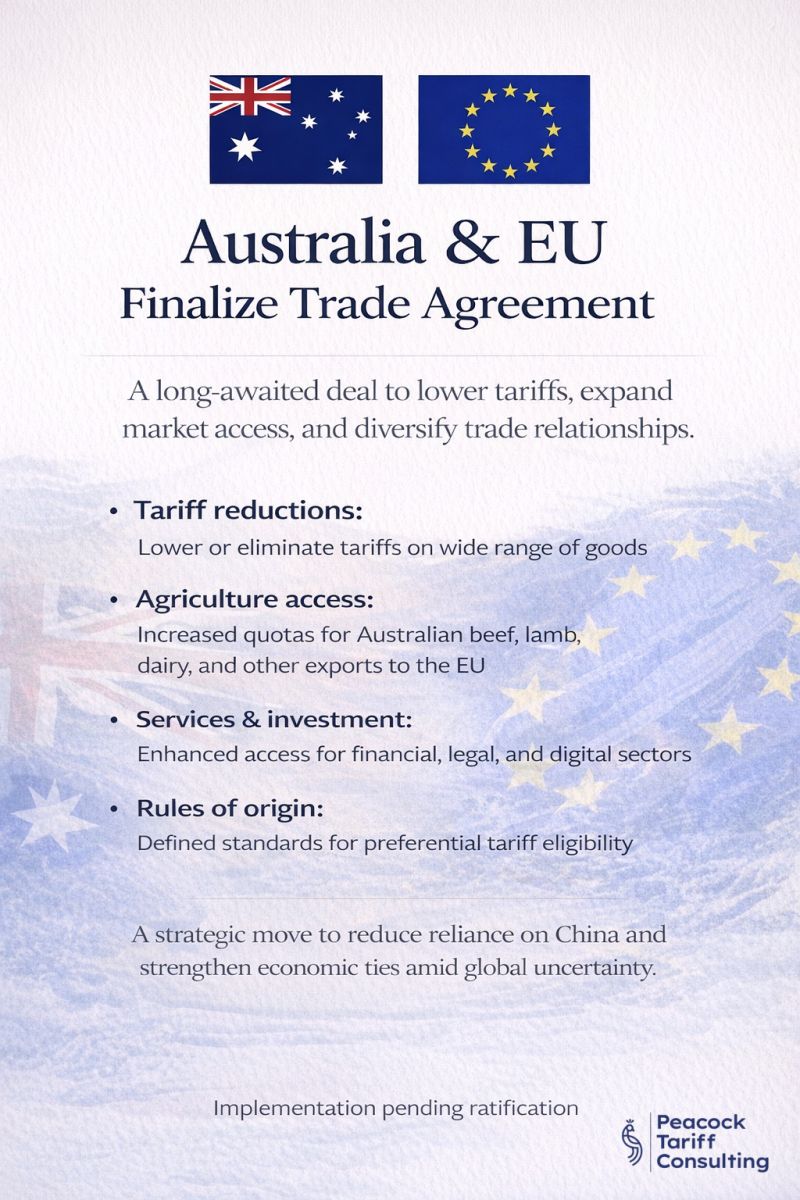
Introduction: A Trade Agreement Shaped by Agricultural Sensitivity
After years of intensive negotiation, Australia and the European Union have reached a comprehensive free trade agreement that represents a significant recalibration of their bilateral trade relationship. On the surface, the agreement appears straightforward: elimination or reduction of tariffs across goods, improved market access for services, and enhanced investment frameworks. However, the complexity embedded within this agreement-particularly around agricultural trade, rules of origin, and regulatory alignment-reveals the multifaceted challenges that characterize modern trade negotiations. The agreement’s development was heavily shaped by one critical reality: agriculture remains deeply sensitive in both regions. For Australia, agricultural exports represent crucial economic value; for the EU, agriculture involves powerful constituencies and long-standing subsidy structures that resist liberalization. The result is an agreement that manages these tensions through carefully structured phase-in periods, negotiated exemptions, and sophisticated rules of origin provisions. Understanding these elements is essential for exporters, importers, and investors seeking to benefit from improved market access.
Agricultural Negotiations: Finding Balance in an Asymmetrical Relationship
Australian agriculture represents a competitive force in global markets. Beef, lamb, wine, sugar, grains, and dairy products are all produced at scale with cost structures that can undercut many traditional EU producers. This represents both opportunity and threat from the EU perspective. Opening EU markets fully to Australian agricultural products could disrupt established producer communities, particularly in regions that have limited economic alternatives. The negotiation therefore focused on creating market access for Australian exporters while managing adjustment for EU producers. This typically manifests in tariff reduction schedules that phase in improvements over extended periods-often 5 to 15 years-allowing EU producers to adjust gradually. For beef and lamb, the agreement likely includes both general tariff reductions and negotiated quotas, where Australia receives guaranteed market access at preferential rates for specific volumes. This represents a significant improvement over previous regimes but falls short of complete tariff elimination that would theoretically provide maximum market access. Sugar proved particularly contentious given EU production support mechanisms and existing preferential access arrangements for African, Caribbean, and Pacific suppliers. Wine and dairy likely received similar treatment. For Australian exporters, the agreement provides meaningful new market opportunities, but the phased implementation requires patience and long-term planning. The quota structure means that immediate price-based competition with all EU producers is limited, but market share expansion is structured and predictable.
- Beef and lamb negotiations centered on tariff schedules and negotiated quotas
- Sugar negotiations balanced Australian export growth against EU producer protection
- Agricultural tariffs phase in over extended periods to manage EU producer adjustment
Rules of Origin: Determining What Qualifies for Preferential Treatment
Perhaps the most technically complex element of any free trade agreement, rules of origin determine which products qualify for preferential tariff treatment. This matters enormously because preferential access is the primary economic benefit of FTA membership. A product that qualifies for zero tariff access is vastly more valuable than one assessed at standard most-favored-nation rates. Rules of origin create incentives for content to originate within the FTA zone and disincentives for excessive foreign content. The Australia-EU FTA likely employs a combination of approaches: value-based thresholds requiring that a certain percentage of product value originate within the FTA zone, component-based rules specifying that particular inputs must source from partner countries, and processing requirements defining the minimum amount of value addition required. For agricultural products, rules of origin are typically straightforward-beef from Australian cattle processed in Australia clearly qualifies. But for manufactured goods, particularly those involving complex supply chains, determining origin becomes intricate. A component manufactured in Vietnam but incorporated into a good assembled in Australia must be evaluated against the FTA’s specific rules. If the rules require 60% regional content and Vietnamese components comprise 45% of value, the product may not qualify for preferential treatment. These rules profoundly affect supply chain planning. Companies must evaluate whether to concentrate sourcing within the FTA zone to ensure preferential access or accept standard tariff rates in exchange for sourcing flexibility. For Australian exporters and importers, understanding and managing rules of origin compliance has become a core supply chain competency.
- Value-based thresholds require minimum percentage of content from FTA countries
- Component-specific rules may require particular inputs to source from partner nations
- Compliance requires careful supply chain tracking and documentation
Sustainability and Regulatory Standards Integration
Modern trade agreements increasingly incorporate provisions addressing labor standards, environmental protection, and sustainability practices. The Australia-EU FTA includes explicit provisions requiring that trade be conducted in accordance with sustainability principles and relevant international standards. This represents an evolution beyond purely economic trade agreements toward agreements that embed social and environmental considerations. For exporters, this means meeting not just tariff requirements but also sustainability certifications and labor standards. Australian beef, for example, must be produced according to animal welfare standards that may exceed domestic requirements. Wine exports must comply with pesticide restrictions that EU regulators have determined hazardous. Agricultural producers must often invest in certification processes and compliance verification. These requirements, while well-intentioned, effectively function as non-tariff barriers that increase compliance costs and complexity. They can also create incentives for industry consolidation toward larger producers with resources to manage compliance complexity. Smaller operations may struggle to afford certification processes and documentation systems required to demonstrate compliance. At the same time, these provisions create market differentiation opportunities. Producers that can demonstrate compliance with rigorous sustainability standards may command price premiums in EU markets where consumers explicitly value these certifications. The net effect is complex: market access improves for compliant producers, but compliance costs may exclude smaller or less-developed suppliers.
- Sustainability provisions require compliance with EU environmental and labor standards
- Certifications and compliance verification represent significant non-tariff compliance costs
- Producers meeting standards can benefit from market differentiation and price premiums
Implementation Timelines and Phased Tariff Elimination
The agreement’s operational complexity extends to implementation timelines. Rather than immediate tariff elimination across the board, most agreements employ phased approaches where tariffs decline gradually according to negotiated schedules. This allows businesses to adjust to new competitive realities and allows governments to manage domestic political and economic adjustment. For immediate tariff elimination (often negotiated for products with minimal political sensitivity), benefits accrue immediately upon implementation. For phased elimination, companies must plan for multi-year tariff schedules, adjusting cost structures and pricing as tariffs gradually decline. A tariff that begins at 15% and declines 2% annually over 7 years requires different strategic planning than immediate elimination. Additionally, some product categories or sensitive sectors may be excluded from the agreement entirely or relegated to extended phase-in periods of 10+ years. The agreement also requires legal finalization and ratification by both parties. This means that negotiations may conclude, but implementation may face delays as domestic legislative processes unfold. Australian exporters should prepare for gradual market opening rather than immediate dramatic changes. Companies should evaluate tariff schedules for their specific products, forecast tariff rates across the implementation period, and adjust their competitive positioning and cost structures accordingly. This phased approach actually provides clarity that can support longer-term investment decisions.
- Most tariffs phase in over 5-15 year periods rather than eliminating immediately
- Implementation timelines allow gradual business adjustment to new competitive conditions
- Ratification process means implementation may lag negotiation completion
Market Access Implications for Services and Investment
While goods trade often attracts headlines, modern agreements also address services and investment. The Australia-EU FTA likely includes provisions allowing Australian services providers-in sectors like professional services, finance, telecommunications, and logistics-to establish operations more easily within EU markets. For investment, the agreement likely includes protections against arbitrary seizure or discriminatory treatment, dispute resolution mechanisms, and commitments to transparency. These provisions can be as economically significant as tariff elimination, particularly for service-sector companies. A financial services firm or consulting company that can operate across the EU without navigating separate regulatory approvals in each country gains substantial competitive advantages. However, services liberalization also creates competitive pressure as EU service providers can operate more easily in Australia. For both sets of businesses, these provisions require adaptation and competitive positioning strategy. Companies should evaluate whether improved EU access opportunities justify investment in European operations. Similarly, companies facing new Australian competition from EU service providers must develop differentiation strategies based on local knowledge, relationships, or specialized capabilities. The agreement’s impact on services and investment may ultimately exceed its impact on goods trade.
Conclusion: Strategic Positioning in an Expanding Market
The Australia-EU free trade agreement represents a significant recalibration of bilateral economic relationships after years of negotiation. The agreement’s structure-with phased agricultural tariff reductions, sophisticated rules of origin provisions, sustainability standards, and services liberalization-creates new market opportunities while requiring careful compliance and strategic positioning. For Australian exporters, the agreement provides improved access to a market of over 400 million consumers, but access is neither immediate nor unlimited. Phased implementations, negotiated quotas, and compliance requirements mean that benefits accrue gradually and require proactive engagement. For EU companies, the agreement offers improved access to Australian markets but also exposes them to competitive challenges from Australian suppliers. For businesses operating across both regions, the agreement’s implementation requires careful tracking of tariff schedules, rules of origin rules, and regulatory alignment to ensure compliance and capture available benefits. The broader significance of this agreement extends beyond bilateral trade. It demonstrates the possibility of complex FTA negotiations succeeding despite agricultural sensitivities and different regulatory approaches. It also signals both regions’ commitment to trade expansion and diversification at a time when global trade faces headwinds from geopolitical tensions and rising protectionism.