
Introduction: When Trade Policy Extends Beyond Price
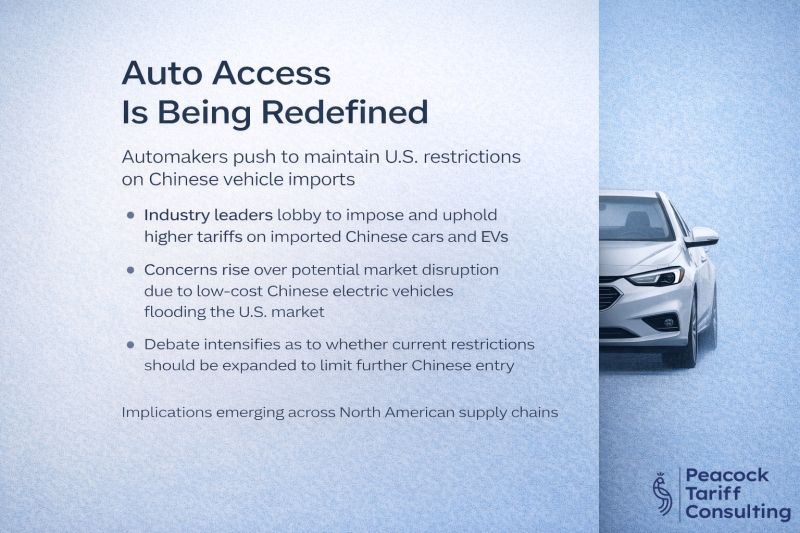
The automotive industry stands at an inflection point where traditional trade tools-tariffs and quotas-no longer capture the full scope of trade policy concerns. Major automakers including Toyota and General Motors have recently urged the U.S. administration to maintain or even expand restrictions on Chinese vehicle imports. On the surface, this appears to be a conventional protectionist request aimed at limiting price competition from lower-cost competitors. But the actual reasoning reveals a more sophisticated understanding of modern automotive trade dynamics. Data security vulnerabilities in connected vehicles, stability concerns in global supply chains, and long-term competitive positioning now occupy equal weight with traditional pricing considerations. This shift reflects how geopolitical tensions, technological integration, and strategic competition are reshaping automotive trade policy. For companies operating in this space, understanding these multidimensional concerns is essential to navigating regulatory environments and competitive strategies.
Data Security: The Connected Vehicle Vulnerability
Modern vehicles have transformed into sophisticated computing platforms that collect, transmit, and process vast amounts of user and operational data. Location history, driving patterns, vehicle diagnostics, user preferences, and increasingly, personal communications are all captured by vehicle systems. This data represents enormous value to automotive manufacturers, suppliers, and increasingly, to government surveillance operations. Chinese automakers, particularly those with direct relationships to government entities, present regulatory concerns about data sovereignty and national security. Foreign vehicles with comprehensive connectivity features could theoretically transmit sensitive location and behavioral data outside the country of operation. For government and military personnel, this risk is particularly acute. But it extends beyond security officials to ordinary drivers whose behavioral patterns and location data could be exposed to foreign actors. Additionally, vehicle-to-infrastructure communications could potentially be compromised if fundamental operating systems are controlled or influenced by foreign entities. These concerns have led to serious discussions about restricting or requiring significant modifications to Chinese vehicles sold in Western markets. The U.S. approach has been to require data localization, limit remote access capabilities, and maintain domestic control over critical vehicle systems. These requirements effectively function as non-tariff barriers that make Chinese vehicle imports less competitive regardless of pricing.
- Connected vehicles collect extensive user location, behavioral, and personal data
- Data security concerns extend to government operations and national infrastructure
- Non-tariff requirements around data localization and system control can be more effective than traditional tariffs
Supply Chain Stability and Industrial Dependency
Beyond immediate security concerns, automotive trade restrictions reflect deeper anxieties about supply chain vulnerability and industrial dependency. The global automotive sector has become highly interconnected, with critical components sourced from specialized suppliers across multiple countries. Chinese automotive production has expanded rapidly, creating a concentration risk that could leave Western automakers dependent on Chinese supply sources for key technologies. Battery technology, rare earth components, semiconductor chips, and advanced electrical systems are increasingly sourced from or dependent on Chinese manufacturing. This concentration creates strategic vulnerability, particularly given the possibility of supply disruptions during geopolitical tensions. Major automakers have learned painful lessons from recent supply chain disruptions, ranging from COVID-related shutdowns to semiconductor shortages that crippled production. The concern is not simply about Chinese vehicle imports capturing market share, but about structural dependence on Chinese-controlled supply chains for critical technologies. Trade restrictions on finished Chinese vehicles are designed partly to protect domestic market access and partly to create space for North American and allied manufacturers to develop alternative supply sources. This requires investment and time-both of which are threatened if Chinese competitors capture significant market share during the transition period.
- Chinese suppliers dominate battery and semiconductor supply chains for vehicles
- Supply concentration creates strategic vulnerability during geopolitical tensions
- Trade restrictions create space for alternative supply chain development
Regulatory Measures as the New Trade Tool
Trade policy is rapidly evolving beyond simple tariffs and quotas toward more sophisticated regulatory mechanisms. Rather than imposing a 25% tariff on Chinese vehicles, regulators can now require compliance with extensive safety standards, emissions testing, cybersecurity protocols, and data protection regulations that effectively accomplish the same market-access limitation. This approach is less transparent than traditional tariffs and often faces less political opposition because it appears to be driven by legitimate regulatory concerns rather than protectionist intent. However, the effect is functionally similar: it raises the cost of market entry and creates barriers that favor incumbent producers familiar with the regulatory environment. The U.S. and EU have both deployed this strategy extensively. Standards around vehicle cybersecurity, data handling, software update procedures, and remote diagnostics can all be designed in ways that incidentally disadvantage foreign competitors while appearing to pursue legitimate safety and privacy objectives. The advantage of this approach is that it can be maintained even if the World Trade Organization challenges explicit tariffs. The disadvantage is that it can become an escalating game where each side develops more sophisticated regulatory barriers, ultimately reducing trade and innovation efficiency.
- Cybersecurity, privacy, and safety standards function as effective non-tariff barriers
- Regulatory approaches appear neutral but can be designed to disadvantage specific competitors
- WTO challenges to tariffs have driven shift toward regulatory trade barriers
North American Divergence: Canada’s Different Path
Perhaps the most significant recent development in automotive trade policy is the divergence between U.S. and Canadian approaches to Chinese vehicle imports. The U.S. has signaled a cautious, restrictive path with substantial barriers to Chinese vehicle entry. Canada, by contrast, has taken a more open approach, allowing broader Chinese vehicle imports and investment. This divergence creates significant complications for integrated North American supply chains. Many automotive suppliers operate across both countries, and different regulatory regimes increase compliance costs and complexity. Companies must now evaluate whether to manufacture for Canadian markets separately or risk compliance issues in U.S. sales. The divergence also creates potential arbitrage opportunities and supply chain complications. Chinese vehicles could theoretically enter the U.S. market via Canadian transshipment if such vehicles were initially imported into Canada. This has led to serious discussions about harmonizing North American automotive standards. However, full harmonization is unlikely in the near term, given different geopolitical assessments and industrial capacities. Instead, companies should expect to see ongoing regulatory divergence, with Canada maintaining relatively more open markets and the U.S. maintaining more restrictive approaches. This creates both compliance challenges and strategic opportunities for companies positioned in both markets.
- The U.S. is moving toward restrictive Chinese vehicle policies
- Canada is taking a more permissive approach to Chinese EV imports
- This divergence complicates supply chains and creates transshipment risks
Implications for Automakers, Suppliers, and Investors
For major automakers, the policy environment creates both constraints and opportunities. Constraints arise from the need to develop alternative supply sources for critical components and to navigate divergent regulatory regimes across key markets. Opportunities emerge for companies that can position themselves as solutions to supply chain diversification and data security concerns. Investment in domestic battery production, semiconductor manufacturing, and critical component sourcing is becoming increasingly strategic. For suppliers, the implications are equally significant. Companies must evaluate whether to maintain concentration in existing supply locations or invest in geographic diversification. A supplier heavily dependent on Chinese sourcing faces regulatory and supply-chain risks that may ultimately threaten customer relationships. Conversely, a supplier that can offer North American or allied-country sourcing has a competitive advantage. For investors, the automotive sector is increasingly driven by geopolitical considerations alongside traditional business fundamentals. Companies with supply chains concentrated in strategically vulnerable locations face additional risk premiums. Those successfully navigating regulatory complexity and developing alternative supply sources may benefit from strategic investment.
Conclusion: The Automotive Sector at a Geopolitical Crossroads
The automotive industry’s engagement with Chinese vehicle import restrictions reflects a fundamental evolution in how trade policy is understood and deployed. This is no longer primarily about protecting domestic manufacturers from price competition. Instead, it encompasses data security, supply chain resilience, technological sovereignty, and strategic competition. The rise of regulatory trade barriers and non-tariff measures will characterize automotive policy for the foreseeable future. North American divergence between U.S. restrictive and Canadian open approaches creates additional complexity that companies must navigate. For businesses operating in this sector, the strategic imperatives are clear: diversify supply sources, invest in alternative sourcing capabilities, maintain compliance flexibility across multiple regulatory regimes, and engage actively in policy discussions to shape outcomes consistent with your business model. The companies that succeed in this environment will be those that understand automotive trade as fundamentally geopolitical rather than purely economic.