
Extreme Ice Conditions Creating Historic Shipping Constraints
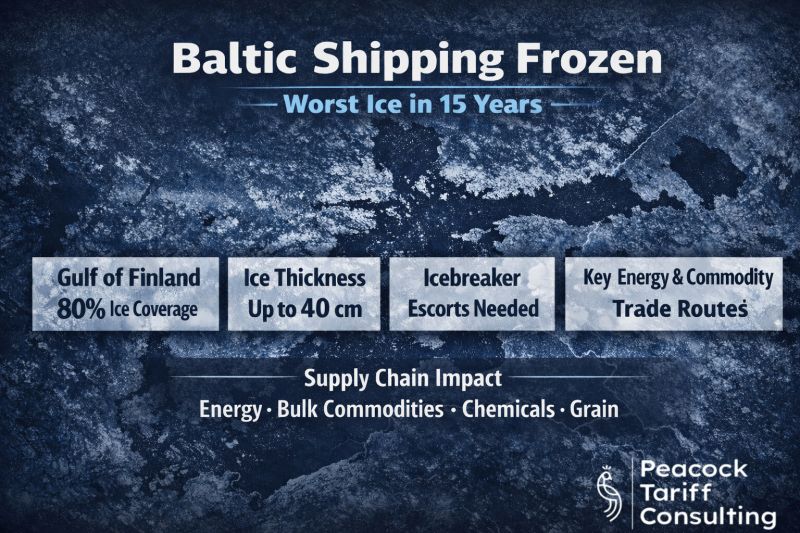
The Baltic Sea is experiencing the worst ice conditions in 15 years, with the Gulf of Finland completely frozen and ice coverage across the Baltic reaching approximately 80% of the sea surface. Ice thickness in critical areas has reached 40 centimeters, creating conditions where standard merchant vessels cannot operate without icebreaker assistance. These extreme ice conditions have been experienced only once in the past 15 years and represent a rare occurrence of natural constraint limiting maritime commerce in one of Europe’s most critical shipping regions.
The severity of the ice conditions reflects a combination of factors including extremely cold winter temperatures, persistent winter conditions extending into March when normalization is typically beginning, and favorable conditions for ice formation. The ice coverage and thickness are beyond the tolerance of normal merchant vessels. Ships without reinforced hulls and ice-class ratings struggle to navigate frozen waters. The widespread nature of the ice-covering 80% of the Baltic rather than affecting limited zones-means that ice diverts shipping lanes extensively and forces routing through icebreaker-assisted channels.
- Baltic Sea ice coverage at 80% of surface area
- Ice thickness reaching 40 centimeters in critical zones
- Worst conditions in 15 years for Baltic shipping
- Gulf of Finland completely frozen
Icebreaker Dependency and Navigation Constraints
Merchant ships attempting to operate in the Baltic must now rely on icebreaker escort and assistance. Ships without ice-class ratings cannot operate independently in the frozen waters. Ships with ice-class ratings (Ice Class 1-3) can operate with reduced efficiency in ice conditions but still benefit from icebreaker assistance. The most heavily ice-restricted zones, particularly the Gulf of Finland, require mandatory icebreaker escort for all vessels. This icebreaker dependency creates bottlenecks where limited icebreaker capacity constrains vessel traffic.
The icebreaker escort system operates on queuing principles where vessels wait for available icebreaker capacity. When multiple vessels accumulate awaiting icebreaker assistance, queue delays extend. Vessels waiting in queue for icebreaker escort are unable to operate independently, unable to make meaningful progress toward destination, and accumulating delays. The queuing system creates artificial constraints on vessel traffic even where ice conditions might permit some independent movement. The limited icebreaker capacity means that vessel throughput is constrained regardless of cargo demand.
- Icebreaker escort required for standard merchant vessels
- Ice-class vessels operating at reduced efficiency
- Gulf of Finland requiring mandatory icebreaker assistance
- Queue delays accumulating as vessels wait for icebreaker capacity
Critical Baltic Supply Flows and Economic Impact
The Baltic Sea supports critical flows of energy, raw materials, industrial inputs, and manufactured goods essential to European supply chains. Energy flows including crude oil, refined petroleum products, and coal move through Baltic ports from Russian and Eastern European sources. Raw materials including iron ore, timber, and minerals move through Baltic ports from Scandinavian and Eastern European sources. Chemical and industrial products move both through Baltic ports and between Baltic ports. Agricultural products including grain flow through Baltic ports. Manufactured goods flow to and from Baltic region manufacturers. The termination or severe reduction of these flows creates supply disruption across European supply chains.
The economic impact extends beyond Baltic shipping to Europe’s broader energy and supply chain economics. Energy constrained from Baltic sources increases energy costs. Raw material supplies constrained from Baltic sources increase input costs. Manufacturing disruption in Baltic region affects export-dependent producers. The cascading effects create Europe-wide supply chain disruption. The geographic importance of Baltic shipping makes ice-related disruption strategically significant for European economic activity.
- Energy (crude oil, refined products, coal) flowing through Baltic
- Raw materials (iron ore, timber, minerals) from Scandinavian sources
- Chemicals and industrial products dependent on Baltic routing
- Agricultural products including grain flowing through Baltic ports
Energy Supply Chains Under Pressure
Energy supply chains are particularly vulnerable to Baltic ice disruption. Crude oil shipments from Eastern European sources, coal shipments from Poland and Russia, and petroleum product shipments from Baltic refineries all depend on Baltic Sea navigation. Ice conditions that reduce vessel capacity and extend transit times are directly constraining energy supply to European markets. The constraint compounds already elevated energy costs from Middle East disruptions and Strait of Hormuz constraints. European energy supply is being squeezed from both Middle East sources (via Strait of Hormuz) and Baltic sources (via ice), creating compound supply pressure.
The energy supply constraint is particularly acute for heating oil and natural gas supplies during winter months. While March weather is warming in Southern Europe, Northern European heating seasons often extend into April and May. Ice-related disruption of Baltic energy supplies during this extended heating season period creates genuine energy supply vulnerability. Heating oil supply constraints could create heating fuel shortages in Northern Europe. This compounds the existing natural gas supply constraints from Middle East disruptions.
- Crude oil supplies constrained from Eastern European sources
- Coal supplies disrupted from Baltic ports
- Heating oil supplies vulnerable in Northern Europe
- Ice constraints compounding Middle East supply pressures
Bulk Commodity and Manufacturing Input Disruption
Bulk commodities including grain, minerals, timber, and metals depend on Baltic Sea shipping for export. The ice constraint reduces capacity for these bulk commodity shipments. Grain suppliers in Eastern Europe face delayed export opportunities. Timber exporters in Scandinavia face shipping delays. Iron ore exporters face constrained capacity. These supply disruptions increase commodity prices for European buyers. Manufacturing industries dependent on these bulk commodity inputs face constrained input availability and increased input costs.
The bulk commodity supply disruption extends through manufacturing supply chains. Steel mills dependent on iron ore supply face production constraints. Paper and wood product manufacturers face timber supply constraints. Food processors and livestock producers dependent on grain imports face feed and input constraints. The manufacturing supply disruption ripples through European manufacturing, creating production constraints across multiple industries. The geographic concentration of manufacturing in Northern and Central Europe makes Baltic supply disruption strategically significant.
- Grain exports constrained from Eastern European suppliers
- Timber exports delayed from Scandinavian sources
- Iron ore supply limited to steel manufacturers
- Manufacturing input constraints creating production pressure
Alternative Routing and Economic Cost Premium
Some vessels are responding to Baltic ice constraints by rerouting around the ice through longer maritime routes. Alternative routes to Scandinavian and Eastern European ports involve sailing around North Africa or through longer North Atlantic passages. These alternative routes add 7-14 days to typical transit times and increase fuel consumption by 25-40%, depending on destination and vessel type. The additional distance and fuel consumption create substantially higher shipping costs. However, for time-sensitive cargo, the alternative routing is preferable to queue delays in ice-constrained Baltic ports.
The economic cost premium of alternative routing is significant. A container vessel rerouting from direct Baltic routing to longer alternative routes incurs 2,000-5,000 euros in additional fuel costs, 7-14 additional days of voyage time, and associated operating expenses. These additional costs are passed through to shippers. For suppliers dependent on Baltic routes for cost-effective shipping, the alternative routing creates substantial cost penalties. The choice between queuing in ice-constrained ports or paying additional costs for alternative routing is economically unpleasant for all participants.
- Alternative routing adding 7-14 days to transit times
- Additional fuel costs 2,000-5,000 euros per vessel
- Time-sensitive cargo choosing alternative routing despite cost
- Long-term cargo potentially queuing in ice-constrained ports
Duration and Forecast Outlook
The duration of Baltic ice conditions depends on weather patterns and spring temperature development. If spring warming progresses normally, Baltic ice will begin melting in April and May, with significant opening by late May. However, if cold weather persists, ice conditions could extend into April. The current ice thickness of 40 centimeters requires weeks of warming to melt. The worst-case scenario would involve ice persisting through April, extending supply disruption through the spring season. The most-likely scenario involves ice beginning to clear in mid-to-late April, with major clearing by May.
The supply chain impact will persist beyond ice clearing because supply chains adjust gradually to disruption. Vessels queued awaiting icebreaker assistance will require days to clear even after ice constraints ease. Commodity supply backlogs will require weeks to clear through Baltic ports. Energy supply chains that were disrupted during the ice period will require inventory rebuilding. The full normalization of Baltic supply chains will likely extend into May or early June 2026. During this extended disruption period, European supply chains will be operating under constraint.
- Ice expected to begin clearing mid-to-late April
- Significant clearing likely by late May
- Supply backlog clearance extending into June
- Full supply chain normalization delayed through spring season
Strategic Implications for European Supply Chain Resilience
The Baltic ice crisis is demonstrating the vulnerability of European supply chains to natural disruptions. The Baltic region provides critical supplies of energy, raw materials, and manufactured goods that are difficult to replace through alternative sources. When natural events like extreme ice create supply disruption, European supply chains experience significant pressure. This vulnerability suggests that European supply chain strategy should incorporate redundancy and resilience against natural disruptions.
Looking forward, the Baltic ice crisis may catalyze investment in supply chain resilience. European companies may increase inventory buffers for Baltic-dependent supplies. Alternative supply sources for Baltic commodities may be developed. Strategic storage of energy and raw materials may be increased. Diversification away from Baltic supply dependency may be pursued where economically feasible. The disruption, while temporary, is demonstrating the importance of supply chain resilience against natural constraints. These lessons will likely inform long-term supply chain strategy for companies dependent on Baltic supplies.
- Baltic supply disruption demonstrating vulnerability
- Energy supply constraints extending from multiple sources
- Inventory buffer and alternative sourcing becoming strategic
- Supply chain resilience investment likely to increase