
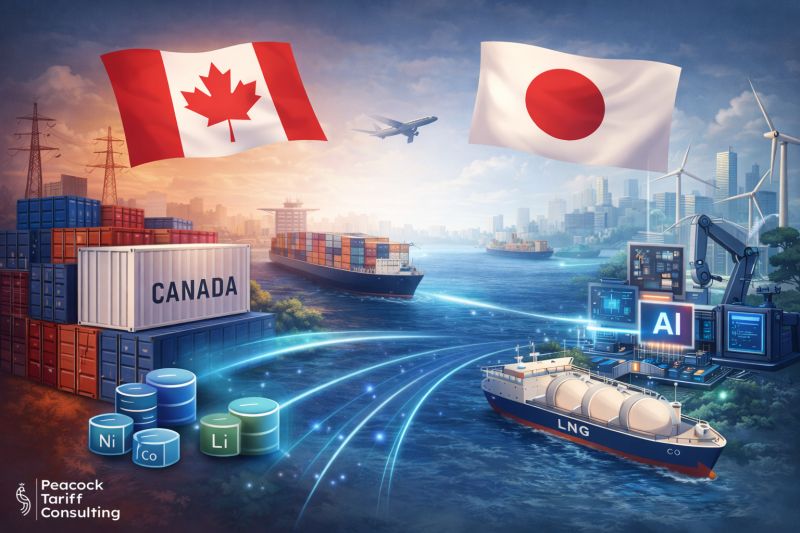
A New Era in Canada-Japan Relations: Strategic Alignment and Economic Integration
Canada and Japan have announced a comprehensive strategic partnership that extends far beyond traditional bilateral trade relationships. This partnership encompasses defense cooperation, energy security arrangements, advanced technology supply chain integration, and coordinated engagement within the Indo-Pacific region. The agreement represents a fundamental recognition by both governments that their security and economic interests are increasingly intertwined and that formal strategic coordination serves mutual objectives.
The partnership signals a significant shift in Canada’s positioning within global geopolitical and economic structures. Rather than adopting a purely neutral stance toward regional competition, Canada is explicitly aligning with like-minded democratic allies and positioning itself as a critical node in technology and energy supply networks serving the Indo-Pacific region. For Japan, the partnership reinforces its pivot toward deeper security and economic relationships with advanced democracies and diversifies its strategic options beyond its traditional reliance on the United States.
- Canada and Japan announce comprehensive strategic partnership
- Defense, energy, and technology cooperation formalized
- Indo-Pacific engagement and regional alignment emphasized
- Departure from traditional bilateral trade arrangements
Defense Cooperation: Military Integration and Security Architecture
The defense component of the Canada-Japan partnership reflects both countries’ security concerns regarding regional stability and their commitment to rules-based international order. The partnership encompasses military-to-military engagement, joint exercises, intelligence sharing frameworks, and coordination on defense procurement and technological development. These arrangements formalize what had previously been more informal and fragmented defense cooperation.
The defense partnership also addresses capability gaps and force structure requirements for both nations. Japan, constrained by its Constitution and historical circumstances, faces limits on certain military capabilities and force projection options. Canada possesses capabilities, particularly in specific technological areas and geographic positioning, that complement Japanese defense requirements. Conversely, Japan’s advanced defense technologies and operational expertise provide value to Canadian defense planning. The partnership allows both countries to optimize their combined defense posture while respecting each nation’s constitutional constraints and strategic preferences.
- Military-to-military engagement frameworks established
- Joint exercises and training programs formalized
- Defense technology sharing and development coordination
- Filling capability gaps through complementary partnerships
Energy Security: Canada as a Critical Supplier in a Resource-Constrained World
Energy security considerations constitute a central pillar of the Canada-Japan partnership. Japan, an island nation heavily dependent on energy imports, faces significant vulnerabilities to supply disruptions and price volatility. The partnership positions Canada as a crucial energy supplier, with particular emphasis on liquefied natural gas (LNG) and critical mineral resources essential for advanced technology manufacturing and energy systems.
Canada’s LNG capacity, particularly from British Columbia facilities, provides Japan with an alternative to traditional Middle Eastern suppliers and Russian sources. In a geopolitical environment characterized by supply chain fragmentation and growing concerns about critical mineral availability, Canadian LNG represents both energy security and reduced exposure to political risk. Additionally, Canada possesses substantial reserves of critical minerals including lithium, cobalt, and nickel—materials essential for battery manufacturing, electric vehicle production, and renewable energy systems. The partnership formalizes arrangements for supply security and processing capacity coordination that benefit both nations.
- LNG supply arrangements ensuring Japanese energy security
- Critical mineral sourcing and processing coordination
- Reduced dependence on potentially unstable suppliers
- Long-term supply contracts and investment frameworks
Advanced Technology Supply Chain Integration
The technology component of the partnership addresses supply chain vulnerabilities exposed by pandemic disruptions and geopolitical tensions. Both countries recognize that advanced manufacturing, semiconductor production, and critical technology development require resilient supply chains resistant to political disruption. The partnership incorporates specific initiatives focused on semiconductors, artificial intelligence systems, and advanced manufacturing capabilities.
Semiconductor supply chain resilience is a particular focus, given the extreme concentration of production in Taiwan and the geopolitical vulnerabilities this creates. Canada and Japan are exploring opportunities for expanded semiconductor manufacturing capacity in both countries, potentially attracting multinational fabrication facilities seeking geographic diversification. The partnership also addresses intellectual property protection, research collaboration, and talent development in technology sectors. Joint investments in research institutions, accelerated visa processes for technology workers, and coordinated standards development are anticipated to enhance technological competitiveness and innovation capacity.
- Semiconductor supply chain diversification and resilience
- AI and advanced manufacturing technology cooperation
- Research collaboration and IP protection frameworks
- Investment in technology talent and innovation ecosystems
Battery Materials and Electric Vehicle Integration
Battery materials and electric vehicle (EV) manufacturing represent a specific technology focus with substantial commercial implications. Japan is a global leader in battery technology and EV manufacturing, with companies like Toyota, Nissan, and Panasonic dominating key segments. Canada possesses critical minerals essential for battery production, including lithium and cobalt. The partnership creates opportunities for vertical integration across the battery supply chain.
The arrangement aligns with Japan’s ambitions to establish secure, long-term supplies of battery materials as it transitions toward electrification. Canadian mining and processing companies gain access to technology partnerships and preferred customer status with leading Japanese manufacturers. The partnership also contemplates potential joint ventures in battery manufacturing or assembly, potentially locating facilities in either country to serve regional markets. This integration represents a significant shift from traditional spot-market mineral transactions toward long-term strategic partnerships with assured supply flows.
- Lithium and cobalt supply integration for battery manufacturing
- Joint ventures in battery production and assembly
- Technology transfer and manufacturing process collaboration
- Supply chain security for EV sector expansion
Indo-Pacific Trade Alignment Through CPTPP
The partnership reinforces both countries’ commitment to the Comprehensive and Progressive Agreement for Trans-Pacific Partnership (CPTPP), a major regional trade agreement that has become increasingly important as a counterweight to Chinese economic influence in the region. Through CPTPP, Canada and Japan coordinate trade positions, support supply chain integration among member countries, and establish standards and rules that reflect democratic market values.
The CPTPP framework provides a formal mechanism for Canada-Japan cooperation on regulatory harmonization, technical standards, and trade dispute resolution. It also incorporates provisions on labor standards, environmental protection, and intellectual property rights that both countries support. By aligning within CPTPP, Canada and Japan strengthen the agreement’s collective influence and create opportunities for collaborative engagement with other member countries including Australia, Vietnam, and New Zealand. This regional trade alignment serves both countries’ broader interests in supporting a rules-based international order and constraining arbitrary trade practices.
- CPTPP framework formalizing trade and regulatory cooperation
- Harmonized standards and technical requirements across members
- Coordinated positions on regional trade issues
- Counterweight to non-democratic trading practices
Looking Forward: Implementation Challenges and Strategic Implications
While the Canada-Japan partnership framework is ambitious and comprehensive, implementation will present significant challenges. Coordinating defense procurement across countries with different technologies and requirements demands substantial technical effort. Negotiating energy supply agreements with long-term price and volume commitments requires careful attention to economic risks. Establishing joint ventures in technology and manufacturing sectors involves navigating regulatory requirements, intellectual property concerns, and competitive dynamics.
Strategically, the partnership signals Canada’s explicit realignment toward Indo-Pacific engagement and closer alignment with advanced democratic allies. This positioning may create tensions with other relationships, particularly as China views such partnerships as exclusionary and potentially provocative. However, both Canada and Japan assess that strategic alignment serves their core interests in security, prosperity, and the maintenance of rules-based international order. The partnership will likely evolve as circumstances change, but its current scope and ambition reflect the strategic significance both nations attach to deepening cooperation and creating resilient supply chains and security architectures resistant to coercive disruption.
- Implementation requiring significant technical coordination
- Economic risks in long-term supply arrangements
- Potential strategic tensions with non-democratic competitors
- Evolution expected as circumstances and capabilities change