
Category: Industry-Specific Tariff Guidance
-
Tariff Consulting for Amazon Sellers: What Every FBA Importer Needs to Know About Customs Compliance
Introduction: You Are an Importer, Whether You Realize It or Not If you sell products on Amazon that are manufactured overseas, you are an importer. It does not matter whether you think of yourself as an importer, whether you have ever heard the term importer of record, or whether your freight forwarder handles everything from…
-
Section 232 and Its Lasting Impact 25 percent tariffs on steel and 10 percent on aluminum from most countries have fundamentally altered cost structures for manufacturers, fabricators, and distributors. The tariffs apply to primary products and certain downstream articles. Scope of Section 232 Tariffs Steel tariffs cover flat-rolled, long, tubular, stainless, wire, and semifinished products.…
-
Food and Beverage Importing Is Different F&B products face extensive FDA regulation, specialized tariff provisions including tariff-rate quotas and seasonal duties, and duty rates among the highest in the HTSUS – some exceeding 40 percent. Classification Challenges Preparation level matters (fresh vs. dried vs. canned). Ingredient composition drives classification for prepared foods. Sugar and dairy…
-
The Small Business Disadvantage in International Trade While barriers to importing have fallen, regulatory complexity has not. A small business faces the same tariff classification requirements, valuation rules, and penalty provisions as a Fortune 500 company. A trade advisory firm bridges that gap. What a Trade Advisory Firm Does Tariff classification, duty optimization, compliance program…
-
Why Customs Compliance Matters for Small Businesses If you run a small business that imports goods into the United States or Canada, customs compliance is not optional. The regulatory framework does not distinguish between a multinational corporation shipping ten thousand containers a year and a small business importing a single pallet. The same classification rules,…
-
Serbia has emerged as a strategic European manufacturing destination, attracting major automotive OEMs and suppliers. Low labor costs, strategic location for EU market access, free zones with tax incentives, and infrastructure improvements position Serbia as competitive for automotive, agriculture, and technology manufacturing. Understanding tariff and supply chain implications is essential for manufacturers evaluating Serbia operations.…
-
Peacock Tariff ConsultingPeacock Tariff Consulting Answer Capsule: Brexit fundamentally disrupted UK-EU supply chains through new customs requirements, rules of origin challenges, and border delays. UK manufacturers must employ strategies like bonded warehousing, distribution hub repositioning, near-shoring of components, and leveraging Northern Ireland’s dual access to optimize costs and maintain EU market access. Related Articles Section…
-
Section 232 of the US Trade Expansion Act of 1962 authorized the US President to impose tariffs on products deemed necessary for national security. In March 2018, President Trump invoked this authority to impose 25% tariffs on steel imports and 10% tariffs on aluminum imports, tariffs that remain in effect today. For UK manufacturers and…
-

The 50% Tariff on Semi-Finished Copper Section 232 of the Trade Expansion Act of 1962 grants the President authority to impose tariffs on imports deemed essential to national defense. Using this authority, the current administration has imposed a 50% tariff on semi-finished copper products, including wire, tubes, sheets, and rods. This represents one of the…
-
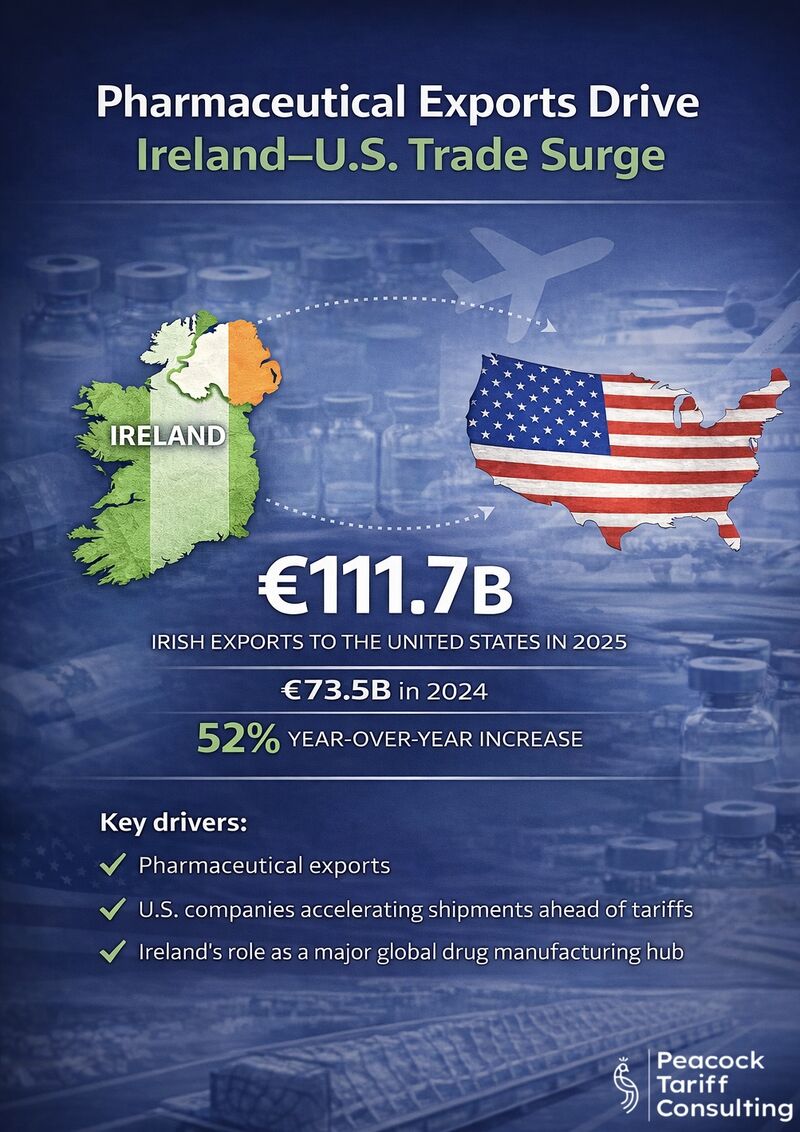
The Dramatic Export Growth Narrative Ireland’s exports to the United States surged 52% in 2025, a growth rate that initially appears exceptional and warrants celebration. At first glance, the statistics suggest a thriving bilateral trade relationship and expansion of Irish export capacity. However, the underlying dynamics driving this export growth tell a more nuanced story…