
The Recent Chinese Export Control Actions
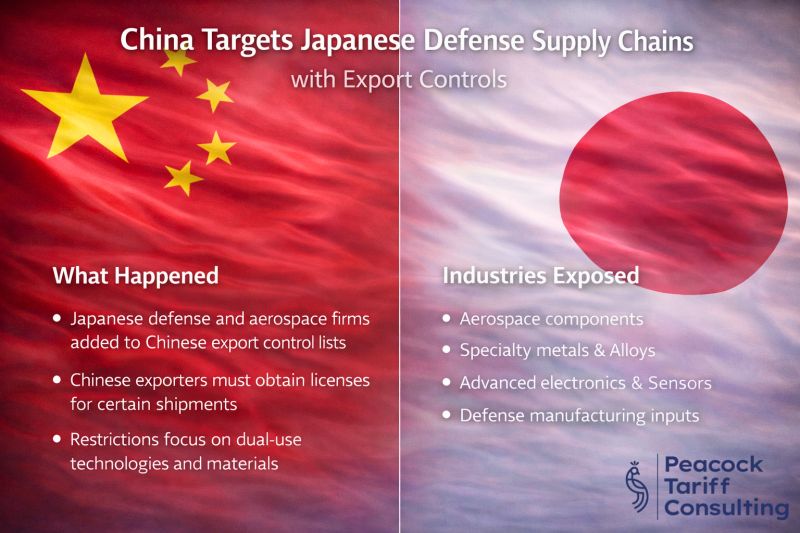
In a significant escalation of trade tensions between China and Japan, Beijing has imposed targeted export controls on dozens of Japanese companies with defense and aerospace industry connections. These restrictions represent more than a simple tariff dispute-they signal a fundamental shift toward using supply chain weaponization as a primary geopolitical instrument. The affected Japanese entities span multiple sectors within defense and aerospace supply chains, from component manufacturers to systems integrators.
The controls require Chinese exporters to obtain government approval before shipping certain categories of goods to these Japanese entities. This approval requirement introduces a new layer of friction into what were previously established commercial relationships. Unlike outright bans, licensing requirements create sustained operational complexity that can persist for extended periods, affecting procurement timelines and increasing business uncertainty even when shipments ultimately proceed.
The Dual-Use Goods Problem
At the heart of these trade tensions lies a fundamental characteristic of modern manufacturing: the convergence of civilian and military applications. Dual-use goods-materials and components designed for commercial purposes but applicable to defense uses-permeate global supply chains. These include specialty metals like rare earth elements and titanium, sophisticated sensors used in navigation and detection systems, advanced electronics for control and communications, and aerospace components that serve both civilian aircraft and military platforms.
China’s position in these supply chains is particularly critical. The country has become vertically integrated into numerous dual-use supply chains, controlling upstream processing capacity, raw material availability, and intermediate component manufacturing. For many critical inputs-whether it’s specialized aluminum alloys for aerospace, rare earth magnets for defense systems, or advanced electronics components-Chinese manufacturers represent either the primary source or a significant alternative supplier.
This structural position gives Beijing considerable leverage. Companies outside China cannot easily circumvent Chinese suppliers for certain material inputs without major supply chain reorganization, significant capital investment, or extended development timelines to qualify alternative sources. The export controls capitalize on this structural dependency.
- Specialty metals processing (rare earths, titanium, tungsten)
- Sensor and detection systems components
- Advanced semiconductors and electronics
- Aerospace materials and precision components
- Industrial chemicals used in electronics manufacturing
How Export Licensing Creates Supply Chain Risk
While export restrictions that amount to total bans are disruptive, they at least provide clarity-companies know they must find alternatives or exit affected markets. Licensing requirements introduce a more insidious problem: sustained uncertainty. Suppliers must apply for approval on each shipment or maintain standing approvals that can be modified or revoked. Lead times extend unpredictably as approval processes introduce delays. Manufacturing schedules that depend on predictable material flows face constant friction.
Beyond the obvious delays, licensing requirements create hidden costs. Compliance documentation requirements increase administrative burden. Companies may maintain higher safety stock to buffer against approval delays, tying up working capital. Procurement teams must build contingency suppliers even for non-restricted goods, as the regulatory environment itself becomes unreliable. Some manufacturers may preemptively shift orders away from affected materials to alternative sources-even when those alternatives are less optimal-simply to reduce regulatory uncertainty.
The strategic advantage of licensing over outright bans is precisely this friction-without-absolute-blockade dynamic. It allows the controlling nation to apply pressure while maintaining a veneer of openness. Exporters can technically still supply products, but the operational burden makes those sales increasingly unattractive relative to alternative markets with simpler regulatory frameworks.
- Unpredictable approval timelines create buffer stock requirements
- Administrative costs rise for compliance documentation and tracking
- Companies diversify suppliers to reduce single-source regulatory risk
- Higher effective costs than stated tariffs due to operational friction
- Relationship damage as importers seek more reliable sources
Strategic Trade Controls as Geopolitical Instruments
The shift toward export controls represents a broader trend in modern trade policy. Rather than relying primarily on tariffs-which affect price signals and trade volumes-major powers are increasingly deploying restrictions on specific goods, technologies, and suppliers to achieve strategic objectives. These controls are less transparent than tariffs, harder to negotiate away through traditional trade mechanisms, and often framed as security measures rather than trade policy.
This transformation reflects several factors. First, globalization has created such tight integration of supply chains that controlling specific material flows can create outsized disruption. Second, technology competition-particularly in semiconductors, defense systems, and artificial intelligence-has elevated the importance of controlling inputs to high-tech manufacturing. Third, geopolitical competition has intensified, making economic supply chain tools as important as traditional diplomatic or military instruments.
For supply chain managers, this trend suggests a long-term shift in how to evaluate sourcing risk. Geopolitical relationships between supplier countries and your home country are becoming as important as traditional commercial factors like price, quality, and reliability. Diversification strategies must account for potential supply chain bifurcation along geopolitical lines.
- Export controls are harder to predict than tariff changes
- Controls often target specific sectors or technologies rather than broad categories
- Framed as security measures-less subject to traditional trade negotiations
- Integrated supply chains amplify impact of material flow restrictions
- Long-term trend rather than temporary policy response
Implications for Global Supply Chain Design
Organizations with exposure to dual-use goods in China-dependent supply chains face concrete decisions. For companies importing into the United States, Europe, or other allied nations, the calculus has shifted. Sourcing strategies that optimize purely on cost or lead time without accounting for geopolitical risk are increasingly vulnerable.
The implications vary by sector and product type. Aerospace manufacturers, defense contractors, and semiconductor companies face the most immediate exposure. But companies in automotive, electronics, medical devices, and industrial equipment may also encounter disruption if their supply chains contain Chinese-sourced dual-use components. Even companies in traditionally non-defense sectors have discovered that modern manufacturing relies on materials and components with potential defense applications.
Strategic Responses for Supply Chain Managers
Effective response to escalating strategic trade controls requires several coordinated actions. First, map supply chain exposure to dual-use goods and identify China-dependent nodes. This mapping should go beyond tier-one suppliers to understand the full sourcing architecture. Where are the bottlenecks? Which materials or components have concentrated supply? Which vendors have geopolitical exposure?
Second, develop contingency sourcing strategies before disruption occurs. This may include qualifying alternative suppliers from non-restricted countries, even if they carry cost premiums. It may involve investing in inventory buffers for critical materials. It may require redesign efforts to substitute away from China-dependent inputs where feasible. The cost of these mitigation steps is typically far lower than the cost of supply disruption once it occurs.
Third, strengthen supplier relationships and communication. Engage directly with suppliers about regulatory risks and timeline vulnerabilities. Share information about your company’s exposure so suppliers can understand your constraints. This transparent communication often reveals alternative sourcing pathways that formal procurement channels might miss.
Finally, stay engaged with industry associations and trade groups tracking these policy developments. The landscape of export controls evolves rapidly. Collective industry advocacy can sometimes influence policy implementation, and organized information sharing helps companies understand impacts and develop coordinated responses.
- Map exposure to dual-use goods at all supplier tiers
- Qualify alternative suppliers before restrictions activate
- Build strategic inventory buffers for critical materials
- Communicate transparently with suppliers about constraints
- Engage with trade associations tracking export control changes
- Consider product redesign to reduce control-dependent inputs
Looking Forward: A Bifurcating Supply Chain Landscape
The China-Japan export controls on defense-linked companies represent one data point in a larger pattern. As geopolitical tensions intensify and technology competition sharpens, we should expect more granular, sector-specific supply chain restrictions. The era of completely integrated, cost-optimized global supply chains operating without geopolitical consideration may be ending.
For supply chain professionals, this shift demands a new sophistication in how we evaluate risk. Geopolitical risk is no longer a secondary concern-it is a primary factor in sourcing architecture decisions. The companies best positioned for this environment will be those that can maintain operational flexibility, cultivate diverse supplier relationships, and make strategic decisions about which parts of the value chain require geographic concentration and which require geographic distribution.
The costs of these adjustments are real-higher material costs, increased working capital needs, and more complex procurement operations. But they are the price of resilience in an increasingly strategic trade environment.