
Introduction: A Shift from Escalation to Structure
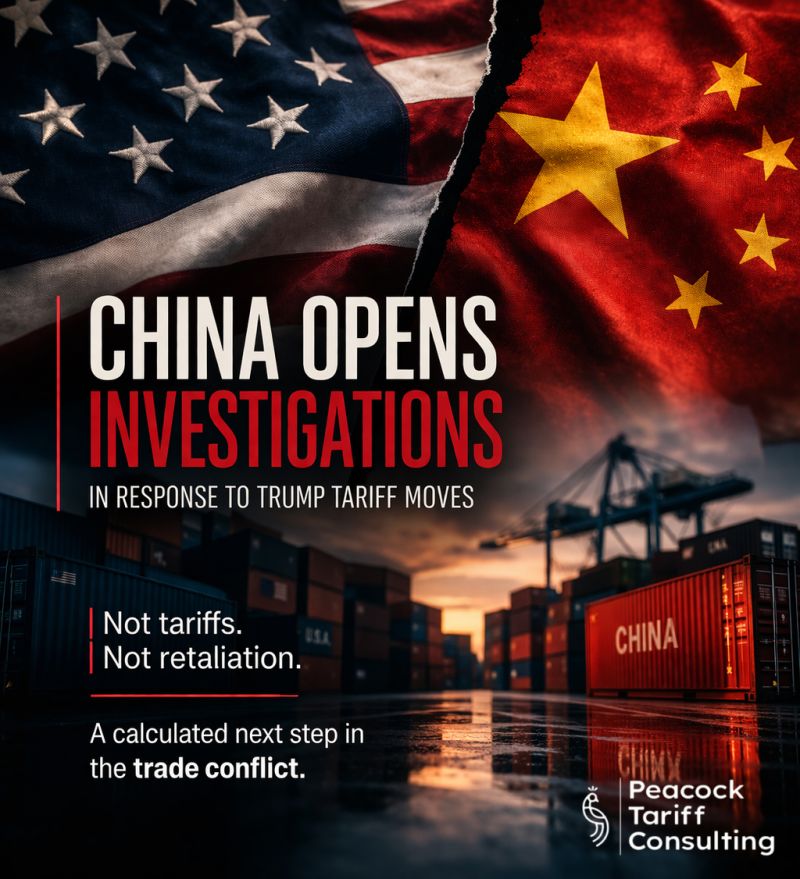
The global trade landscape has entered a new phase. Rather than responding to U.S. trade actions with immediate tariff retaliation, China has chosen a more deliberate path: opening formal investigations into American trade practices. This strategic decision signals a fundamental shift in how trade tensions are being managed-from reactive escalation to carefully structured leverage building.
While headlines often focus on tariff announcements and retaliatory measures, the real story lies beneath the surface. Investigations into U.S. trade practices represent something more calculated and potentially more consequential: the establishment of a legal and strategic foundation that will define trade relationships for months, if not years, to come.
Understanding these investigations and their implications is essential for any business operating in or trading with China, the United States, or global supply chains dependent on either economy.
The Strategic Logic Behind Formal Investigations
China’s decision to pursue formal investigations rather than immediate retaliation follows a deliberate playbook. By mirroring the U.S. approach to trade enforcement, Beijing is creating what might be called ‘legal cover’-establishing a documented, methodical process that provides justification for whatever measures may follow. This approach is not new, but its careful application signals confidence and patience.
Investigations serve multiple purposes simultaneously. First, they gather data and legal arguments that will support future actions. Second, they create a timeline that allows both sides to assess leverage and consider negotiation opportunities. Third, they signal resolve without forcing an immediate commitment to escalatory measures. This is strategic ambiguity at its finest.
For observers accustomed to rapid-fire trade wars, this deliberate pace may seem like de-escalation. It is not. Rather, it represents a shift from chaotic escalation to managed tension-a state where friction persists and pressure builds, but in a controlled, documented manner.
Key Areas Under Investigation
The scope of China’s formal investigations reveals important priorities and potential pain points. Three primary focus areas have emerged, each with significant implications for different sectors and supply chains:
Advanced technology restrictions represent the most strategically sensitive area. These investigations likely examine U.S. export controls, licensing requirements, and restrictions on semiconductor sales and technology transfer. For Chinese companies and their global partners, this area touches the heart of long-term competitiveness and innovation capacity.
Market access barriers constitute the second focus. This investigation will likely scrutinize tariffs, non-tariff barriers, regulatory hurdles, and government procurement preferences that effectively limit Chinese goods and services from accessing U.S. markets. This is particularly relevant for renewable energy, telecommunications, and manufacturing sectors.
Pressure on Chinese exports, particularly in renewables, represents the third pillar. Solar panels, wind turbines, batteries, and related components have become targets in U.S. trade policy. China’s investigation into these measures signals that Beijing considers renewable energy exports as both economically important and strategically significant-a fact that may surprise some Western observers.
- Advanced technology restrictions and export controls
- Market access barriers and tariff structures
- Pressure on Chinese renewable energy exports
- Each area creates distinct risk profiles for different industries
What This Means for Business: Uncertainty as the Primary Risk
The most immediate impact of these investigations is not disruption-it is uncertainty. Businesses operate with risk models that account for known costs, timelines, and competitive factors. Investigations disrupt those models by introducing variables that cannot yet be quantified or predicted.
When China opens formal investigations, the message to businesses is clear: change is coming, but the timing, scope, and specific form of that change remain unknown. A company might face new tariffs, export controls, compliance requirements, or market restrictions. The investigation period-typically spanning months-is when contingencies should be developed, supply chains diversified, and risk mitigation strategies implemented.
For multinational enterprises with exposure to both markets, this creates a particularly complex situation. Decisions made to satisfy one market’s regulatory environment may conflict with emerging requirements in the other. Companies must simultaneously prepare for multiple possible outcomes while maintaining operational efficiency and profitability.
The Timeline: Months Ahead Will Determine Trade Flows
One critical detail often overlooked in trade analysis is the timeline. Formal investigations do not conclude overnight. The investigation process-fact gathering, stakeholder consultations, legal analysis, and deliberation-typically extends over several months. For businesses, this timeline is crucial because decisions made now will shape trade flows later in 2026 and beyond.
This extended timeline creates both risk and opportunity. On the risk side, uncertainty persists through the spring and summer months. On the opportunity side, businesses have time to adjust sourcing, renegotiate contracts, secure regulatory approvals, and position themselves strategically. The key is recognizing that waiting until investigations conclude to respond is not a viable strategy.
Historical precedent suggests that investigations often lead to action. The preliminary findings typically reinforce the initial motivation for opening the investigation. Companies should assume that the investigation process will eventually result in some form of measure-tariff, control, or requirement-rather than hoping the issue will simply disappear.
Practical Implications: What Companies Should Do Now
Understanding the strategic logic and timeline of these investigations is only the first step. The real value lies in translating this understanding into concrete business actions. Companies with exposure to U.S.-China trade dynamics should be taking specific steps during this investigation period.
First, conduct a comprehensive assessment of supply chain exposure. Identify where your operations depend on imports from China, exports to China, or products that compete with Chinese goods. Map the vulnerability of each supply chain segment to potential tariffs, controls, or market restrictions. This assessment creates the foundation for all subsequent decisions.
Second, develop contingency plans for the areas under investigation. If advanced technology restrictions are tightened, what alternative suppliers or technologies are available? If market access barriers increase, how can you maintain market presence? If renewable energy exports face new controls, how does this affect your sourcing or sales? Developing these scenarios now, before pressure mounts, produces better strategic outcomes.
Third, engage with industry associations, trade counsel, and government relations professionals who monitor these investigations. These specialists can provide early warning signals about emerging consensus and potential outcomes. They can also help your company contribute to the policy dialogue in constructive ways.
- Conduct comprehensive supply chain assessments by sector and product line
- Develop contingency plans for technology, market access, and renewable energy scenarios
- Engage trade counsel and industry associations to monitor investigation developments
- Document decisions and compliance measures for audit and regulatory purposes
- Consider geographic and supplier diversification strategies where viable
Conclusion: Managed Tension as the New Normal
China’s formal investigations into U.S. trade practices represent a transition point in global trade dynamics. We are no longer in a period of rapid, headline-driven escalation. Instead, we have entered a phase of managed tension, where both sides are using investigative tools, legal frameworks, and strategic patience to build leverage and create conditions for action.
This is not a full trade war, but it is a state of persistent friction. For businesses, the implications are clear: trade policy uncertainty will remain elevated throughout 2026. Decisions made now-about supply chains, regulatory compliance, market positioning, and risk management-will determine competitive position once investigations conclude and new measures take effect.
Companies that treat this investigation period as a planning opportunity rather than a moment to defer difficult decisions will emerge stronger. Those who wait for certainty may find themselves reacting hastily to developments they could have anticipated. In an era of managed trade tension, strategic foresight is competitive advantage.