
A Bilateral Crisis Unfolds: From Tariff Escalation to Economic Brinkmanship
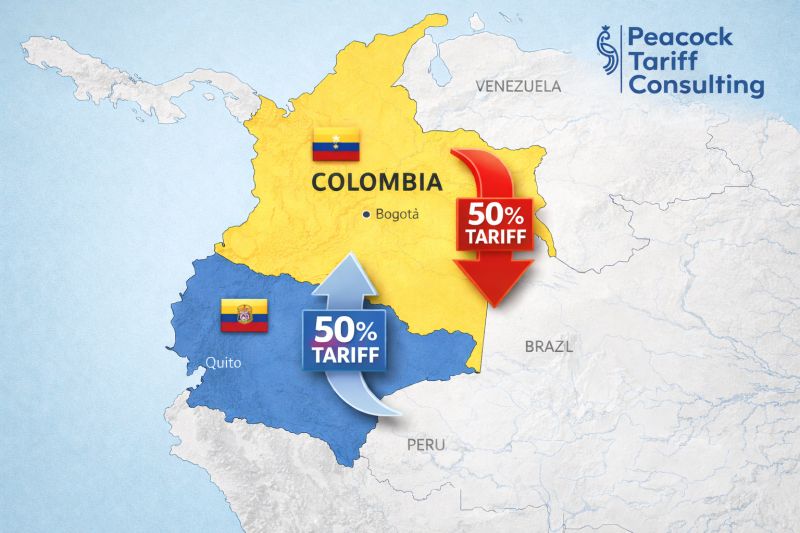
The trade relationship between Colombia and Ecuador has reached a critical juncture, marking a significant departure from the historical pattern of trade disputes being confined primarily to advanced economies and their key trading partners. What began as Ecuador’s unilateral decision to impose 50 percent tariffs on Colombian imports has now escalated into a full bilateral tariff confrontation, with Colombia preparing reciprocal 50 percent tariffs on hundreds of Ecuadorian products. This escalation represents not merely a commercial disagreement, but a fundamental rupture in regional trade relations with profound economic consequences for both nations.
The stakes for both countries are extraordinarily high. Traditional assumptions that trade disputes remain limited to major economies—the United States, China, the European Union, and other developed trading powers—are being challenged by the intensity and scope of this regional conflict. For smaller, less diversified economies like Colombia and Ecuador, trade wars carry existential economic implications that extend far beyond the affected product categories.
- Ecuador imposed initial 50% tariffs on Colombian imports
- Colombia responded with threatened 50% reciprocal tariffs
- Approximately 300 products affected across both economies
- Dispute reflects broader regional trade tensions
The Scope of Impact: 300 Products and Cascading Economic Effects
The breadth of product categories affected by the Colombia-Ecuador tariff dispute is staggering, encompassing roughly 300 distinct goods across multiple sectors. The dispute extends beyond simple consumer goods to include critical industrial inputs, agricultural products, manufactured goods, and services-related imports. For businesses operating across the border, compliance with the evolving tariff regime requires rapid adaptation of supply chains and pricing strategies.
Understanding the product scope requires recognition of the trade complementarities between these nations. Colombian exports to Ecuador include agricultural products, petroleum derivatives, chemicals, textiles, and machinery. Ecuadorian exports to Colombia feature agricultural products, minerals, and processed goods. The imposition of 50 percent tariffs on these products creates immediate competitive distortions and supply chain disruptions that affect not only the bilateral relationship but also the broader regional economy.
- 300 products subject to tariff increases
- Multiple sectors affected including agriculture, manufacturing, and energy
- Supply chain interdependencies creating cascading disruptions
- Pricing mechanisms requiring rapid adjustment
Quantifying the Economic Damage: 75% Decline in Imports and 79% Export Contraction
Economic modeling suggests that the full implementation of reciprocal 50 percent tariffs could result in a decline of approximately 75 percent in Colombian imports from Ecuador and a contraction of roughly 79 percent in Colombian exports to Ecuador. These figures are not merely statistical abstractions; they represent thousands of businesses, millions of workers, and entire supply chain networks facing collapse or radical restructuring. The severity of these projected declines reflects the extraordinary burden imposed by 50 percent tariff rates and the limited alternatives available to importers accustomed to tariff-free or low-tariff access.
The asymmetrical nature of trade between the two countries means that these percentage declines translate into vastly different absolute impacts. Ecuador’s smaller economy and greater dependence on trade relationships with Colombia means that the 79 percent export contraction represents a more significant proportion of overall economic activity. For Colombian enterprises dependent on Ecuadorian inputs or markets, the 75 percent import decline forces immediate decisions about sourcing alternatives, production relocation, or market exit.
- Colombian imports from Ecuador expected to fall 75%
- Colombian exports to Ecuador expected to fall 79%
- Severe supply chain disruptions anticipated
- Regional economy facing significant contraction
Beyond the Numbers: Real-World Consequences for Businesses and Workers
The statistical projections of 75 and 79 percent declines mask more granular realities of business disruption. Manufacturers relying on Ecuadorian inputs face immediate choices: accept substantially higher input costs and reduced competitiveness, invest capital in identifying and qualifying alternative suppliers, or relocate production to countries with more favorable tariff access. Each option imposes substantial transition costs and strategic risks.
For workers in export-dependent sectors, the tariff conflict threatens employment, wages, and opportunity. Agricultural workers in regions whose output depends on Colombian or Ecuadorian markets face uncertain futures. Manufacturing facility workers in industries dependent on cross-border supply chains encounter the prospect of reduced production and potential plant closures. The distributional consequences of the trade war will not be evenly spread; they will concentrate in specific regions and sectors, creating pockets of severe economic distress.
- Manufacturing input cost increases reducing competitiveness
- Supply chain disruptions forcing sourcing decisions
- Employment uncertainty in export-dependent sectors
- Regional economic concentration of negative impacts
The Broader Lesson: Trade Disputes Are No Longer Confined to Economic Superpowers
The Colombia-Ecuador dispute challenges the conventional narrative that trade conflicts are primarily the domain of major economic powers engaged in strategic competition. This regional conflict demonstrates that tariff escalation and trade war dynamics have become universalized tools available to smaller economies, with outcomes that can be equally devastating within regional contexts. The absence of countervailing power that a large economy like the United States or China might leverage means that smaller countries must rely more heavily on negotiation, third-party mediation, and de-escalation strategies.
The dispute also highlights the vulnerability of regional trade relationships to political shocks and policy changes. Without robust institutional mechanisms for trade dispute resolution—beyond what the World Trade Organization provides—bilateral relationships remain susceptible to unilateral tariff actions with limited recourse. For other Latin American countries observing this conflict, the message is clear: trade relationships with neighbors can deteriorate rapidly, and economic interdependencies do not necessarily prevent trade wars.
- Trade wars demonstrated to affect mid-sized economies
- Regional trade institutions limited in preventive capacity
- Political shocks driving policy changes
- Need for conflict resolution mechanisms
Strategic Implications and Regional Trade Architecture
The Colombia-Ecuador tariff confrontation raises important questions about the future architecture of regional trade relationships in Latin America and beyond. The Andean Community, of which both countries are members, failed to prevent this escalation, suggesting institutional weaknesses in conflict prevention and dispute resolution. Regional trade agreements, it appears, are insufficient to constrain unilateral tariff action when political relationships deteriorate.
The broader question for Latin American policymakers concerns the appropriate institutional design for managing trade relationships at the regional level. Should there be binding arbitration mechanisms? Should tariff actions require notice periods and negotiation phases before implementation? Should proportionality requirements limit the magnitude of tariff increases? The Colombia-Ecuador conflict may catalyze reforms to regional trade governance structures, but such reforms typically emerge only after significant economic damage has been inflicted.
- Andean Community institutional limitations exposed
- Need for stronger dispute resolution mechanisms
- Questions about proportionality and notice requirements
- Broader implications for regional trade governance
Looking Ahead: De-escalation Prospects and Economic Recovery
Whether the Colombia-Ecuador tariff dispute can be de-escalated before reaching the projected maximum impact remains uncertain. The political dynamics driving the conflict, which extend beyond purely commercial considerations into broader bilateral relationship concerns, suggest that trade negotiation alone may be insufficient to resolve the crisis. Regional mediation, third-party involvement, or broader political negotiations may be necessary to chart a path toward reduced tensions.
For businesses caught in the middle of this conflict, the immediate priority is scenario planning and contingency preparation. Companies should develop strategies for alternative sourcing, cost pass-through, or market repositioning depending on their specific circumstances. The tariff dispute, whether it persists at current levels or escalates further, will reshape competitive dynamics in the region for years to come. Forward-thinking companies are using this period of uncertainty to reassess their regional strategies and identify opportunities created by disruption in competitor networks.
- Political factors complicating pure trade resolution
- Need for regional mediation and broader negotiations
- Business contingency planning becoming critical
- Long-term reshaping of regional competitive dynamics