
A Paradigm Shift: Ports as Strategic Infrastructure
The European Union has unveiled a comprehensive Maritime Industrial Strategy and Ports Strategy that signals a fundamental shift in how governments view global shipping infrastructure. This is not merely a logistics initiative focused on operational efficiency. Rather, it represents a recognition that ports are among the most critical strategic economic and security assets a nation can possess.
European ports handle 74 percent of the European Union’s external trade, processing approximately 3.4 billion tonnes of cargo annually. These figures are not abstract statistics-they represent the physical arteries through which the majority of European commerce flows. Containers, vehicles, raw materials, agricultural products, and consumer goods move through these ports en route to European consumers and businesses. Any disruption to port operations ripples throughout the entire European economy.
The strategic importance of ports has become starkly apparent in the context of recent global disruptions: container ship blockages in the Suez Canal, geopolitical tensions affecting shipping routes, cyber attacks on port infrastructure, and foreign investment in critical port facilities. The EU’s new strategy responds to these vulnerabilities by treating port infrastructure with the same strategic priority traditionally reserved for defense, energy, and telecommunications.
The Four Pillars of the EU Maritime Strategy
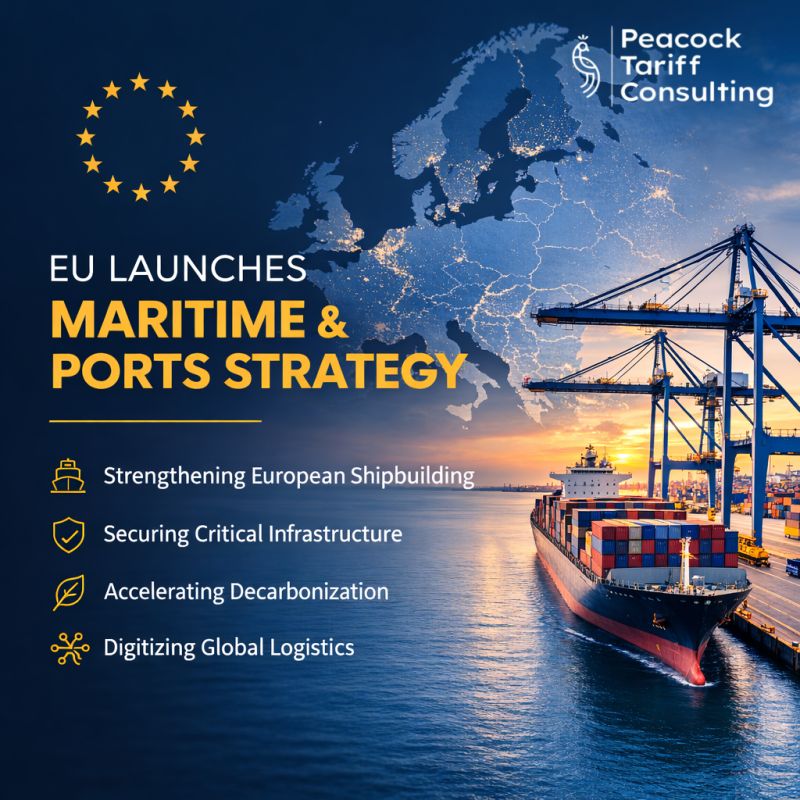
The European Union’s Maritime Industrial Strategy rests on four interconnected pillars, each addressing a critical dimension of port and maritime competitiveness. Understanding these pillars provides insight into how European supply chains will evolve over the coming years.
The first pillar addresses shipbuilding resilience. European shipyards have historically been world-class, but global competition from Asian shipbuilders has eroded market share and reduced the technological autonomy of European maritime industries. The strategy aims to strengthen European shipyards, support innovation in maritime technology, and reduce dependence on foreign shipbuilding capacity. This initiative reflects the recognition that the ability to construct and maintain the vessels that carry global trade is itself a strategic capability.
The second pillar focuses on port security. This encompasses multiple dimensions: physical security against potential threats, cybersecurity protecting digital port infrastructure, and geopolitical risk management. The strategy explicitly addresses concerns about foreign ownership of critical port infrastructure and the need for oversight mechanisms that ensure ports remain under reliable stewardship. Recent investments by non-European entities in major European ports have prompted this heightened focus on ownership and control.
The third pillar centers on decarbonization. European ports are transitioning from fossil fuel-dependent operations to lower-carbon alternatives. This includes shore power infrastructure that allows docked vessels to power operations from land-based electrical systems rather than ship engines, port electrification converting internal logistics equipment to electric power, and the development of low-carbon maritime fuels such as sustainable ammonia and hydrogen. These investments require significant capital but position European ports as leaders in environmental sustainability and potentially create competitive advantages as global shipping faces increasing environmental regulations.
The fourth pillar emphasizes digitalization. Ports are being transformed into smart logistics hubs through automation, data integration, and digital systems that optimize container handling, vessel traffic, and supply chain coordination. This digital transformation increases operational efficiency, improves safety, and creates real-time visibility into cargo movement. It also supports the geopolitical objective of reducing dependence on non-European digital infrastructure and data systems.
- Shipbuilding resilience and European maritime technology autonomy
- Port security including physical security, cybersecurity, and geopolitical risk management
- Decarbonization through shore power, electrification, and low-carbon fuels
- Digitalization creating smart ports with automation and data integration
Broader Implications: Supply Chains as Strategic Infrastructure
The EU’s maritime and ports strategy reflects a broader global trend: governments are increasingly treating supply chains as strategic infrastructure worthy of direct investment, policy attention, and security oversight. This trend is not unique to Europe. The United States has made similar investments in port infrastructure and supply chain resilience. China has invested heavily in port development globally. Other developed nations are following similar paths.
This shift represents a fundamental change in how governments view globalization and international commerce. During the era of unfettered globalization, supply chains were viewed primarily as the domain of private companies, regulated lightly to maximize efficiency. Today, governments view supply chains as critical to national economic and security interests, deserving of strategic attention comparable to energy policy, defense spending, and infrastructure investment.
For multinational companies operating supply chains through European ports, this shift has multiple implications. Port operations may be subject to more stringent security requirements and government oversight. Investment in European port infrastructure may become increasingly tied to strategic considerations, with governments favoring investments that support European technological independence, sustainability goals, and security objectives. Environmental regulations will continue to tighten, requiring ships and logistics operations to meet increasingly stringent decarbonization standards.
Practical Implications for Supply Chain Operators
For companies operating supply chains through European ports, the strategic shift toward treating ports as critical infrastructure creates both challenges and opportunities. On the challenge side, compliance requirements will increase. Port operators, shipping lines, and logistics companies should anticipate more rigorous security screening, cybersecurity requirements, and documentation demands. Environmental regulations will accelerate decarbonization timelines, requiring investment in lower-carbon logistics operations.
On the opportunity side, companies positioned to support European digital port infrastructure, renewable energy integration, and lower-carbon logistics will find growing markets. Providers of cybersecurity services, automation technology, and sustainable logistics solutions will find strong demand from European ports seeking to implement the new strategy.
For global supply chains that route cargo through European ports, the emerging infrastructure investments should generally improve operational efficiency and reduce transit times. Digitalized ports with advanced automation will process cargo more quickly. Improved intermodal connections will facilitate smoother transitions between maritime and land transport. These improvements will offset some of the costs associated with increased regulatory compliance and environmental investments.
Supply chain managers should also monitor developments in port ownership and control. Emerging restrictions on foreign ownership of critical port facilities could affect the operations of companies with non-European ownership or control structures. Understanding local governance requirements and ensuring compliance with evolving regulatory standards will be increasingly important.
Investment Implications and Market Development
The EU’s commitment to modernizing port infrastructure and maritime industries creates substantial investment opportunities. Estimated capital requirements for decarbonization, digitalization, and security upgrades across European ports are in the tens of billions of euros. This represents significant market opportunity for technology providers, engineering firms, renewable energy companies, and logistics service providers.
European governments and port authorities will increasingly partner with private sector companies to implement the strategy. Companies with capabilities in port automation, renewable energy integration, cyber security, and sustainable logistics will find growing contract opportunities. The strategy also supports innovation in maritime technology, including lower-carbon vessel designs and propulsion systems.
For investors, European port infrastructure and maritime technology represents a growth sector backed by government policy and strategic commitment. Unlike some infrastructure investments that depend on uncertain demand growth, the EU’s maritime strategy is backed by explicit government support and sustained funding commitments.
Geopolitical Dimensions and Competitive Dynamics
The EU’s maritime strategy reflects geopolitical competition with other major powers. China’s Belt and Road Initiative has invested heavily in port infrastructure globally, creating strategic influence and commercial advantages. The United States is investing in port capacity to enhance its competitive position. European governments recognize that port infrastructure is not merely an economic asset but a source of geopolitical influence and national economic resilience.
By strengthening European shipyards and reducing dependence on foreign maritime manufacturing, the strategy seeks to preserve European technological autonomy. By addressing foreign ownership of critical ports, the strategy aims to prevent other powers from gaining strategic leverage over European supply chains. By advancing decarbonization and digitalization, the strategy positions Europe as a leader in the future of sustainable and digital-first maritime logistics.
For multinational companies, these geopolitical dimensions mean that port operations and maritime strategy will be increasingly intertwined with broader questions of national interest, technological sovereignty, and competitive positioning. Companies operating in this space should understand how their activities align with or diverge from the strategic objectives of the governments whose ports they utilize.
Conclusion: Adapting to a Strategically Reinvigorated Maritime Sector
Europe’s Maritime Industrial Strategy and Ports Strategy represent far more than a logistics modernization initiative. They signal that governments now view port infrastructure and maritime industries as strategic assets comparable to energy, defense, and telecommunications. This shift will reshape how European ports operate, who can invest in them, and what environmental and security standards they must meet.
For supply chain managers, port operators, and logistics companies, the key imperative is to anticipate and embrace these changes rather than resist them. The regulatory environment will tighten. Environmental standards will increase. Security requirements will grow more stringent. Digital systems will become more sophisticated. But these changes also create opportunities for companies that can support the transition, invest in modernization, and align their operations with European strategic objectives.
The future of European maritime logistics is one of strategic autonomy, environmental sustainability, digital sophistication, and heightened security. Companies that position themselves to support this vision will thrive. Those that attempt to maintain legacy operational models will find themselves increasingly constrained by regulatory pressure and competitive disadvantage. The time to adapt is now.