
Introduction: When Trade Disruption Reaches the Farm Gate
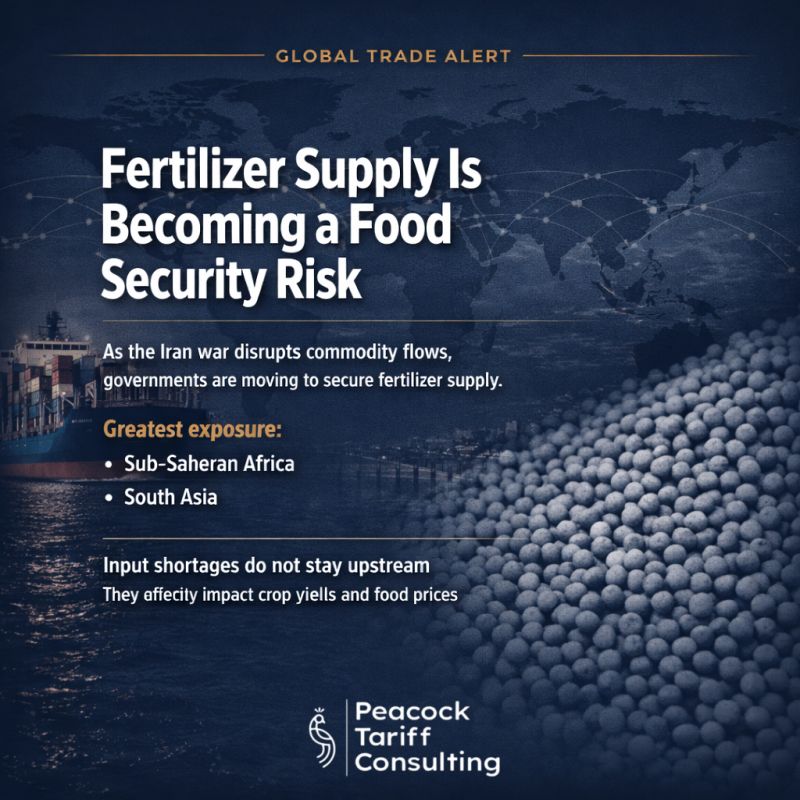
The global fertilizer market has moved from a commodity concern to a front-line food security issue. As the Iran conflict disrupts key commodity flows, governments and agricultural systems worldwide are confronting a familiar but intensifying challenge: securing access to the inputs that determine whether crops get planted, yields hold, and food prices remain manageable.
This is not the first time geopolitical conflict has stressed fertilizer supply chains. The Russia-Ukraine war demonstrated how quickly disruptions in fertilizer production and trade can cascade through global agricultural systems. But the current situation carries its own distinct risks, particularly for regions where agricultural systems are already operating with minimal margin.
The Mechanics of Fertilizer Supply Disruption
Fertilizer supply chains are concentrated in ways that make them inherently vulnerable to geopolitical disruption. A relatively small number of producing countries account for the majority of global nitrogen, phosphate, and potash supply. When conflict disrupts production, export infrastructure, or shipping routes involving any of these key suppliers, the effects ripple outward through global commodity markets.
The Iran conflict has introduced disruptions at multiple points in the supply chain. Shipping route uncertainty in the Persian Gulf and broader Middle East has increased transport costs and created delays. Sanctions and countersanctions have complicated trade flows for fertilizer-related commodities. And the broader market uncertainty has driven speculative pricing behavior that amplifies the underlying supply constraints.
The result is a market where physical availability and pricing are both under pressure, creating a dual challenge for agricultural systems that depend on affordable and timely access to fertilizer inputs.
Where the Impact Will Be Felt Most
The effects of fertilizer supply disruption are not distributed evenly. As commodity trading firms like ETG have warned, the pressure is likely to be felt most acutely in sub-Saharan Africa and parts of South Asia, where agricultural systems are especially exposed to input shortages.
These regions face a compounding set of vulnerabilities. Smallholder farmers, who produce the majority of food in many developing countries, have limited ability to absorb price increases or secure alternative supply. Government subsidy programs, where they exist, are often insufficient to bridge the gap between market prices and what farmers can afford. And the agricultural calendar is unforgiving: if fertilizer is not available when it is needed for planting, the consequences show up in reduced yields months later, regardless of whether supply normalizes in the interim.
The food security implications extend well beyond the farm. When fertilizer access tightens, the consequences cascade through planting decisions, crop selection, yield outcomes, and ultimately food prices. In regions where food expenditure already represents a large share of household income, even modest price increases can have significant welfare effects.
The Broader Trade Disruption Pattern
Fertilizer supply disruption is illustrative of a broader pattern in conflict-driven trade shifts. Disruptions that originate in one commodity market or geographic region rarely stay contained. They propagate through supply chains, affect related markets, and create secondary and tertiary effects that can be difficult to predict or manage.
In the case of fertilizer, the upstream disruption in commodity flows translates directly into downstream effects on agricultural productivity. But the same pattern applies across critical commodities: energy, minerals, intermediate goods. When trade routes are disrupted, production is interrupted, or market access is restricted, the consequences flow downstream through interconnected global supply chains.
For businesses and policymakers, this underscores the importance of understanding supply chain dependencies and building resilience against disruptions that may originate far from their immediate operations.
Policy Responses and Their Limitations
Governments have responded to fertilizer supply concerns with a range of policy measures, from strategic stockpiling to export restrictions to subsidy programs. Each approach has merit, but none fully addresses the underlying vulnerability.
Stockpiling provides a buffer but is expensive and logistically complex, particularly for countries with limited storage infrastructure. Export restrictions by producing countries can protect domestic supply but worsen global shortages and invite retaliatory trade measures. Subsidy programs support farmers in the short term but create fiscal pressures that are difficult to sustain, especially for developing country governments already managing multiple economic challenges.
The most durable solutions involve diversifying supply sources, investing in domestic production capacity where feasible, and developing more efficient agricultural practices that reduce fertilizer dependency. But these are medium-to-long-term strategies that do not address the immediate pressures created by ongoing conflict-driven disruption.
Conclusion: Upstream Disruption Does Not Stay Upstream
The fertilizer supply situation is a reminder that trade disruption upstream rarely stays upstream for long. What begins as a shipping delay or a sanctions complication can evolve into a planting crisis, a yield shortfall, and ultimately a food price spike that affects millions of people far removed from the original point of disruption. For importers, agricultural businesses, and policymakers, the lesson is consistent: monitoring upstream supply chain risks is not optional, and the time to develop contingency strategies is before the disruption arrives at the farm gate.