
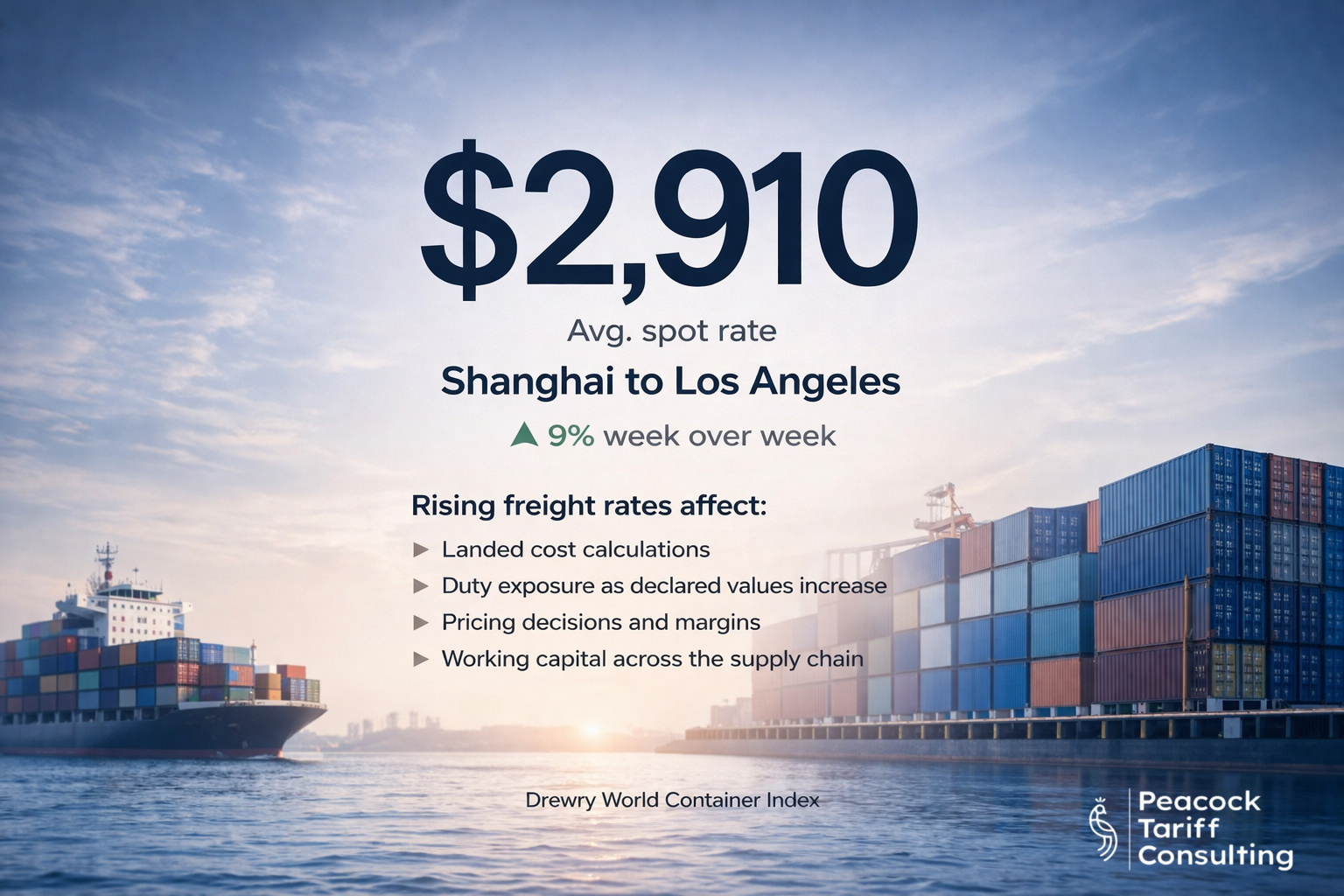
The cost of moving goods across the Pacific is surging once more. Last week, the average spot rate to ship a 40-foot container from Shanghai to Los Angeles reached $2,910, a 9% jump in just seven days. For anyone who lived through the volatility of 2021 to 2022, this number carries a familiar sting. But for importers focused solely on logistics line items, the real risk may be hiding somewhere they are not looking: inside their customs entries.
Rising freight is not just a transportation problem. It is a tariff problem, a margin problem, and a working capital problem all rolled into one.
The Ripple Effect Most Importers Miss
When freight rates spike, the conversation in most boardrooms centers on shipping budgets and carrier negotiations. That is understandable. But the downstream effects on trade compliance and duty costs are often overlooked until they have already eroded margins.
Here is the mechanism: U.S. Customs and Border Protection assesses duties based on the declared transaction value of imported goods, which in many cases includes freight and insurance costs depending on the terms of sale. When freight costs rise, the declared value of each shipment can rise with it. Higher declared values mean higher duties automatically, silently, and across every single entry.
For a mid-size importer bringing in hundreds or thousands of containers per year, even a modest increase in per-unit declared value can translate into tens or hundreds of thousands of dollars in additional duty payments over the course of a quarter. That money does not show up as a freight surcharge on an invoice. It shows up buried in customs entries, often unnoticed until a year-end reconciliation if it is noticed at all.
Landed Cost: The Number That Actually Matters
Freight rates grab headlines, but landed cost is the number that determines whether a product is profitable. Landed cost encompasses the full expense of getting a product from a foreign supplier dock to a warehouse shelf in the United States: the product price, international freight, insurance, customs duties, harbor maintenance fees, merchandise processing fees, domestic transportation, and warehousing.
When any single component of that equation shifts, as freight rates are doing right now, the entire landed cost calculation needs to be revisited. Importers who set their landed cost models at the beginning of the year and have not updated them since are almost certainly working with outdated numbers. Pricing decisions, vendor negotiations, and inventory strategies built on stale landed cost data will quietly underperform.
The discipline of recalculating landed costs in response to market shifts is not glamorous work, but it is the difference between companies that protect their margins and companies that wonder where their margins went.
Duty Exposure: The Hidden Amplifier
This is where rising freight rates become particularly dangerous for importers who have not invested in trade compliance. Duties in the United States are calculated as a percentage of the appraised value of imported goods. For many tariff classifications, that percentage ranges from 2% to 25% and significantly higher for goods subject to Section 301 tariffs on Chinese-origin products, which can add an additional 7.5% to 25% on top of the normal duty rate.
Consider a straightforward example. An importer brings in a container of consumer electronics classified under a tariff heading carrying a 3.9% duty rate, plus a 25% Section 301 tariff. If the declared value of that shipment increases by $5,000 due to higher freight costs folded into the transaction value, the additional duty on that single container is approximately $1,445. Multiply that across 200 containers per year, and the importer is looking at nearly $289,000 in incremental duty costs not because the product changed, not because the tariff rate changed, but because freight went up.
This is the amplifier effect. Duties do not just rise in proportion to freight increases. They rise in proportion to the duty rate applied to those increases. The higher the applicable duty rate, the more painful each dollar of freight inflation becomes.
Classification Accuracy: Your First Line of Defense
In an environment of rising costs, the accuracy of your Harmonized Tariff Schedule classifications takes on heightened importance. Every product entering the United States is assigned a 10-digit HTS code that determines the applicable duty rate. A misclassification, even an unintentional one, can mean the difference between a 2% duty rate and a 12% duty rate, or between eligibility for a trade preference program and full-rate duty.
Many importers established their classifications years ago and have not revisited them since. Products evolve. Suppliers change materials or manufacturing processes. Customs rulings update. The tariff schedule itself is revised annually. A classification that was correct three years ago may no longer be accurate today and in a high-freight-cost environment, the financial penalty for that inaccuracy is magnified.
Now is the time to conduct a classification review. Not a cursory glance, but a rigorous, line-by-line examination of your top-imported items against current HTS provisions, applicable rulings, and any available explanatory notes. The goal is to ensure every product is classified at the most specific and accurate and legally defensible tariff provision available.
Recovery Opportunities: Looking Backward to Move Forward
One of the most underutilized tools in an importer arsenal is the ability to recover overpaid duties on past entries. U.S. Customs regulations allow importers to file Post Summary Corrections and protests to amend previously liquidated entries and claim refunds on duties that were overpaid due to classification errors, incorrect valuation, or failure to claim applicable trade preference programs.
The window for these corrections is limited, generally within 180 days of liquidation for Post Summary Corrections, or within 180 days of the date of liquidation for protests, but the dollars at stake can be substantial. Importers who have been overpaying duties due to misclassification or overvaluation may be sitting on significant recovery opportunities without realizing it.
In the current freight environment, where every cost input is being squeezed, recovering overpaid duties from the past 12 to 24 months can provide a meaningful offset to rising supply chain costs. It is not a hypothetical benefit. It is cash that belongs to the importer, waiting to be claimed.
Valuation: Getting the Declared Value Right
Customs valuation is one of the most technically complex areas of trade compliance, and it is also one of the areas where importers most frequently leave money on the table or inadvertently create compliance risk.
The transaction value method, which is the primary basis for appraisement under U.S. law, requires that the declared value reflect the price actually paid or payable for the goods, with certain statutory additions and deductions. Freight costs, depending on the terms of sale, may or may not be included in the declared value. Importers shipping on CIF (Cost, Insurance, and Freight) terms include freight in the declared value; those shipping on FOB (Free on Board) terms generally do not, though the international freight is still reported separately on the entry.
As freight rates climb, importers should review their terms of sale and ensure their customs broker is correctly applying the appropriate valuation methodology. An error in how freight is treated in the declared value, either including it when it should not be, or failing to deduct allowable amounts, can result in systematic overpayment of duties across every entry.
Additionally, importers should examine whether they qualify for any valuation deductions, such as for post-importation costs (certain installation, assembly, or transportation charges within the United States) that should not be included in the dutiable value.
Working Capital: The Compounding Pressure
Rising freight costs do not just increase the per-unit cost of goods. They increase the cash tied up at every stage of the supply chain. Deposits to carriers go up. Duty payments at the border go up. The total capital deployed per container goes up. For importers operating on thin margins or seasonal cash flow cycles, this compounding pressure on working capital can force difficult decisions about inventory levels, payment terms, and pricing.
Trade compliance strategies can directly alleviate some of this pressure. Duty deferral programs, such as Foreign Trade Zones and bonded warehouses, allow importers to delay duty payments until goods are actually entered into U.S. commerce. For companies that warehouse inventory for extended periods before sale, these programs can free up significant working capital.
Similarly, drawback programs allow importers to recover up to 99% of duties paid on imported goods that are subsequently exported, whether in their original form or after being manufactured into a different product. For companies with any export activity, drawback represents a direct cash recovery mechanism that is particularly valuable when duty costs are elevated.
The Strategic Imperative
The current freight rate environment is a reminder that supply chain costs are not static, and the trade compliance strategies that support them should not be static either. Importers who treat customs compliance as a set-it-and-forget-it function will continue to absorb unnecessary costs that compound with every rate increase, every misclassified shipment, and every missed recovery opportunity.
The importers who will navigate this environment most effectively are those who view rising freight rates not just as a cost to be managed, but as a signal to reassess their entire landed cost structure. That means reviewing classifications, validating valuation methodologies, modeling duty exposure under current and projected freight rates, and actively pursuing recovery opportunities on past entries.
The gap between importers who manage trade compliance proactively and those who manage it reactively has always existed. In a rising-cost environment, that gap widens quickly, and expensively.
What You Should Do This Week
The actions available to importers right now are concrete and immediate. First, pull your top 20 imported products by volume and duty spend, and verify that each one is classified under the most accurate and beneficial HTS provision available. Second, review your customs valuation methodology with your broker to confirm that freight costs are being treated correctly under your terms of sale. Third, examine your entries from the past 12 months for any overpayments that may be recoverable through Post Summary Corrections or protests. Fourth, model your projected duty spend for the remainder of the year under current freight rate assumptions and compare it to your budget.
These are not abstract recommendations. They are the specific, tactical steps that separate importers who control their costs from importers who are controlled by them.
Peacock Tariff Consulting helps importers reduce duty exposure, recover overpaid duties, and build trade compliance programs that protect margins in any market environment. To discuss how rising freight costs may be affecting your landed cost and duty spend, contact us at kyle.peacock@peacocktariffconsulting.com.