
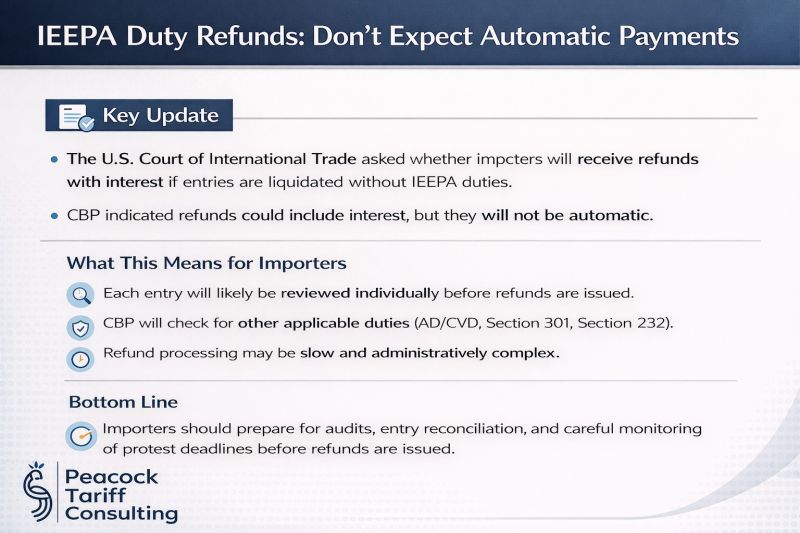
The Refund Uncertainty: CBP’s Position on Interest and Individual Review
Following the Court of International Trade’s ruling that IEEPA tariffs are unlawful, importers assumed that refund processing would be relatively straightforward: CBP would calculate the difference between duties paid under IEEPA and duties owed under applicable tariff schedules, and refund the difference. However, recent interactions between the CIT and CBP have clarified that refund processing will be far more complex. CBP has indicated that while refunds are legally required, the agency intends to conduct individual entry-by-entry reviews before issuing any refunds.
When the CIT asked whether refunds should include interest compensation for the time importers were deprived of capital due to unlawful duty collection, CBP’s response was notably cautious. The agency indicated that refunds could theoretically include interest, but that interest would not be automatic and would require individual assessment. This position suggests that CBP intends to exercise substantial discretion in determining refund amounts and eligibility, transforming what might seem like a straightforward entitlement into a heavily reviewed administrative process.
- CBP indicating no automatic refund payments
- Individual entry review required before refunds processed
- Interest inclusion possible but not automatic
- Substantial CBP discretion in refund determination
Entry-by-Entry Review: The Gatekeeper Function
CBP’s commitment to individual entry-by-entry review of refund claims means that each entry subject to IEEPA tariffs will be subject to separate examination by CBP personnel. During this review, CBP will examine entry documentation, verify import information, assess compliance with applicable regulations, and determine whether the entry is eligible for refund. This process introduces multiple opportunities for CBP to identify technical deficiencies or compliance issues that could delay or prevent refund processing.
The entry-by-entry review process is administratively intensive and time-consuming. CBP must have adequate staffing and systems to process what could be tens of thousands of entries across all US ports. Given the agency’s existing workload and resource constraints, the review process will likely create substantial delays. Importers should expect that refund claims will not be processed in any rapid timeframe and should prepare for multiple interactions with CBP to provide documentation and respond to agency inquiries about individual entries. Additionally, importers should recognize that CBP’s review creates opportunities for the agency to identify additional compliance issues or assessment challenges that could extend processing timelines.
- Thousands of entries requiring individual CBP review
- Documentation verification necessary for each entry
- Compliance assessment potentially identifying additional issues
- Resource constraints at CBP creating delays
Interest Calculations and the Time Value of Capital
The question of whether refunds should include interest is not merely a technical accounting matter; it concerns compensation for the opportunity cost of capital unlawfully held by the government. When importers pay duties believed to be legally required, they are deprived of the use of that capital. If the duties are later determined to be unlawful, elementary principles of fairness suggest that importers should be compensated not only for the principal amount of the unlawful duties, but also for the time value of the capital held by the government.
CBP’s position that interest would not be automatic means that importers must affirmatively assert interest claims, potentially providing specific calculations of appropriate interest rates and accrual periods. The agency may then challenge interest calculations, arguing that the appropriate rate is lower than the importer claims or that interest should accrue from a different date than the importer proposes. These disputes could result in substantial delays and may require negotiation or litigation to resolve. Importers holding significant refund claims should strongly consider enlisting accountants or financial advisors to calculate appropriate interest charges and to document the basis for interest calculations with precision.
- Interest representing compensation for time value of capital
- Not automatic, requiring affirmative claim by importers
- Interest rates and accrual periods likely subject to dispute
- Professional financial assistance valuable for claim preparation
Checking for Other Duties: Multi-Regime Assessment
CBP has indicated that as part of the refund review process, the agency will check whether other duties apply to the same entries subject to IEEPA tariffs. These other duties could include Anti-Dumping (AD) duties, Countervailing Duties (CVD), or Section 301 tariffs imposed in connection with other trade disputes. If multiple duties apply to a single entry, CBP must determine the sequencing of refunds, which duties are owed, and how the entry should be ultimately liquidated.
The presence of multiple duty regimes applying to the same entry creates substantial complexity. An importer might believe it is owed a refund of IEEPA tariffs, but upon entry review, CBP might determine that AD or CVD duties also apply. The AD or CVD duties might exceed the IEEPA refund due, meaning the importer could owe additional duties rather than receiving a refund. Alternatively, the combination of duties might result in a net payment due to the government. This possibility underscores the importance of importers obtaining comprehensive analysis of their duty exposure across all applicable tariff regimes, not merely the IEEPA tariffs initially assessed.
- Multiple duty regimes potentially applying to same entries
- AD/CVD duties possibly exceeding IEEPA refunds
- Sequencing and offset calculations determining net refunds or payments
- Comprehensive duty analysis necessary for accurate claim assessment
Documentation Requirements and Compliance Verification
Importers seeking IEEPA refunds must be prepared to provide comprehensive documentation supporting their refund claims. This documentation should include the original entry paperwork, commercial invoices, bills of lading, and customs declarations. Additionally, importers must verify that they are the correct party to receive refunds—the importer of record shown on the entry. If entries were imported through third-party brokers or agents, establishing the right to refund proceeds may require additional documentation or agreements clarifying that the third party was acting as agent for the importer.
CBP’s review of documentation will likely uncover technical deficiencies or compliance issues in a percentage of entries. For example, an importer might have failed to properly document the country of origin of goods, leading to questions about the applicable tariff classification. Alternatively, an importer might have imported goods subject to licensing or regulatory requirements that were not fully satisfied. These compliance issues may not have been previously identified by CBP but could emerge during the refund review process. Importers should conduct internal audits of entries they plan to include in refund claims, identifying any compliance concerns and developing explanations or remedial documentation.
- Comprehensive documentation required for refund claims
- Importer of record status determining eligibility
- Technical deficiencies likely to emerge during review
- Compliance verification potentially revealing additional issues
Audit and Entry Reconciliation: Preparing for Scrutiny
CBP’s commitment to individual entry review means that importers should prepare for the possibility of audits and detailed reconciliation of their entry-level data. The agency may request that importers provide additional documentation, explain tariff classifications, justify valuation methodologies, or provide details about supply chain relationships and transactions. These inquiries could extend beyond the IEEPA refund issue to broader questions about import compliance.
Importers should use the refund claim process as an opportunity to audit their own historical entries and ensure that all documentation is in order. Internally conducted audits before submission of refund claims can identify issues proactively and allow importers to either resolve issues or provide explanations along with their refund requests. This approach positions importers more favorably in interactions with CBP and may accelerate refund processing by reducing the agency’s need for follow-up inquiries. Additionally, importers should assign qualified personnel to manage CBP interactions and ensure that all requested documentation is provided completely and comprehensively.
- CBP likely to request additional documentation and explanations
- Potential for audits extending beyond IEEPA refunds
- Internal audit preparation improving interactions with CBP
- Qualified personnel essential for comprehensive documentation
Strategic Considerations: Refund Claim Timing and Valuation
Importers must make strategic decisions about how aggressively to pursue IEEPA refund claims and whether to seek to sell claims to financial investors rather than waiting for CBP refund processing. These decisions depend on individual circumstances including the size of the refund claim, the importer’s cash flow needs, and the importer’s assessment of the likelihood that CBP will honor the claim in full and include interest.
Large importers with substantial refund claims and strong cash flow positions may choose to pursue claims directly with CBP, betting that the agency will ultimately process full refunds with interest. Smaller importers with more limited resources and more pressing cash flow needs may find it advantageous to sell refund claims to financial investors at a discount, gaining immediate liquidity while ceding future refund proceeds. The decision should be informed by professional valuation analysis and clear-eyed assessment of CBP’s likely behavior and processing timeline. Importers should also consider the tax implications of their approach—selling claims may have different tax consequences than receiving refunds directly from CBP.
- Importers evaluating claim timing and selling strategies
- Trade-off between immediate liquidity and future refund proceeds
- Professional valuation analysis essential
- Tax implications varying by approach
Conclusion: Preparing for the Long Process
The clear message from CBP is that IEEPA refund processing will be neither automatic nor swift. Importers should prepare for a process involving individual entry review, documentation requests, potential audits, interest disputes, and reconciliation of multiple duty regimes. The timeline for refund processing could extend to multiple years, with substantial uncertainty about ultimate refund amounts and whether interest will be included.
Given these realities, importers should take immediate steps to assess their IEEPA refund exposure, organize their entry-level documentation, conduct internal audits, and engage with experienced customs attorneys or consultants to develop strategies for claim presentation and negotiation with CBP. Additionally, importers should consider whether selling refund claims to financial investors makes sense given their individual circumstances. The most important step is recognizing that IEEPA refunds are not automatic entitlements but rather contested claims that will require substantial effort and resources to pursue successfully. By preparing comprehensively and engaging experienced advisors, importers can improve the likelihood of receiving full and timely refund recovery.
- Refund process requiring sustained engagement with CBP
- Multiple documentation requests and potential audits anticipated
- Timelines measured in months or years
- Professional advisory support critical to claim success