
The Dramatic Export Growth Narrative
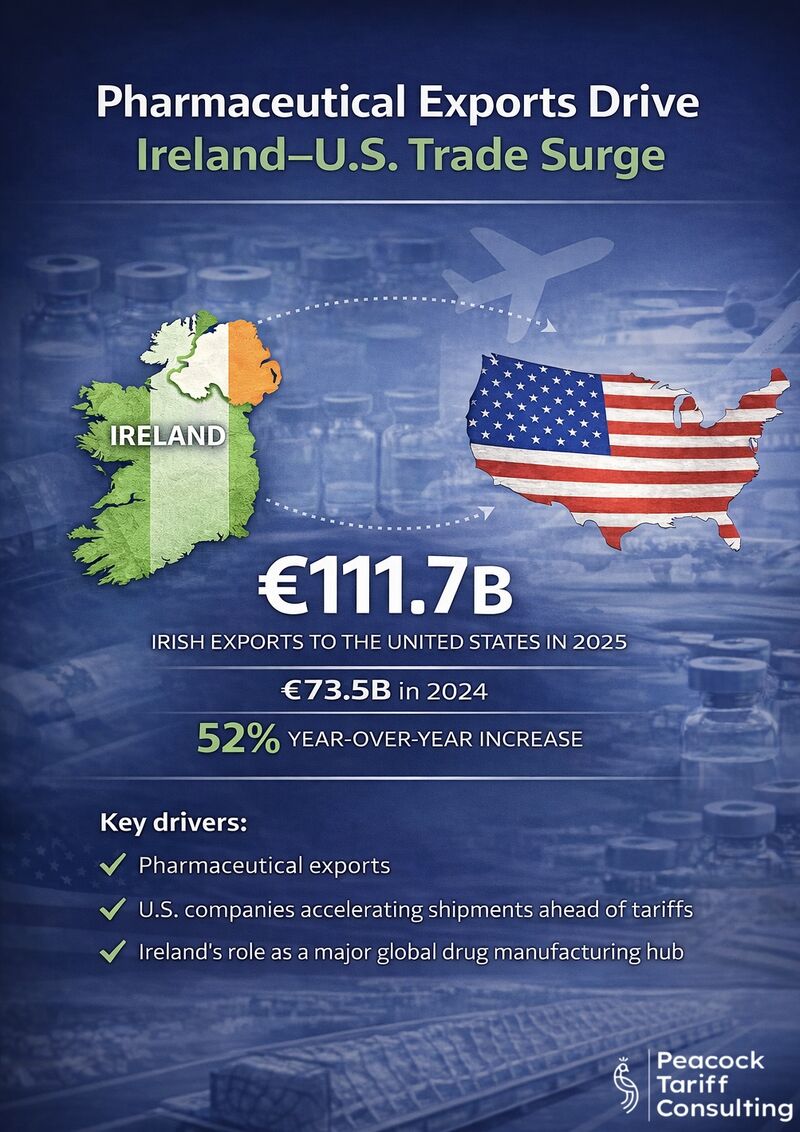
Ireland’s exports to the United States surged 52% in 2025, a growth rate that initially appears exceptional and warrants celebration. At first glance, the statistics suggest a thriving bilateral trade relationship and expansion of Irish export capacity. However, the underlying dynamics driving this export growth tell a more nuanced story about corporate supply chain strategy, tariff anticipation, and inventory positioning ahead of potential policy changes. Understanding the true drivers of the 52% export increase requires examining the composition of exports and the timing of shipment patterns.
The Irish economy has long benefited from a substantial pharmaceutical and life sciences sector, with major international companies establishing manufacturing and distribution facilities in Ireland. US-Ireland trade in pharmaceuticals represents a significant bilateral flow. However, 2025’s export surge does not reflect underlying industry expansion or new production capacity. Instead, the surge primarily reflects strategic timing of shipments and inventory accumulation ahead of anticipated tariff changes.
- Ireland’s US exports increased 52% in 2025
- Export growth concentrated in pharmaceutical sector
- Growth does not reflect equivalent production increases
- Strategic timing relative to tariff expectations driving shipments
Pharmaceutical Manufacturing Concentration in Ireland
Ireland has established itself as a major pharmaceutical manufacturing hub, with dozens of major multinational pharmaceutical companies operating facilities on the island. Companies including Pfizer, Merck, Janssen, AbbVie, and others manufacture active pharmaceutical ingredients and finished pharmaceutical products in Ireland for global distribution. The concentration of pharmaceutical manufacturing in Ireland reflects tax policy, regulatory environment, and established infrastructure supporting the sector.
Many major US pharmaceutical manufacturers operate substantial production facilities in Ireland. These companies manufacture key pharmaceutical inputs-active pharmaceutical ingredients and intermediates-that are subsequently shipped to the United States for formulation, packaging, and distribution. The Ireland-US pharmaceutical trade flow represents an integrated supply chain where products manufactured in Ireland are components of final products distributed in the US market. This integrated supply chain structure is critical to understanding the 2025 export surge.
- Major US pharma manufacturers operate Irish production facilities
- Ireland produces active pharmaceutical ingredients for US market
- Integrated supply chain connecting Irish production to US distribution
- Tax and regulatory environment supporting pharma manufacturing concentration
Tariff Anticipation and Strategic Inventory Positioning
The dominant driver of the 52% export growth in 2025 is supply chain strategy designed to manage tariff risk. US pharmaceutical companies operating Irish facilities recognized that potential tariff increases could materially affect supply chain economics. Faced with the prospect of tariffs on pharmaceutical imports from Ireland, these companies accelerated shipments in 2025, positioning inventory in the United States ahead of any tariff implementation. This strategy of pre-tariff inventory accumulation is economically rational when companies anticipate tariff increases.
Pharmaceutical companies imported record volumes of Irish-manufactured products in advance of potential tariff changes. Active pharmaceutical ingredients and intermediate products that would normally be shipped on standard schedules were front-loaded into 2025. This acceleration created the dramatic export growth statistics while simultaneously building inventory buffers that would allow companies to reduce import volumes in subsequent periods. The export surge should therefore be interpreted as temporary inventory positioning rather than sustained market expansion.
- Companies anticipated potential tariff implementation
- Pre-tariff inventory accumulation reduced 2025-2026 import volumes
- Acceleration strategy rational response to tariff risk
- Export growth represents timing shift, not volume increase
Broader Supply Chain Reconfiguration
Beyond inventory timing, the pharmaceutical sector is simultaneously evaluating longer-term supply chain reconfiguration in response to tariff policy. US pharmaceutical companies are assessing whether Irish manufacturing locations remain cost-optimal under tariff scenarios. Some companies may evaluate shifting production to US facilities or to countries with favorable tariff treatment. Others may adjust product flow patterns to minimize tariff exposure. These strategic evaluations will reshape pharmaceutical trade patterns over the coming years.
The 2025 export surge masks underlying strategic uncertainty about long-term supply chain positioning. Pharmaceutical companies face a decision architecture where tariff increases could justify shifting production, adjusting manufacturing locations, or reconfiguring supply chains. Irish manufacturing facilities that operate at high volume may face reduced utilization if US companies shift sourcing. The 52% export growth in 2025 should not be interpreted as indicating sustained high growth; rather, it reflects a temporary adjustment period as companies adapt supply chains to tariff realities.
- Companies evaluating long-term supply chain reconfiguration
- Potential production shifting to minimize tariff exposure
- Irish manufacturing facility utilization under pressure
- Strategic uncertainty affecting investment decisions
Market Implications and Inventory Normalization
The dramatic 2025 export surge will likely reverse as inventory normalizes in 2026 and 2027. Pharmaceutical companies with accumulated inventory will reduce import volumes as they consume accumulated stock. This inventory normalization will create a cyclical pattern where 2026 exports from Ireland decline relative to 2025 levels, potentially dropping 20-30% before stabilizing at levels reflecting underlying tariff-adjusted supply chain economics. This cyclical pattern is entirely consistent with the inventory accumulation hypothesis and inconsistent with sustained growth narratives.
Looking forward, Ireland’s pharmaceutical export volumes will be determined by tariff policies, manufacturing cost competitiveness, and company decisions regarding supply chain optimization. If tariff policies stabilize at higher levels, companies will adjust supply chains accordingly. If tariff policies revert to previous levels, supply chains may normalize. The key insight is that the 2025 export surge reflects temporary supply chain timing rather than fundamental expansion of Ireland’s pharmaceutical sector capacity or demand.
- 2026-2027 export volumes likely to decline from 2025 peaks
- Inventory normalization creating cyclical pattern in trade flows
- Long-term export levels dependent on tariff policy resolution
- Manufacturing location optimization ongoing across sector
Strategic Implications for Tariff Policy Analysis
The Ireland case study illustrates how tariff policies create supply chain timing dynamics that distort trade statistics. The 52% export growth appears dramatic until one understands the inventory accumulation strategy motivating the growth. This pattern has significant implications for how policymakers interpret trade statistics and how tariff policies are designed. Trade statistics reflecting inventory timing adjustments may suggest market dynamics that do not reflect underlying economic realities.
For Peacock Tariff Consulting clients, the Ireland example demonstrates the importance of supply chain intelligence beyond headline trade statistics. Understanding which companies are accumulating inventory, which facilities are optimizing production, and which supply chains are reconfiguring requires detailed analysis of company behavior and supply chain patterns. Tariff policy impacts companies differently based on their supply chain structure, manufacturing locations, and product mixes. Sophisticated analysis must account for these variations rather than relying on aggregate trade statistics.
- Trade statistics reflect both market dynamics and timing adjustments
- Inventory accumulation creating distorted growth patterns
- Supply chain optimization ongoing across pharmaceutical sector
- Detailed company-level analysis critical for policy assessment