
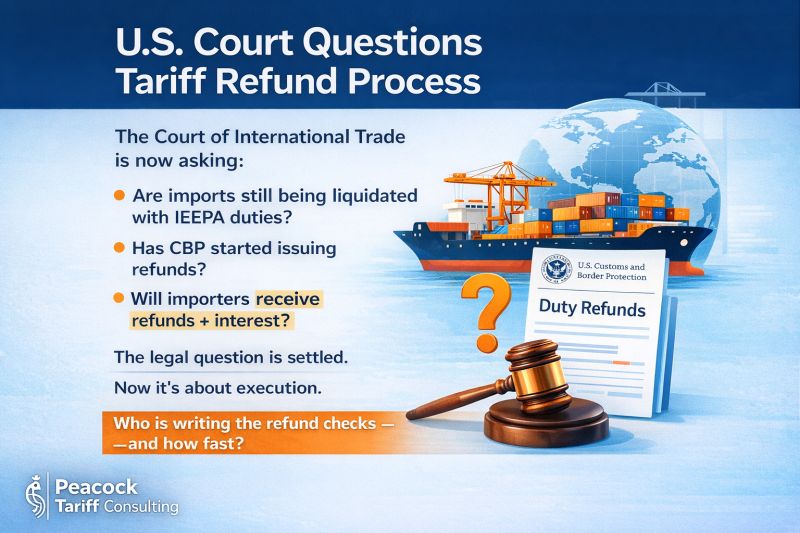
The Supreme Court Settled One Question; The CIT Must Answer Others
The Supreme Court’s decision on tariff refunds established a foundational principle: importers are owed refunds for duties collected under the International Emergency Economic Powers Act (IEEPA). However, settling the legal principle of refund eligibility does not resolve the practical complexities of execution. The Court of International Trade (CIT) scheduled hearing in Filtration Inc v US now shifts focus to the operational realities that will determine whether importers actually receive those refunds.
The distinction matters profoundly for importers holding or managing inventory sourced from countries targeted by IEEPA measures. A favorable legal ruling proves hollow if the administrative machinery cannot process refunds efficiently or if CBP’s collection practices have already created irreversible consequences for cash flow and working capital.
Has Import Activity Dropped? Understanding the Baseline
The first critical question the court must address concerns the scope of refund claims. Has import activity into the United States declined for affected goods during the IEEPA duty period? If so, by how much? This question matters because it establishes both the scale of affected transactions and the behavioral response to tariff policy.
Lower import volumes might suggest that tariffs effectively deterred sourcing from targeted countries, reducing the universe of refund claims. Conversely, stable or growing import volumes indicate that tariffs did not meaningfully change sourcing decisions but instead increased costs for importers who continued ordering from affected countries. The court’s examination of import statistics will inform remedial scope and the practical burden on CBP to process claims.
- Import volume trends between IEEPA implementation and suspension
- Comparative data for affected product categories
- Geographic diversification patterns among importers
Is CBP Still Liquidating Entries with IEEPA Duties?
A second operational question concerns CBP’s current liquidation practices. The liquidation process determines the formal assessment and collection of duties. If CBP continues liquidating entries to which IEEPA duties apply, it creates a situation where refund claims must either wait for those entries to be formally liquidated or proceed through protest mechanisms before liquidation occurs.
The timing of liquidation directly affects importers’ ability to claim refunds. Entries that have not yet been liquidated may qualify for refunds at the liquidation stage. Entries already liquidated require importers to file protests and pursue litigation to challenge the duty assessment. This creates two parallel tracks: one potentially expedited, the other requiring extended litigation.
- Current CBP liquidation timeline for IEEPA-affected entries
- Protest procedures for already-liquidated entries
- Administrative barriers to refund processing
Have Refunds Started? The Reality of Claims Processing
Despite the legal clarity that refunds are owed, the operational question remains: have actual refunds begun flowing to importers? The absence of widespread refund activity would indicate either that the administrative mechanisms are not yet in place or that CBP is requiring importers to navigate formal claims procedures.
Importers need clarity on the process for submitting refund claims, the documentation required, the timelines for processing, and the interest calculations that should accompany refunds. The longer refunds remain unprocessed, the greater the financial impact on importers who have absorbed IEEPA duties into their cost structures.
Will Importers Get Refunds Plus Interest?
The final question in this trilogy of practical concerns addresses whether refunds will include interest. Importers bore the financial burden of IEEPA duties for months. Interest compensation is not merely a technical matter; it represents fair recompense for the use of capital that should not have been required.
The court’s ruling on interest will determine the true value of the refund remedy. Interest calculations compound over the IEEPA duty period, potentially adding substantial value to refund claims for large importers or those with significant transaction volumes. Absence of interest language in refund processing could signal that CBP intends to return only the principal duties, leaving importers to absorb opportunity costs.
- Interest rate determination (statutory rates vs. actual cost of capital)
- Calculation methodology for interest accrual periods
- Impact on total refund value for affected importers
Implications for Import Strategy and Compliance
For importers currently managing transactions under active tariff policies, the Filtration Inc v US proceeding serves as a critical indicator of how courts will resolve refund claims when tariff policy changes. It demonstrates both the potential for tariff relief and the practical challenges in realizing that relief through administrative channels.
The case also highlights the importance of meticulous entry documentation and timely protest filing. Importers who can clearly establish IEEPA-affected entry histories and maintain organized records of duty payments will be better positioned to navigate refund claims when mechanisms are established. The absence of administrative clarity on refund procedures makes contemporaneous documentation essential insurance against future disputes.