
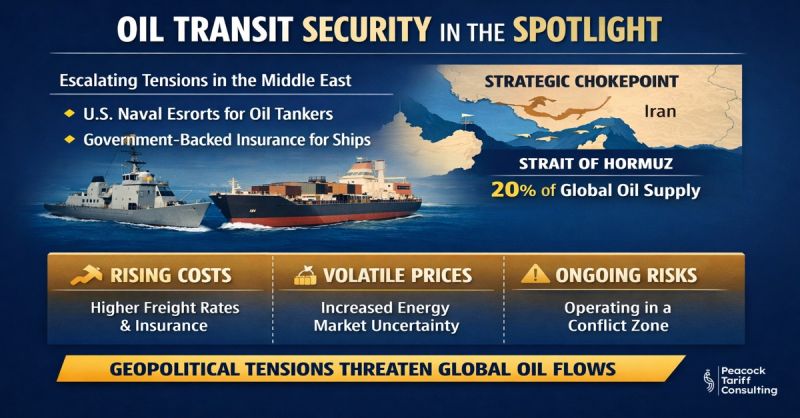
Trump Administration Proposes Oil Tanker Escorts Through the Strait of Hormuz
The Trump administration has proposed a new mechanism for enhancing oil tanker security through the Strait of Hormuz: direct US government-backed escort services and insurance arrangements for commercial oil tankers transiting this critical chokepoint. The proposal reflects recognition that the Strait of Hormuz—through which approximately 20 percent of global oil flows—faces rising security risks that have driven shipping costs and insurance premiums to elevated levels. The administration’s escort proposal represents an unprecedented expansion of US government involvement in commercial maritime logistics.
The escort proposal contemplates US naval vessels or contracted naval services accompanying commercial oil tankers through the Strait, providing direct protection against seizure, attacks, or other hostile acts. The government would also provide insurance coverage for vessels utilizing the escort services, effectively shifting some of the commercial risk from individual shipping companies and oil producers to the US government. This arrangement would substantially reduce the insurance premiums and risk premiums that shipping companies currently embed in transit costs, theoretically lowering oil prices and reducing energy cost inflation for American consumers.
- US proposes government-backed escort services for oil tankers
- Insurance coverage provided by US government
- Strait of Hormuz handles 20% of global oil
- Proposal aims to reduce shipping costs and insurance premiums
The Strait of Hormuz: Strategic Chokepoint and Global Vulnerability
The Strait of Hormuz, located between Iran and Oman, connects the Persian Gulf to the Gulf of Oman and the Arabian Sea beyond. All oil exported from the Persian Gulf must transit this narrow waterway, creating a critical dependence on transit security and freedom of navigation. The Strait is approximately 21 miles wide at its narrowest point, with heavily traveled shipping lanes passing through Iranian territorial waters. This geography creates inherent vulnerabilities and makes the Strait a natural focal point for security concerns.
The strategic significance of the Strait derives from the concentration of global oil supply that depends on Hormuz transit. Saudi Arabia, Iraq, Iran, UAE, Qatar, and Kuwait collectively contain more than 45 percent of the world’s proven oil reserves, and the vast majority of their oil exports transit the Strait. Disruptions to transit through the Strait—whether due to military conflict, terrorism, piracy, or other causes—can threaten global oil supplies and trigger price spikes that ripple through the global economy. The COVID-19 pandemic and various geopolitical crises have highlighted how sensitive global oil markets are to any threat to Strait transit security.
- Strait of Hormuz connects Persian Gulf to Arabian Sea
- Only passage for oil from Gulf producers
- Narrow waterway vulnerable to disruption
- 45%+ of world’s proven oil reserves dependent on Strait access
Rising Conflict Risks: Drivers of Elevated Shipping Costs
The past several years have witnessed escalating regional tensions that have elevated shipping costs and insurance premiums for vessels transiting the Strait. Conflicts involving multiple parties, including state actors, Iranian proxies, and non-state organizations, have created genuine security risks. Several commercial vessels have been attacked, seized, or damaged while transiting the Strait, creating real precedents for the risks that shipping companies must now price into their operations.
The elevated risk environment drives shipping cost increases through multiple channels. First, insurance premiums for hull and cargo insurance have increased substantially as underwriters reassess risk. Second, shipping companies demand higher fees to compensate for risk exposure and potential vessel loss or damage. Third, re-routing around the Strait—via the Suez Canal or around the Cape of Good Hope—becomes economically viable for some shipments as Strait transit costs rise, but these alternatives add days to transit times and increase costs for companies choosing that option. Fourth, charterers demand higher wages and provide hazard pay for crews willing to work in high-risk environments. The cumulative effect is that oil transit costs have increased substantially, with these costs ultimately reflected in higher oil prices for consumers.
- Regional conflicts creating security risks for transiting vessels
- Insurance premiums increasing due to reassessed risk
- Multiple attacks and seizures establishing precedent for risk
- Re-routing alternatives increasing transit costs and times
Oil Price Volatility and Economic Impacts
Rising transit costs through the Strait of Hormuz contribute directly to oil price volatility and upward pressure on global oil prices. When investors and traders assess the value of crude oil, they factor in the probability of Strait transit disruptions and the potential cost impacts. Heightened security risks increase the risk premium embedded in oil futures prices, raising the price at which producers are willing to sell and consumers must pay.
The economic consequences of elevated oil prices reverberate through the global economy. Higher energy costs increase inflation pressures, reduce consumer purchasing power, and dampen economic growth. Companies dependent on energy-intensive production processes face compressed margins and reduced competitiveness. Transportation companies see fuel costs escalate, leading to higher prices for goods movement. Broader economic impacts include reduced investment in high-energy-cost sectors and shifts in consumer and business behavior toward energy conservation.
- Strait transit risks increase risk premiums in oil pricing
- Higher oil prices driving inflation pressures
- Consumer purchasing power reduced by energy cost increases
- Energy-intensive industries facing margin compression
The Escort Proposal: Benefits and Limitations
The Trump administration’s escort proposal offers potential benefits in terms of reducing transit risks and lowering insurance premiums for participating vessels. US military or contracted security providers operating in the Strait would have superior capabilities compared to private security companies, potentially providing more reliable protection against sophisticated threats. Government insurance backing would reduce the financial risk to individual shipping companies, allowing them to offer lower shipping fees and operate more competitively.
However, the proposal faces substantial limitations and uncertainties. Even with robust US naval escorts, the Strait remains a dangerous environment where determined adversaries could implement attacks causing damage or disruption. The proposal also creates questions about the scope of US government liability for losses, the cost allocation between government and private actors, and the appropriate level of insurance indemnification. Additionally, some nations and international law experts may question the legality of US naval operations within the territorial waters of Iran and other states, even if conducted ostensibly for neutral commercial purposes. The proposal also requires willingness from oil producers and shipping companies to utilize the escort services, which may be complicated by concerns about political entanglement or accusations of dependency on US military protection.
- Military escorts providing superior protection capabilities
- Government insurance reducing financial risks
- Scope of liability and cost allocation uncertain
- Legal questions about operations in foreign territorial waters
- Political and entanglement concerns affecting utilization
Carrier Hesitation: Active Conflict Zone Realities
Despite the potential benefits of US-backed escorts and insurance, oil carriers and shipping companies remain deeply concerned about transiting the Strait regardless of security arrangements provided. The fundamental issue is that even with government escorts and insurance protection, a vessel caught in active military conflict could suffer damage, be stranded, or be involved in maritime incidents with unpredictable consequences. Insurance compensation does not address the operational disruption, reputational damage, or potential loss of vessel and crew.
The carrier hesitation reflects rational risk assessment. A US escort presence reduces certain risks but does not eliminate the threat of conflict escalation, weaponization of the Strait, or other security challenges that go beyond the protective capacity of even well-equipped naval forces. Carriers worry that military conflict could intensify despite or because of increased US military presence, potentially making the Strait more dangerous rather than less dangerous. Some carriers also face pressure from insurers, charterers, and clients to avoid high-risk routes regardless of government-provided security. The result is that even with the escort proposal implemented, some carriers may continue to avoid the Strait or demand substantial additional compensation for transit, limiting the proposal’s effectiveness in reducing overall shipping costs.
- Carriers concerned about active conflict risks despite escorts
- Insurance compensation not addressing operational disruption
- Conflict escalation concerns regardless of naval presence
- Client and insurer pressure to avoid high-risk routes
Broader Security Architecture and Long-Term Implications
The escort proposal represents one element of a broader strategic consideration about US involvement in Middle Eastern security and energy security. The proposal reflects the administration’s view that the United States has strategic interests in maintaining oil transit freedom through the Strait and that military or government resources are appropriately deployed to advance these interests. However, the proposal also raises broader questions about the sustainability of this approach, the costs to the US government, and the long-term strategic implications.
If the Strait of Hormuz remains unstable and transit security requires sustained US military presence and government insurance backing, the long-term economic and political costs to the United States could be substantial. Alternative approaches—including energy diversification, reduced dependence on Middle Eastern oil through renewable energy deployment, or negotiated agreements with regional actors—may offer more sustainable long-term solutions than indefinite military protection. The escort proposal may serve as a near-term security measure, but it does not address the underlying regional instability that makes Strait transit risky in the first place. For policymakers and strategists, the escort proposal raises important questions about the appropriate balance between near-term security measures and longer-term strategic repositioning.
- Escort proposal reflecting US strategic interests in energy security
- Raises questions about sustainability and long-term costs
- Alternative approaches including energy diversification
- Underlying regional instability not addressed by escort measures