
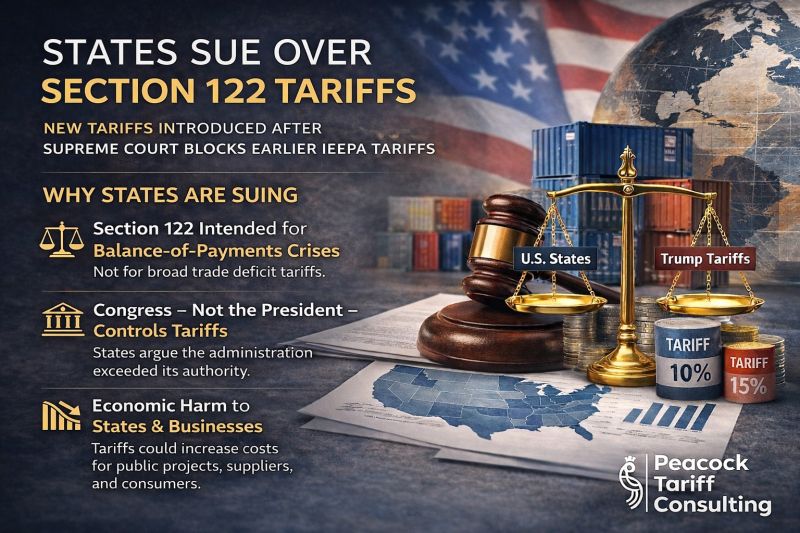
The Constitutional Crisis: States Question Presidential Authority Over Section 122 Tariffs
More than 20 US states have filed legal challenges asserting that the Trump administration’s implementation of Section 122 tariffs exceeds constitutional and statutory presidential authority. This coalition lawsuit represents an unprecedented assertion of state power to challenge federal tariff authority and reflects deep concerns about the scope of executive power in trade policy. The lawsuit comes in the wake of a significant Supreme Court ruling that struck down IEEPA tariffs as unlawful, establishing legal precedent for questioning tariff authority.
The states argue that the administration’s shift from IEEPA tariffs to Section 122 tariffs, following the Supreme Court’s adverse ruling, represents an attempt to circumvent judicial authority and implement economically equivalent policies through alternative legal mechanisms. This argument suggests that the fundamental legal question is not about which specific statute the executive branch invokes, but whether the tariffs are consistent with constitutional limitations on executive power and statutory requirements that Congress has imposed on trade policy authority.
- 20+ states filed lawsuit challenging Section 122 tariffs
- Supreme Court previously ruled IEEPA tariffs unlawful
- States argue administration circumventing judicial authority
- Constitutional questions about executive power in trade policy
Understanding Section 122: A Trade Tool Designed for Balance of Payments Crises
Section 122 of the Trade Act of 1974 grants the President authority to impose emergency trade measures to address balance of payments deficits. This statutory provision was enacted to provide the executive branch with flexibility to respond to sudden balance of payments crises that threatened currency stability and international financial relationships. The statute contemplates temporary measures implemented in response to specific, identifiable financial crises—not broad, permanent trade policies applied across multiple countries and product categories.
The text and legislative history of Section 122 emphasize that it is designed for extraordinary circumstances. The statute requires finding that a country faces a balance of payments crisis and that tariffs are necessary to address it. Additionally, Section 122 authority is explicitly temporary—it expires unless affirmatively renewed by the President, and it includes notification and review requirements reflecting Congressional oversight expectations. The states argue that the administration’s use of Section 122 to implement across-the-board tariffs absent any demonstrable balance of payments crisis fundamentally violates the statute’s text and intent.
- Section 122 designed for temporary balance of payments crises
- Statute includes expiration and renewal requirements
- Congressional notification and oversight embedded in text
- Broad tariff application inconsistent with statutory purpose
The Supreme Court Precedent: Why IEEPA Tariffs Failed
The Supreme Court’s recent decision striking down IEEPA tariffs provides crucial legal context for understanding the states’ challenge to Section 122 tariffs. The Court concluded that the International Emergency Economic Powers Act does not authorize the President to impose broad-based tariffs as a trade policy tool. Rather, IEEPA is designed to address national security threats and foreign policy emergencies, not economic competition concerns or trade imbalances.
The Court’s reasoning focused on the gap between IEEPA’s language and purpose versus the scope of authority the administration claimed. IEEPA’s explicit reference to blocking transactions, seizing property, and other specific powers did not reasonably extend to comprehensive tariff authority. Additionally, the Court emphasized that if IEEPA authorized tariffs, the statute would grant the President essentially unlimited trade authority with minimal Congressional oversight—an outcome inconsistent with constitutional text and separation of powers principles. The decision fundamentally constrains the President’s ability to invoke IEEPA for trade purposes.
- Supreme Court ruled IEEPA does not authorize broad tariffs
- Decision emphasized separation of powers concerns
- Gap between statute language and claimed authority identified
- Precedent constraining executive trade policy authority
Circumventing Judicial Authority: The Administration’s Strategic Shift
The states’ core argument is that the administration’s pivot from IEEPA to Section 122 represents an attempt to accomplish through alternative statutory mechanisms what the Supreme Court prohibited. Rather than accepting the judicial determination that certain authorities do not support broad tariff authority, the administration has identified another statutory provision potentially supportive of tariffs and implemented economically equivalent policies. From the states’ perspective, this strategy suggests fundamental disregard for judicial authority and constitutional limitations.
This argument raises profound questions about the nature of judicial review and executive accountability. If executive agencies can simply shift between different statutory authorities in response to adverse court rulings, judicial review becomes essentially illusory. Each statute the executive branch could invoke as a basis for tariffs would require separate litigation to invalidate. The practical consequence would be perpetual litigation over tariff authority absent decisive Congressional action establishing clear limits on executive power. The states argue that courts must recognize this pattern and address the fundamental constitutional question rather than deciding narrow statutory issues that could be circumvented through alternative authority citations.
- Strategic shift from IEEPA to Section 122 seen as circumventing courts
- Perpetual litigation risk if executive can shift authorities
- Fundamental question about judicial review effectiveness
- Need for decisive Congressional action on tariff authority
Congressional Intent and Statutory Misuse: The Balance of Payments Test
Section 122 explicitly requires that the President find that a country faces a balance of payments deficit and that tariffs are necessary to address it. The states argue that the administration has made no credible effort to demonstrate that the countries subject to tariffs face balance of payments crises. Instead, tariffs have been applied broadly to numerous countries based on general trade policy concerns unrelated to balance of payments conditions.
The factual record supporting Section 122 findings would be central to the litigation. If the administration has issued findings that particular countries face balance of payments crises without supporting evidence, courts may find that the statutory prerequisites have not been satisfied. Conversely, if the administration provides evidence of such crises, courts must assess whether this evidence is credible and whether the statistical measures of balance of payments conditions support the requisite findings. The states may argue that the administration’s findings are conclusory and lack evidentiary support, establishing a basis for setting aside the tariffs as arbitrary and capricious.
- Section 122 requires balance of payments crisis findings
- States question evidentiary support for findings
- Possible arbitrary and capricious designation
- Statutory prerequisites potentially unsatisfied
Broader Implications for the Separation of Powers
The states’ lawsuit raises constitutional questions that extend beyond the specific controversy over tariff authority. The case concerns the appropriate boundary between executive flexibility in foreign trade policy and Congressional limitations on executive power. The Constitution grants Congress the power to regulate commerce with foreign nations—a power the Supreme Court has recognized as comprehensive and largely exclusive to Congress.
The states argue that allowing the executive branch to implement broad tariffs through creative statutory interpretation would fundamentally shift the constitutional balance, granting the President essentially unlimited trade policy authority through creative invocation of various statutes. From this constitutional perspective, the case becomes about preserving Congressional authority over trade policy and preventing executive aggrandizement that would undermine constitutional text and original understanding. The states’ challenge thus encompasses not merely the legality of these particular tariffs but the broader question of how much flexibility the Constitution permits the executive branch in trade matters.
- Constitutional questions about separation of powers
- Congress holds primary authority over foreign commerce
- Executive flexibility versus Congressional limitations debate
- Precedent implications for future executive authority claims
Looking Ahead: Litigation Prospects and Policy Implications
The states’ lawsuit faces uncertain litigation prospects. Courts may find that Section 122 provides sufficiently clear authority to support the tariffs despite the administration’s shift from IEEPA. Alternatively, courts may conclude that the statutory prerequisites have not been satisfied or that the executive interpretation of Section 122 is unreasonable. The outcome will depend heavily on statutory interpretation principles, the quality of evidence supporting balance of payments findings, and the judges’ views on appropriate limits to executive power.
Regardless of litigation outcomes, the states’ challenge signals that the tariff issue remains legally contested and politically divisive. The lawsuit may catalyze Congressional action to clarify tariff authority and establish explicit boundaries on executive power. Congress could legislatively ratify the Section 122 tariffs, modify the statutory authorization, or impose new restrictions on executive trade authority. The political feasibility of each option depends on broader political dynamics and the perceived economic impacts of existing tariffs. For businesses and importers, the litigation underscores that tariff policy remains subject to substantial legal uncertainty, and that tariff regimes implemented through executive authority alone face ongoing vulnerability to judicial invalidation.
- Litigation outcomes uncertain and fact-dependent
- Congressional action possible to clarify authority
- Political dynamics and economic impacts shaping options
- Ongoing legal uncertainty surrounding tariff regimes