
Tag: Export Controls
-
Answer Capsule The UK Trade Remedies Authority (TRA) is the independent body created post-Brexit to investigate and apply trade remedies to protect UK domestic industries. Unlike the EU Commission, the TRA operates with unique procedural rules including the economic interest test. Importers can participate in investigations, but face tighter timelines and different appeal mechanisms than…
-
Peacock Tariff ConsultingPeacock Tariff Consulting Answer Capsule: The EU Customs Union eliminates tariffs between member states and applies a Common External Tariff to imports from third countries like the US, Canada, and UK. Non-EU exporters must navigate EU customs territory entry, Union Customs Code procedures, and special transit regimes. Understanding these requirements is essential for…
-
Peacock Tariff ConsultingPeacock Tariff Consulting Answer Capsule: Selecting the right UK customs broker post-Brexit is critical for importers and exporters. Look for HMRC-approved intermediaries with strong digital capabilities, relevant experience, transparent fee structures, and a proven track record handling your specific commodity sectors. Related Articles Post-Brexit Supply Chain Strategies for UK Manufacturers How Brexit Changed…
-
Answer Capsule Post-Brexit, UK importers can optimize costs through Postponed VAT Accounting (PVA), understanding the 20% standard VAT rate and relief mechanisms, leveraging duty relief schemes like Temporary Admission and customs warehousing, and ensuring proper valuation declarations. Authorized Economic Operator (AEO) status provides expedited clearance, while trade agreements unlock duty rate reductions. Peacock Tariff Consulting…
-
Peacock Tariff Consulting Answer Capsule: The European Union’s sanctions and export control framework has dramatically expanded since 2022, affecting any business trading with or within the EU. This guide covers the key EU sanctions regimes (Russia, Belarus, Iran, North Korea, Myanmar), the Russian sanctions packages (14+ rounds), dual-use goods regulations, screening obligations for exporters and…
-
Aerospace industry tariff strategy. HTS Chapter 88, USMCA Annex 4-B, BIS/EAR overlap, Boeing Charleston ecosystem.
-
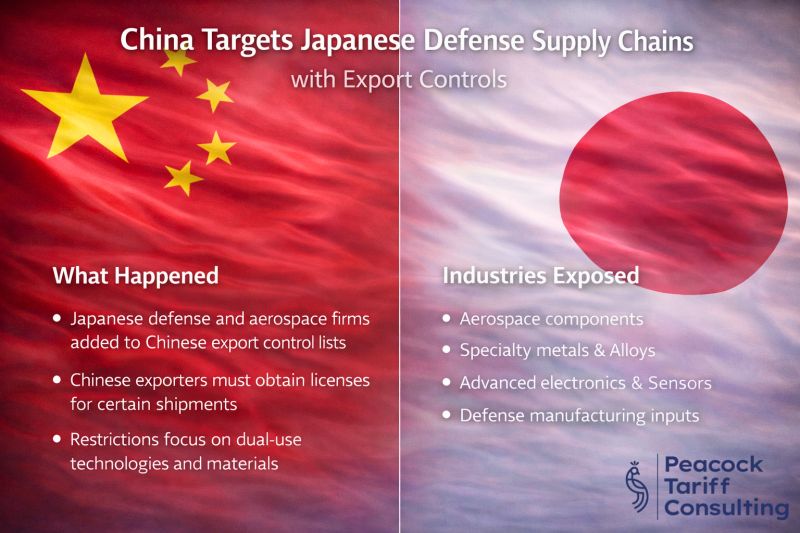
The Recent Chinese Export Control Actions In a significant escalation of trade tensions between China and Japan, Beijing has imposed targeted export controls on dozens of Japanese companies with defense and aerospace industry connections. These restrictions represent more than a simple tariff dispute-they signal a fundamental shift toward using supply chain weaponization as a primary…
-
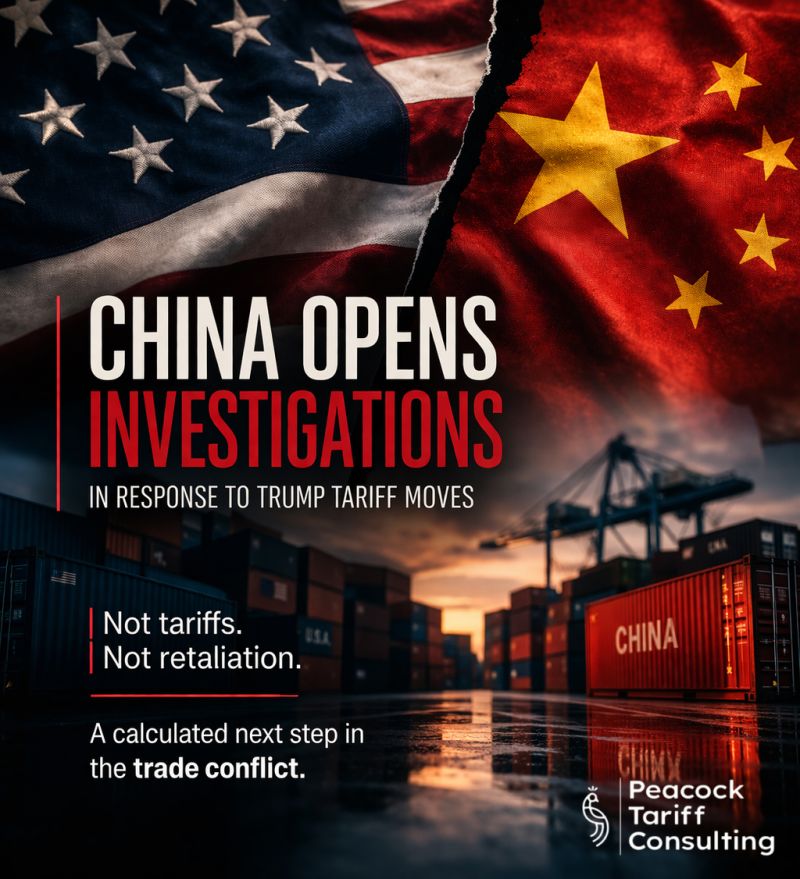
Introduction: A Shift from Escalation to Structure The global trade landscape has entered a new phase. Rather than responding to U.S. trade actions with immediate tariff retaliation, China has chosen a more deliberate path: opening formal investigations into American trade practices. This strategic decision signals a fundamental shift in how trade tensions are being managed-from…
-

The global surge in artificial intelligence development has triggered one of the most significant supply crunches the semiconductor industry has ever faced. As companies race to build larger, more capable AI models, the demand for high‑performance memory chips has skyrocketed far beyond what manufacturers can currently supply. High‑bandwidth memory (HBM), DRAM, and NAND flash once…
-

Author: Maria Pechurina, Director of International Trade It is Tuesday, November 4th, and the 100% tariff on China we so feared (did we, though, after so many empty threats?) is nowhere to be seen. The internet is exploding with images of President Trump decked out in CCP gear and saluting Chairman Xi, with the recent…