
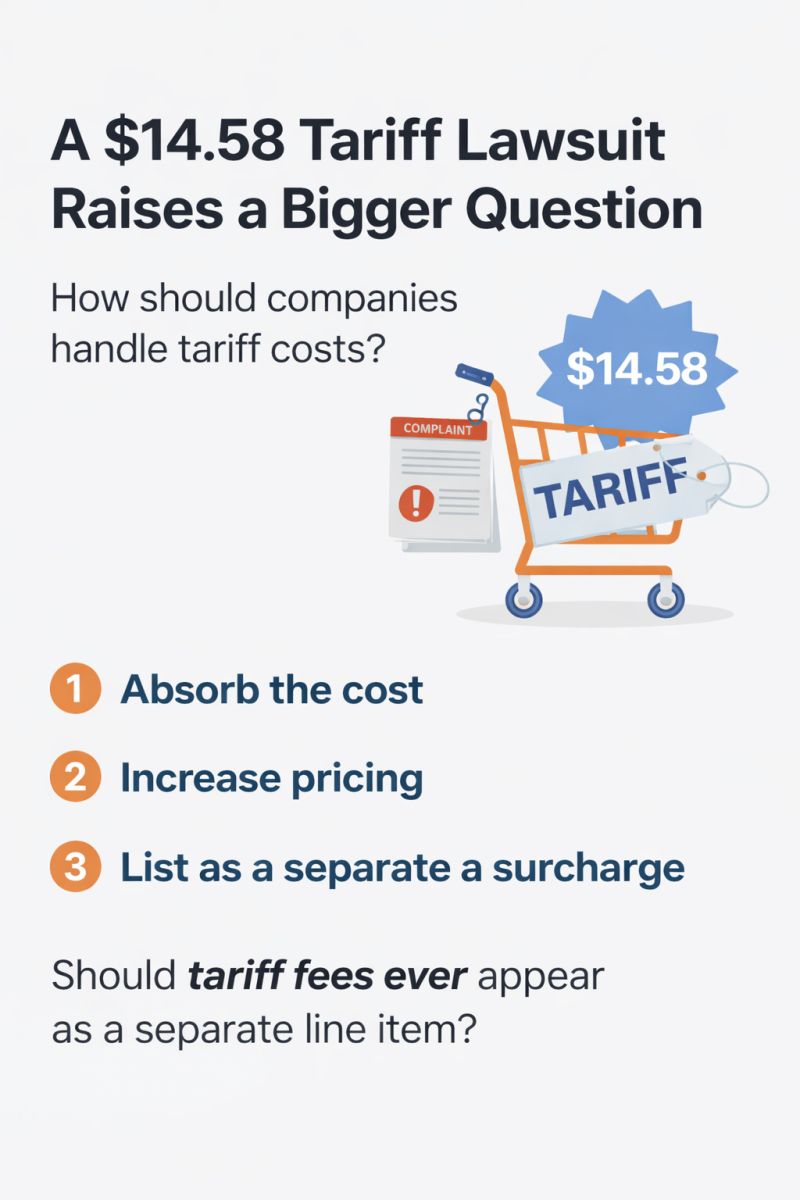
The Fabletics Case: $14.58 in Tariffs and a Significant Legal Question
A consumer lawsuit against Fabletics began as a seemingly modest dispute over tariff charges on three purchases totaling $14.58 in tariff costs. On the surface, the dollar amounts are small. However, the legal issues raised in the case are substantial and carry implications extending to retailers across multiple industries. The lawsuit alleges that Fabletics charged unlawful IEEPA tariffs to consumers and that the manner in which these charges were displayed and processed violated consumer protection laws.
The facts of the case appear straightforward: a customer made purchases from Fabletics during a period when the company was subject to IEEPA tariffs on goods it imported. Rather than absorbing the tariff costs internally, Fabletics passed them through to consumers as separate line items in transactions. The customer claims that the presentation of these charges violated consumer protection statutes by misrepresenting the nature of the fees, suggesting they were government levies being assessed directly by the government rather than costs being imposed and collected by Fabletics.
The case highlights a tension at the intersection of trade policy and consumer protection law. Tariffs are government actions that increase the cost of imported goods. But when companies pass tariffs through to consumers, questions arise about disclosure, transparency, and the accuracy of how charges are presented at checkout. These questions have implications for any company that imports goods and faces decisions about how to handle tariff costs in their pricing and checkout processes.
How Companies Handle Tariff Costs: Three Approaches with Different Implications
When tariffs increase the cost of imported goods, companies face a fundamental business decision: how to address the increased costs. There are three primary approaches, each with distinct financial, operational, and legal implications.
First, companies can absorb the tariff costs internally and take the resulting margin hit. Under this approach, the product price to the consumer remains unchanged. The tariff acts as an additional cost of goods sold, reducing gross margin on the product. This approach is common for companies with significant pricing flexibility or for whom the tariff impact is manageable relative to total product margins. The advantage is simplicity and no customer-facing tariff disclosures. The disadvantage is that it directly reduces profitability per unit sold.
Second, companies can increase product pricing to pass through tariff costs while maintaining previous margin percentages. This approach raises the price of affected products, which is visible to consumers. The tariff cost is embedded in the final product price as part of the cost of goods sold. From a business perspective, this approach maintains margins but may reduce volume if customers are price-sensitive. From a legal perspective, this approach typically does not raise consumer protection concerns because there are no separate tariff disclosures.
Third, companies can display tariff costs as separate line items or surcharges at checkout. This approach itemizes tariff costs as distinct from the product price, allowing the product price to appear unchanged while a separate tariff or duty charge is shown. This provides transparency to the consumer about the source of increased costs. However, it creates a separate disclosure decision about how to characterize and present the charge to the consumer.
Disclosure, Transparency, and Consumer Protection Law: The Legal Gray Areas
The legal question raised by the Fabletics lawsuit centers on disclosure and consumer protection. The FTC and state attorneys general enforce consumer protection laws that prohibit unfair and deceptive practices in commerce. These laws require that material information about products and charges be disclosed clearly and truthfully.
If a company presents a tariff charge at checkout in a way that suggests it is a government fee being assessed directly to the consumer by the government, that could constitute a deceptive practice. A charge labeled as ‘Government Import Duty’ or ‘U.S. Tariff Fee’ might mislead consumers into believing the government is directly assessing the fee against them, when in fact the company is the party collecting and retaining the charge.
However, if a company clearly discloses that the charge is a tariff cost associated with the product being imported, and the disclosure accurately represents the nature of the charge, transparency may be sufficient to avoid legal liability. The distinction between a deceptive presentation and a clear disclosure is fact-dependent.
The Fabletics case will test the boundaries of these principles. The alleged violation is not that tariffs themselves were unlawful. Tariffs were lawfully imposed by the government under IEEPA authority. Rather, the violation alleged is how the tariff was presented to the consumer. This distinction is important: the lawfulness of the tariff is separate from the lawfulness of how the cost was disclosed to the customer.
The Business Decision: Whether Tariff Costs Should Ever Appear as Line Items
The Fabletics litigation raises a broader business question that many retailers have grappled with: should tariff costs ever appear as separate line items at checkout? Or should they always be embedded into product pricing like any other cost of doing business?
There are reasonable arguments on both sides. The transparency argument supports showing tariff charges separately. Consumers can see the actual cost of the product versus the tariff impact, providing clarity about what they are paying for. In a world of increased consumer awareness about supply chain costs, some consumers appreciate this transparency and want to understand the full cost structure of their purchases.
The simplicity and clarity argument supports embedding tariff costs into product pricing. Most consumers do not expect to see government tariffs itemized at checkout. They expect to see a product price and then applicable taxes (sales tax). Showing a tariff as a separate line item may confuse consumers or create the impression of excessive charges. From a legal perspective, embedding costs into product pricing is less likely to create consumer protection exposure because there are no separate disclosures to scrutinize.
From a practical business perspective, embedding tariff costs into product pricing is simpler and less likely to generate consumer complaints or legal claims. Companies that clearly understand this risk have largely moved away from itemizing tariffs separately at checkout. However, some companies may not yet have adjusted their checkout processes, creating ongoing exposure.
Implications for Retailers and Importers: Managing Tariff Cost Passthrough
Retailers and importers should examine their current checkout and pricing practices to identify any potential consumer protection exposure related to tariff costs. Specifically, review how tariff charges are presented to consumers, what labels or descriptions are used, and whether the presentation could be misunderstood.
If your company is currently displaying tariffs as separate line items at checkout, consider whether you need to adjust your practices. Options include eliminating the separate tariff line item and embedding the cost into product pricing, or redesigning the disclosure to clearly and unambiguously explain that the charge is a cost being assessed by the company due to government tariffs, not a government fee being charged directly to the consumer.
Companies should also consider whether their checkout disclosure language could be misunderstood. Avoid language that could suggest the government is directly assessing fees against the consumer. Phrases like ‘government tariff fee’ or ‘tariff assessment’ could create this impression. Clearer language might be ‘tariff cost surcharge’ or ‘import tariff adjustment,’ though even these could be misunderstood depending on context.
For companies with significant tariff exposure, the value proposition of separate line item disclosure may not be worth the legal exposure. The cost of addressing a consumer protection claim or regulatory inquiry from an attorney general office far exceeds the benefit of providing transparent tariff information. Most companies have decided that embedding tariff costs into product pricing is the safer approach.
Additionally, companies should ensure that any tariff-related price increases are justified and reasonable. If a company significantly over-charges relative to actual tariff costs as a way to increase margins under the guise of tariff passthrough, that could expose the company to fraud or deceptive practice claims. Tariff costs should be passed through accurately, not used as a pretext for margin expansion.
- Review current checkout practices for tariff disclosure
- Consider eliminating separate tariff line items and embedding costs in pricing
- Use clear language that cannot be misunderstood as government assessment
- Ensure tariff costs are passed through accurately without margin expansion
The Broader Lesson: Cost Passthrough and Transparency Challenges
The Fabletics case illustrates a broader challenge companies face when major cost structures change. When tariffs increase suddenly, companies must decide how to handle the increased costs. The options-absorbing costs, raising prices, or charging surcharges-all have tradeoffs in terms of financial impact, customer relationships, and legal risk.
Consumer protection laws create constraints on how companies can present costs to customers. Even if tariff costs are real and legally justified, the manner in which they are disclosed can create legal exposure. This is true not only for tariffs but for any significant cost increase. Companies must balance transparency with simplicity and legal risk.
The lesson for business is that while transparency is generally a good principle, there are limits to how much detailed cost information consumers expect or want to see at checkout. Most consumers prefer simplicity: a product price and a tax. Anything beyond that requires careful thought about disclosure to avoid creating confusion or legal exposure.
Companies that have adapted to this reality have generally moved toward embedding increased costs into product pricing rather than showing them separately. This approach is simpler, reduces customer complaints, and reduces legal risk, even if it is less transparent.
Looking Forward: Litigation Outcomes and Industry Practice Evolution
The Fabletics case will likely result in settlement or judicial decision within the next 1-3 years. Depending on the outcome, it may influence industry practices around tariff disclosure. If the court finds that Fabletics’s presentation was deceptive, it will provide guidance to other retailers about acceptable versus unacceptable disclosure practices.
However, regardless of the Fabletics outcome, the broader trend in retail is toward embedding tariff costs and other supply chain costs into product pricing rather than displaying them separately. This approach has become industry standard because it reduces complexity, improves customer experience, and minimizes legal exposure.
Companies should use the Fabletics case as an opportunity to examine their own practices and ensure they are not creating unnecessary legal exposure through tariff disclosure practices. The cost of adjusting checkout processes and pricing strategies is minimal compared to the potential cost of defending a consumer protection claim.
Finally, companies should recognize that while tariff passthrough is economically justified, the manner in which it is communicated to customers matters. Even justified costs can create legal exposure if not disclosed appropriately. Taking the time to design clear, legally sound disclosure practices is an investment in both customer relationships and legal protection.