
A Moment for Canadian SMEs
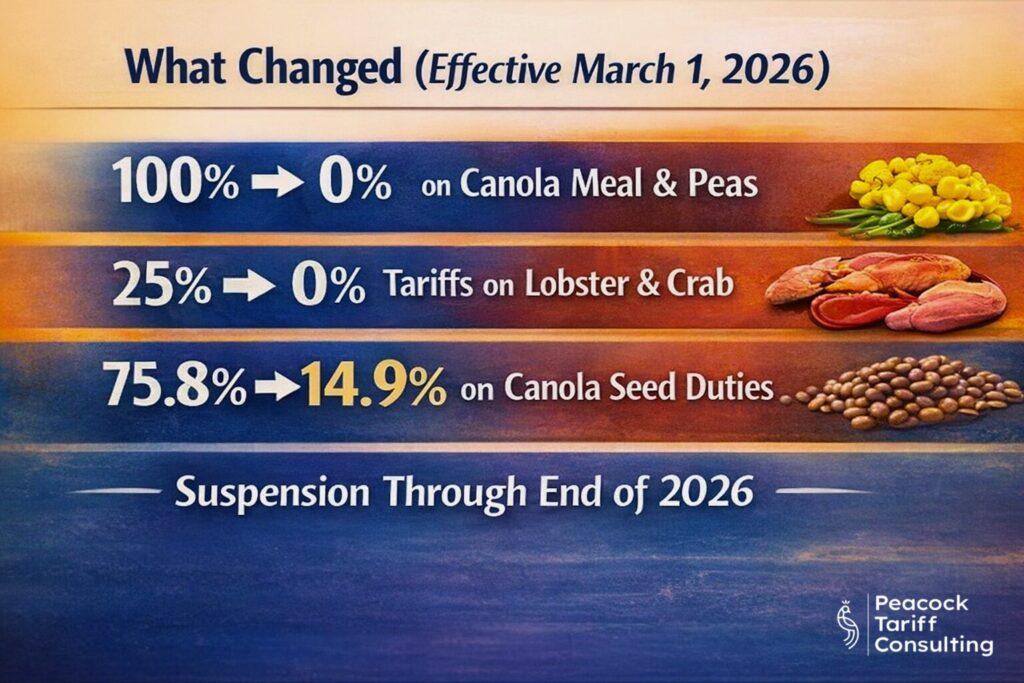
China’s decision to suspend major agricultural tariffs on Canadian exports marks one of the most consequential shifts in Canada–China trade relations in years. Beginning March 1, 2026, China will suspend:
- 100% tariffs on Canadian canola meal and peas
- 25% tariffs on lobster and crab
These suspensions will remain in effect through the end of 2026.
In parallel, China has sharply reduced the anti‑dumping duty on canola seed from 75.8% to 5.9%, with the standard 9% tariff bringing the combined rate to 14.9%.
This shift reopens a market that had been constrained since the bilateral trade dispute escalated in 2025. China was Canada’s second‑largest canola market in 2024, and the suspension restores access to a buyer base that consumes massive volumes of canola meal, peas, and seafood.
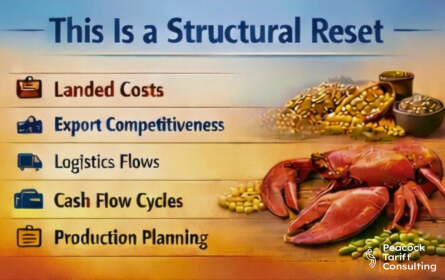
For Canadian SMEs, this is not a policy change it is a structural reset that directly affects:
- landed costs
- export competitiveness
- logistics flows
- contract structures
- cash flow
- production planning
- market access
- long‑term growth strategy
This article provides a deep operational analysis of what the tariff suspension means for SMEs, how they can capitalize immediately, and what risks and opportunities lie ahead.
What Changed: The Tariff Suspension and Its Mechanism
The Tariff Suspension Itself
China’s finance ministry confirmed that beginning March 1:
- 100% surcharges on Canadian canola meal and peas will be suspended
- 25% tariffs on lobster and crab will be suspended
- The suspension will last until the end of 2026
These tariffs were originally imposed during a trade dispute and had effectively shut down major export channels.
The Canola Seed Breakthrough
The most economically significant change is the reduction of the anti‑dumping duty on canola seed:
- Reduced from 75.8% to 5.9%
- Combined with the standard 9% tariff, the total is 14.9%
- This aligns with Canada’s expectation of a ~15% final rate
This reduction follows a 17‑month anti‑dumping investigation and restores competitiveness for Canadian seed exporters.
The EV‑for‑Agriculture Linkage
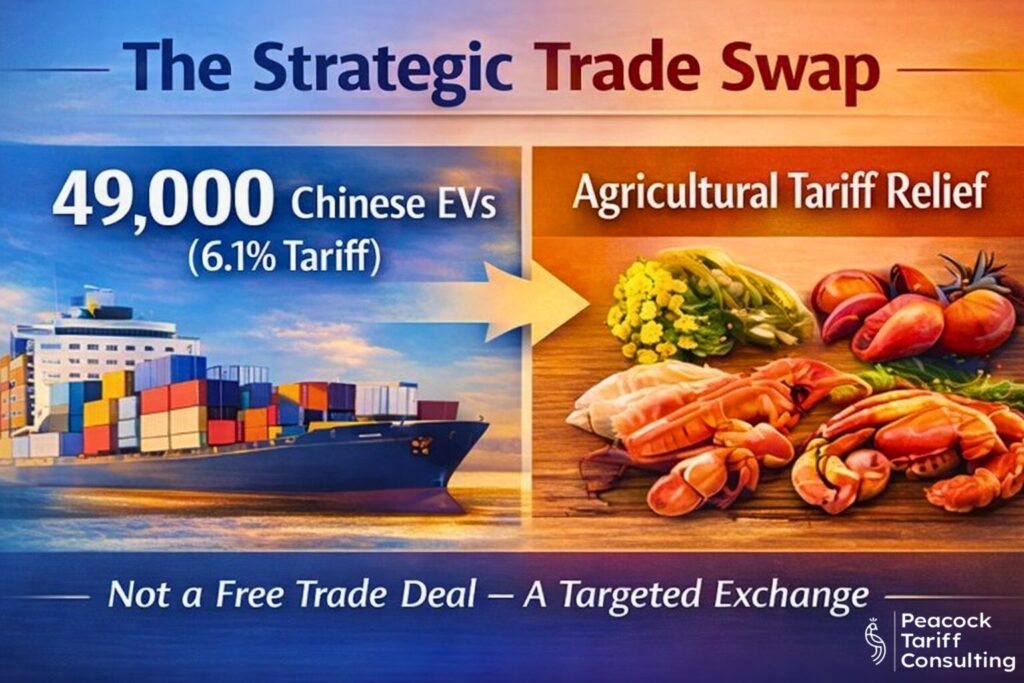
These tariff changes did not occur in isolation. During a January visit to Beijing, Prime Minister Mark Carney negotiated a package deal:
- Canada will allow up to 49,000 Chinese electric vehicles (EVs) annually at a 6.1% MFN tariff
- In exchange, China agreed to suspend agricultural tariffs and reduce canola seed duties
This is not a free‑trade agreement it is a sector‑specific reciprocal arrangement.
Implementation Timeline
- March 1, 2026: Tariff suspensions take effect
- March 9, 2026: Anti‑dumping investigation formally concludes
- End of 2026: Suspension window ends unless extended
Why This Matters for SMEs: The Structural Impact
The tariff suspension disproportionately benefits SMEs because tariff barriers disproportionately harm smaller firms. SMEs typically lack:
- the margin flexibility of large exporters
- the ability to hedge commodity risk
- the capital to absorb tariff‑inflated landed costs
- the scale to reroute shipments to alternative markets
The reopening of China’s market therefore creates outsized opportunities for SMEs across agriculture, seafood, logistics, and value‑added processing.
Sector‑by‑Sector SME Impact Analysis
Agriculture and Crop Producers -Canola Meal and Peas
The suspension of 100% tariffs immediately restores access to China’s high‑volume feed and food markets. SMEs benefit through:
- renewed purchase orders
- restored long‑term contracts
- predictable shipping cycles
- higher price realization compared to domestic markets
China’s fishery sector relies heavily on rapeseed meal for feed, and disruptions had pressured domestic supply chains.
Canola Seed
The reduction of canola seed duties to 14.9% is transformative:
- Canadian seed becomes price‑competitive again
- SMEs can re‑enter a market valued at $4 billion annually for Canadian producers
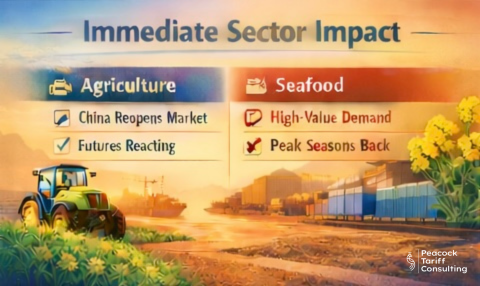
- Futures markets have already reacted positively, with canola futures rising after Carney’s visit as Chinese buyers began booking cargoes
This creates immediate opportunities for SMEs to lock in multi‑year supply agreements.
Seafood Harvesters and Processors – Lobster and Crab
The suspension of 25% tariffs restores access to China’s premium seafood market:
- Chinese buyers pay premium prices for Canadian lobster and crab
- SMEs regain access to peak‑demand periods (Lunar New Year, Golden Week)
- Coastal economies stabilize as export cycles normalize
Many seafood exporters are family‑run SMEs that rely heavily on Chinese demand.
Logistics, Cold‑Chain, and Export Services – Freight Forwarders
As agricultural shipments resume, freight forwarders benefit from:
- increased export volumes
- more predictable container flows
- improved route planning
Cold‑Chain Operators
Seafood and canola meal exports require temperature‑controlled logistics. SMEs in cold‑chain services see:
- higher utilization
- more consistent demand
- opportunities to expand capacity
Customs Brokers and Export Compliance Firms
The tariff suspension increases demand for:
- export documentation
- compliance reviews
- classification corrections
- landed‑cost modelling
SMEs often outsource these functions, creating new business for service providers.
Value‑Added Processors – Canola Crushing and Processing
With tariffs suspended and seed duties reduced, SMEs can:
- scale crushing operations
- expand into specialty oils
- produce higher‑margin processed goods
Pea Protein and Plant‑Based Processing
Pea tariffs were a major barrier for plant‑protein SMEs. With tariffs suspended:
- pea protein becomes competitive again
- SMEs can re‑enter China’s growing plant‑based market
- long‑term supply agreements become viable
Financial and Pricing Impacts – Futures and Market Confidence
Canola futures rose after Carney’s visit as markets anticipated tariff relief, reflecting renewed confidence in the sector.
SME Financing
With reduced risk:
- lenders offer better terms
- SMEs gain access to working capital
- expansion projects become financeable
EV‑Linked Spillover Opportunities – EV Infrastructure and Services
Because the tariff suspension is tied to EV imports, SMEs in:
- charging infrastructure
- parts distribution
- aftermarket services
- logistics for EV imports
They can position themselves early in a growing supply chain.
Operational Impacts for SMEs
The suspension of China’s agricultural tariffs and the reduction of canola seed duties reshape the operational landscape for Canadian SMEs across agriculture, seafood, logistics, and processing. These changes are not abstract policy shifts they directly influence production planning, cost structures, inventory cycles, and export readiness.
Production Planning and Capacity Utilization – Stabilized Demand Signals
With China suspending 100% tariffs on canola meal and peas and 25% tariffs on lobster and crab starting March 1 and running through the end of 2026, SMEs regain access to predictable demand cycles. This matters because:
- SMEs can plan production volumes with greater confidence.
- Seasonal cycles (e.g., seafood harvests, canola crushing windows) can be aligned with Chinese buying patterns.
- Inventory risk decreases as export channels reopen.
Increased Throughput for Processors
Processors of canola meal, pea protein, and seafood can now operate closer to full capacity. Before the tariff suspension, many SMEs were forced to scale back operations or divert product to lower‑margin markets. With tariffs lifted, SMEs can:
- Increase throughput without fear of oversupply.
- Reopen idle processing lines.
- Rehire seasonal labour with confidence.
Cost Structure Improvements – Lower Landed Costs
The suspension of punitive tariffs directly reduces landed costs for Chinese buyers, making Canadian goods competitive again. China’s finance ministry confirmed that these tariffs “will not be imposed” through 2026. Lower landed costs mean:
- SMEs can quote more competitive prices.
- Chinese buyers are more willing to sign long‑term contracts.
- SMEs can regain market share lost during the dispute.
Reduced Compliance and Workaround Costs
During the dispute, SMEs often incurred additional costs:
- rerouting shipments through intermediary markets
- repackaging or relabeling to meet alternative market requirements
- absorbing tariff‑inflated costs to maintain buyer relationships
With tariffs suspended, these workaround costs disappear.
Inventory and Supply Chain Planning – Predictable Export Cycles
The tariff suspension restores predictable export cycles for:
- canola meal
- peas
- lobster
- crab
This predictability allows SMEs to:
- reduce storage costs
- optimize cold‑chain utilization
- plan harvest and processing schedules more efficiently
Reduced Inventory Carrying Costs
With China’s market reopened, SMEs no longer need to hold excess inventory while waiting for alternative buyers. This reduces:
- spoilage risk (especially for seafood)
- financing costs
- warehouse fees
Contracting and Buyer Engagement – Renewed Chinese Buyer Activity
Chinese buyers have already begun booking Canadian canola cargoes in anticipation of tariff relief, according to Reuters and CBC reporting. This early activity signals:
- strong demand
- buyer confidence in the tariff suspension
- willingness to negotiate multi‑month or multi‑year contracts
Improved Negotiating Position for SMEs
With tariffs suspended and duties reduced, SMEs can negotiate:
- better pricing
- longer contract durations
- more favourable payment terms
- volume commitments
Cash Flow and Financing – Improved Access to Working Capital
Lenders view tariff‑free markets as lower risk. With China suspending tariffs and reducing canola seed duties to 14.9% total, SMEs can expect:
- improved credit terms
- lower interest rates
- easier access to operating loans
Faster Inventory Turnover
With China’s market reopened, SMEs can move product faster, improving:
- cash conversion cycles
- liquidity
- reinvestment capacity
Logistics, Routing, and Export Readiness
The tariff suspension has immediate implications for logistics providers, cold‑chain operators, freight forwarders, and customs brokers.
Freight Forwarding and Container Flows – Increased Outbound Volume
As China suspends tariffs on canola meal, peas, lobster, and crab, freight forwarders will see:
- increased container bookings
- more consistent outbound flows
- reduced volatility in shipping schedules
Improved Route Optimization
With China back as a primary destination, SMEs can:
- consolidate shipments more efficiently
- negotiate better freight rates
- reduce transit times
Cold‑Chain Logistics – Higher Utilization Rates
Seafood exports rely heavily on cold‑chain infrastructure. With tariffs suspended, cold‑chain operators benefit from:
- higher utilization
- more predictable demand
- opportunities to expand capacity
Reduced Spoilage and Waste
Predictable export cycles reduce spoilage risk, especially for:
- live lobster
- fresh crab
- frozen seafood products
Customs and Export Compliance – Increased Demand for Documentation Services
SMEs will require:
- export declarations
- certificates of origin
- phytosanitary documentation
- tariff classification reviews
Reduced Risk of Shipment Delays
With tariffs suspended, customs clearance becomes more straightforward, reducing:
- inspection delays
- reclassification disputes
- administrative burdens
SME Market Re‑Entry Strategies for China
This section provides practical, step‑by‑step strategies SMEs can use to re‑enter the Chinese market effectively.
Re‑Establishing Buyer Relationships – Contacting Previous Buyers
SMEs should immediately reconnect with:
- distributors
- importers
- processors
- wholesalers
Many Chinese buyers paused purchases due to tariffs but are now ready to resume.
Highlighting Competitive Pricing
With tariffs suspended and canola seed duties reduced, SMEs can offer:
- lower landed costs
- improved margins for Chinese buyers
- more competitive pricing than alternative suppliers
Updating Pricing Models – Incorporating Tariff Reductions
SMEs must update pricing models to reflect:
- 100% tariff suspension on canola meal and peas
- 25% tariff suspension on lobster and crab
- canola seed duties reduced to 14.9% total
Offering Volume Discounts
With demand rising, SMEs can negotiate:
- volume‑based pricing
- long‑term supply agreements
- seasonal contracts
Strengthening Logistics Partnerships – Securing Freight Capacity Early
As export volumes rise, SMEs should:
- lock in freight contracts early
- negotiate multi‑shipment agreements
- secure cold‑chain capacity
Building Redundancy
SMEs should diversify logistics partners to avoid:
- bottlenecks
- capacity shortages
- single‑point failures
Enhancing Export Readiness – Documentation and Compliance
SMEs must ensure:
- accurate HS codes
- complete export documentation
- compliance with Chinese import regulations
Quality Assurance
Chinese buyers expect:
- consistent quality
- reliable packaging
- adherence to food safety standards
Sector‑Specific Opportunity Maps for Canadian SMEs
The suspension of China’s agricultural tariffs and the reduction of canola seed duties create distinct, sector‑specific opportunity windows for SMEs across Canada. These opportunities differ by product, region, and supply‑chain position and SMEs that move early will secure the most favourable contracts, logistics capacity, and financing terms.
Canola Sector Opportunities
China’s suspension of 100% tariffs on canola meal and its reduction of canola seed duties to 14.9% total (5.9% anti‑dumping + 9% standard tariff) unlocks the single largest opportunity for Canadian SMEs in agriculture.
Canola Meal Exporters
SMEs producing canola meal can now:
- Re‑enter China’s feed market, which had been constrained since punitive tariffs were imposed.
- Restore multi‑year supply agreements with Chinese feed processors.
- Increase crushing throughput to meet renewed demand.
China’s fishery sector which relies heavily on rapeseed meal for shrimp, crab, and carp feed had been under pressure due to disrupted imports. This creates immediate demand for Canadian supply.
Canola Seed Producers
The reduction of canola seed duties from 75.8% to 5.9% (plus 9% standard tariff) is transformative.
SMEs can now:
- Compete directly with Australian and European suppliers.
- Lock in long‑term contracts with Chinese crushers.
- Expand acreage and production planning with confidence.
Chinese buyers have already begun booking Canadian canola cargoes for March, signalling strong demand and confidence in the tariff reduction.
Canola Processors
Processors can now:
- Increase crushing volumes.
- Expand into specialty oils and higher‑margin products.
- Reopen idle processing lines.
Pea Sector Opportunities
China’s suspension of 100% tariffs on peas reopens a critical market for:
- pea protein processors
- whole‑pea exporters
- plant‑based food manufacturers
SMEs in this sector can now:
- Re‑enter China’s rapidly growing plant‑protein market.
- Offer competitive pricing due to lower landed costs.
- Secure multi‑year supply agreements with Chinese food manufacturers.
The suspension runs through end of 2026, giving SMEs a two‑year window to rebuild market share.
Seafood Sector Opportunities
China’s suspension of 25% tariffs on lobster and crab restores access to one of the world’s most lucrative seafood markets.
Lobster Exporters
SMEs can now:
- Re‑enter China’s premium live‑lobster market.
- Capture peak‑demand periods (Lunar New Year, Golden Week).
- Command higher prices than domestic or U.S. buyers.
Crab Exporters
Crab exporters many of which are family‑run SMEs benefit from:
- restored access to high‑margin Chinese buyers
- predictable seasonal demand
- reduced cold‑chain risk
Logistics and Export Services Opportunities
The tariff suspension increases demand for:
- freight forwarding
- cold‑chain logistics
- customs brokerage
- export compliance services
Freight Forwarders
With China suspending tariffs on canola meal, peas, lobster, and crab, outbound container volumes will rise.
SMEs in freight forwarding can:
- negotiate better rates with carriers
- secure long‑term contracts with exporters
- expand service offerings to include China‑specific routing
Cold‑Chain Operators
Seafood exports require temperature‑controlled logistics. SMEs in cold‑chain services can:
- increase utilization
- expand capacity
- reduce spoilage risk
Customs Brokers
SMEs will need:
- updated HS classifications
- export declarations
- certificates of origin
- phytosanitary documentation
This creates new business for brokers and compliance firms.
EV‑Linked Supply Chain Opportunities
The tariff suspension is tied to Canada allowing up to 49,000 Chinese EVs annually at a 6.1% tariff.
This creates opportunities for SMEs in:
- EV charging infrastructure
- parts distribution
- aftermarket services
- logistics for EV imports
SMEs in manufacturing, warehousing, and services can position themselves early in this growing supply chain.
Risk Scenarios Through 2026
While the tariff suspension creates major opportunities, SMEs must also prepare for risks.
Policy Reversal Risk
The suspension runs only until end of 2026.
Risks include:
- China reinstating tariffs after 2026
- Canada adjusting EV import quotas
- geopolitical tensions affecting trade
SMEs should avoid over‑reliance on a single market.
Commodity Price Volatility
Canola futures rose after Carney’s visit as Chinese buyers began booking cargoes.
SMEs must prepare for:
- price swings
- currency fluctuations
- supply‑chain disruptions
Logistics Bottlenecks
As export volumes rise, risks include:
- container shortages
- cold‑chain capacity constraints
- port congestion
SMEs should secure logistics contracts early.
Incomplete Tariff Coverage
China’s announcement did not include:
- canola oil
- pork
These remain priorities for provincial governments.
Provincial Impact Analysis
Different provinces will experience different benefits from the tariff suspension.
Saskatchewan
Saskatchewan is Canada’s largest canola‑producing province. Premier Scott Moe called the tariff suspension a “very significant decision” and expects exports to return to normal.
SMEs in Saskatchewan benefit from:
- increased canola seed demand
- restored access to China’s feed market
- improved futures pricing
Manitoba
Manitoba Premier Wab Kinew emphasized the importance of canola to the province and expressed hope for future progress on pork tariffs.
SMEs benefit from:
- increased canola exports
- improved processing margins
- potential future pork opportunities
Atlantic Canada
Atlantic provinces benefit from the suspension of 25% tariffs on lobster and crab.
SMEs in this region gain:
- restored access to China’s premium seafood market
- higher price realization
- stabilized coastal economies
Alberta and British Columbia
These provinces benefit from:
- increased canola meal and seed exports
- expanded logistics and port activity
- opportunities in EV‑linked supply chains
How Peacock Tariff Consulting Supports SMEs
Canadian SMEs are entering a rare window of opportunity. China’s suspension of 100% tariffs on canola meal and peas and 25% tariffs on lobster and crab through the end of 2026 , combined with the reduction of canola seed duties to 14.9% total (5.9% anti‑dumping + 9% standard tariff) after a 17‑month investigation , creates a landscape where SMEs can grow faster than at any time since before the trade dispute.
But SMEs face real constraints:
- limited compliance capacity
- limited in‑house tariff expertise
- limited ability to model landed costs
- limited bandwidth to re‑enter China strategically
- limited logistics leverage
- limited ability to negotiate long‑term contracts
This is where Peacock Tariff Consulting becomes essential.
Tariff Classification, Compliance, and Documentation
SMEs must ensure their HS codes, certificates of origin, and export documentation are correct. China’s tariff suspension applies only to specific product categories:
- canola meal
- peas
- lobster
- crab
Incorrect classification can result in:
- delays
- rejections
- unexpected duties
- lost contracts
Peacock Tariff Consulting provides:
- audit‑ready HS classification
- documentation packages aligned with CBSA and Chinese customs
- tariff‑eligibility verification
- compliance risk assessments
This ensures SMEs fully benefit from the tariff suspension and avoid costly errors.
Landed‑Cost Modelling and Pricing Strategy
With tariffs suspended and canola seed duties reduced, SMEs must update pricing models. China’s finance ministry confirmed that the punitive rates “will not be imposed” through 2026.
Peacock Tariff Consulting builds:
- landed‑cost calculators
- margin‑protection models
- pricing templates for Chinese buyers
- futures‑linked pricing strategies
This allows SMEs to quote competitive prices while protecting profitability.
China Market Re‑Entry Playbooks
SMEs need more than tariff relief they need a plan.
Peacock Tariff Consulting develops:
- buyer‑engagement scripts
- negotiation frameworks
- contract templates
- export‑readiness checklists
- logistics routing strategies
These playbooks help SMEs reconnect with Chinese buyers who have already begun booking Canadian canola cargoes in anticipation of tariff relief.
Logistics and Cold‑Chain Optimization
With China suspending tariffs on canola meal, peas, lobster, and crab, logistics demand will surge.
Peacock Tariff Consulting supports SMEs by:
- securing freight capacity
- negotiating cold‑chain contracts
- optimizing container routing
- building redundancy into logistics plans
This ensures SMEs avoid bottlenecks as export volumes rise.
Risk Management and Scenario Planning
The tariff suspension runs only until end of 2026. China’s announcement made no mention of canola oil or pork, and future adjustments remain uncertain.
Peacock Tariff Consulting provides:
- risk‑scenario modelling
- diversification strategies
- contingency planning
- contract clauses that protect SMEs if tariffs return
This helps SMEs grow aggressively while managing exposure.
EV‑Linked Supply Chain Advisory
The tariff suspension is tied to Canada allowing up to 49,000 Chinese EVs annually at a 6.1% tariff.
Peacock Tariff Consulting helps SMEs identify opportunities in:
- EV charging infrastructure
- parts distribution
- aftermarket services
- logistics for EV imports
This positions SMEs to benefit from both sides of the trade package.
SME Action Roadmap for 2026
Immediate Actions (Next 30 Days)
- Reconnect with Chinese buyers.
- Update pricing models to reflect tariff suspensions.
- Secure freight and cold‑chain capacity.
- Review HS classifications and export documentation.
- Conduct a landed‑cost analysis for each product line.
Short‑Term Actions (Next 90 Days)
- Negotiate long‑term supply agreements.
- Expand production planning for canola, peas, and seafood.
- Reopen idle processing lines where feasible.
- Build redundancy into logistics networks.
- Conduct a compliance audit to ensure tariff eligibility.
Medium‑Term Actions (6–12 Months)
- Invest in capacity expansion (processing, cold‑chain, storage).
- Explore EV‑linked supply chain opportunities.
- Diversify buyer portfolios within China.
- Strengthen relationships with freight forwarders and brokers.
- Implement futures‑linked pricing strategies.
Long‑Term Actions (Through End of 2026)
- Lock in multi‑year contracts before tariff uncertainty returns.
- Build China‑specific product lines (packaging, specifications).
- Develop contingency plans for potential tariff reinstatement.
- Expand into value‑added processing (specialty oils, plant proteins).
- Position for post‑2026 market scenarios.
Final Strategic Outlook
China’s suspension of 100% tariffs on canola meal and peas and 25% tariffs on lobster and crab through 2026, combined with the reduction of canola seed duties to 14.9%, represents a rare alignment of policy, market demand, and geopolitical opportunity.
SMEs that move quickly will secure:
- long‑term contracts
- preferred‑supplier status
- logistics capacity
- financing advantages
- market share that will be difficult for competitors to reclaim
SMEs that delay will face:
- capacity shortages
- higher logistics costs
- crowded buyer markets
- reduced negotiating leverage
This is a two‑year window, and it will not last.