
The De Minimis Rule: What It Was and Why It Mattered
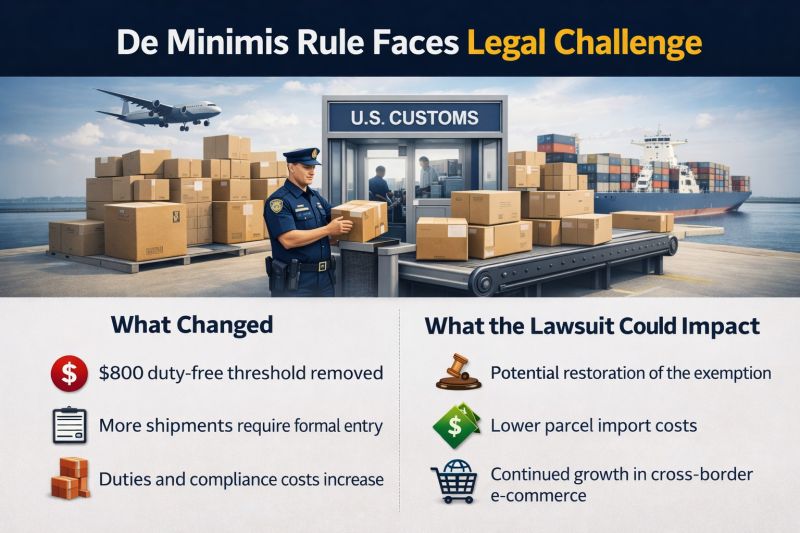
For decades, U.S. customs law included a de minimis import exemption that allowed goods with a total declared value of less than $800 to enter the United States duty-free and with minimal customs processing requirements. This seemingly technical trade policy created the foundation for one of the most significant transformations in global commerce over the past fifteen years: the direct-to-consumer cross-border e-commerce explosion.
The $800 threshold was transformative because it aligned with the economics of small parcel shipments. A typical package from an international seller-whether from China, Vietnam, or other manufacturing centers-fell well below this threshold. The combination of the duty exemption and simplified processing meant that shipping costs and regulatory compliance burdens were minimal. Sellers could offer low prices to American consumers because tariffs were eliminated and customs processing was streamlined.
The scope of de minimis trade was staggering. Millions of small parcels entered the United States daily under this exemption. E-commerce platforms like Shein, AliExpress, and Temu built their entire business models around this principle. Consumers could purchase inexpensive clothing, electronics, household goods, and countless other products directly from international sellers and have them delivered to their doors within days, often at prices that seemed impossibly low by American retail standards. The de minimis exemption was not merely a technical trade rule; it was the infrastructure enabling a revolution in how American consumers shopped.
Why the Government Suspended De Minimis: The Policy Rationale
The Trump administration suspended the de minimis exemption as part of broader trade enforcement efforts, and the Biden administration continued the suspension. The stated policy rationale centers on three concerns. First, the government expressed concern about tariff evasion. Importers could undervalue goods on customs declarations to keep declared values below the $800 threshold, thereby evading duties they would otherwise owe. The inability to inspect the vast volume of small parcels prevented effective monitoring of valuation accuracy.
Second, the government raised concerns about counterfeit goods and intellectual property infringement. Under the de minimis exemption, counterfeit luxury goods, knockoff designer products, and other infringing merchandise could flow into the U.S. market with minimal customs review. The low inspection rate meant that violative shipments frequently entered commerce without detection.
Third, the government cited security and public health concerns. Illicit drugs, precursor chemicals for drug manufacturing, and other dangerous substances were being shipped in small parcels and often escaped detection despite enforcement efforts. The volume of parcels was too large for meaningful inspection of a significant proportion.
From a trade policy perspective, the government’s position is defensible. The de minimis exemption was creating perverse incentives that undermined tariff policy, encouraged undervaluation, and provided avenues for illegal goods to enter the market. However, the suspension of the rule created immediate disruption to legitimate commerce because the exemption had become embedded in supply chain models for millions of transactions.
The Legal Challenge: Testing the Government’s Authority
A federal court has allowed a lawsuit to proceed that challenges the government’s authority to suspend the de minimis exemption. The legal theory centers on whether the President or executive branch agencies possess the statutory authority to eliminate a threshold established in law without congressional approval. This is a question of administrative law and statutory interpretation.
The lawsuit appears to argue that the de minimis threshold is established by statute and that eliminating it requires legislative action rather than executive order or regulatory change. If successful, this legal theory could require Congress to vote on de minimis policy, creating a different political dynamic than administrative action taken by executive agencies.
The litigation will likely proceed slowly. Federal court cases typically take years from filing to final judgment. During this period, the de minimis exemption remains suspended, and the practical impacts on supply chains continue. Businesses cannot reliably plan around a return to the $800 threshold given the legal uncertainty.
It is worth noting that even if the plaintiffs succeed in court, the victory may be temporary. Congress could legislatively reinstate the de minimis exemption if it chooses to do so, but it could also support the government’s suspension through legislation. The outcome of the lawsuit determines whether executive agencies can suspend the threshold unilaterally, but does not automatically return the threshold to $800.
Supply Chain Restructuring: The Forced Migration of Commerce Models
The suspension of the de minimis exemption is forcing a fundamental restructuring of how companies manage international supply chains and how e-commerce flows into the United States. Companies that built fulfillment models around the $800 threshold must now adapt to a different regulatory environment.
The most immediate impact falls on e-commerce retailers and dropshipping businesses that rely on direct shipment from international manufacturers to consumer addresses. Without the de minimis exemption, these shipments now require formal customs entries, duty payment, and associated customs processing. The compliance burden and cost structure of this model changes dramatically.
Many companies are responding by shifting inventory to U.S.-based warehouses and regional distribution hubs. Instead of shipping individual items directly from an international supplier to the consumer, companies import bulk inventory to a U.S. warehouse, and then distribute from that warehouse to consumers domestically. This model avoids the de minimis issue by consolidating shipments into fewer, higher-value entries that can be processed as bulk imports with lower per-unit compliance costs.
However, shifting to warehouse-based fulfillment requires capital investment, real estate commitments, and changes to supply chain infrastructure. Many smaller e-commerce businesses lack the resources to build these alternative models. For them, the loss of de minimis creates a competitive disadvantage against larger competitors with infrastructure to absorb the increased costs.
Tariff Classification and Duty Planning: Technical Challenges and Opportunities
Under the de minimis exemption, companies could ignore tariff classification. Anything under $800 entered duty-free regardless of product type or HTS classification. This simplified operations at the cost of losing visibility into what duties would apply if the de minimis exemption were not available.
Now that de minimis is suspended, companies must engage in detailed tariff classification and duty planning. Products must be properly classified using the Harmonized Tariff Schedule. Different product categories carry different duty rates, ranging from zero duty items to duties of 25 percent or higher depending on the product and country of origin. The classification and duty planning process is technical, time-consuming, and requires expertise.
However, this requirement creates opportunities for companies that can navigate tariff complexity effectively. By properly classifying products and understanding the duty impact of different sourcing choices, companies can optimize costs. For example, sourcing a product from Vietnam might result in lower duties than sourcing from China due to different trade agreement coverage. Alternatively, sourcing from a country with a free trade agreement with the U.S. might eliminate duties entirely.
Companies should invest in tariff expertise and classification knowledge. This might involve hiring customs specialists, engaging customs law firms for classification rulings, or using tariff management software. The investment in tariff expertise can translate to significant cost savings by ensuring proper classification and duty optimization.
Market Effects and Competitive Dynamics: Who Wins and Who Loses
The suspension of de minimis benefits large, established companies with sophisticated supply chains and the ability to invest in warehouse infrastructure and tariff expertise. Companies like Amazon have the resources to build distribution networks, manage tariff classifications, and absorb compliance costs as a fraction of their overall operations.
Smaller e-commerce businesses and dropshippers without significant capital face higher barriers. The cost of formal customs entries, tariff compliance, and distribution infrastructure may exceed the profit margins available on lower-priced items. Some businesses may exit the market entirely, unable to adapt to the new cost structure.
Interestingly, the suspension of de minimis may provide protection for domestic manufacturers and retailers. Products that previously competed on price advantage from eliminated tariffs now carry duty costs that narrow the price gap with domestic alternatives. A consumer choosing between a product imported under the new tariff regime and a domestically manufactured alternative may find the price difference less compelling than before.
The overall effect is likely to be consolidation in e-commerce, with larger players capturing market share from smaller competitors, and some increase in domestic manufacturing competitiveness as tariff disadvantages for imports become more meaningful. This represents a significant shift from the previous regime where de minimis created a level playing field favoring low-cost imports.
Strategic Planning for Companies Affected by De Minimis Suspension
Companies that depended on the de minimis exemption should evaluate several strategic options. First, assess whether restructuring to a warehouse-based fulfillment model is economically viable for your business. Calculate the cost of maintaining inventory in U.S. warehouses versus the tariff and compliance costs of direct shipments from international suppliers. For many businesses, warehouse-based fulfillment becomes economically superior despite increased capital requirements.
Second, engage tariff experts to classify your products and calculate duty costs under different sourcing scenarios. Understanding the actual duty impact of different import strategies allows you to make informed sourcing decisions. In some cases, diversifying sourcing across multiple countries with different tariff treatment can optimize overall duty costs.
Third, evaluate whether your products lend themselves to alternatives like manufacturing partnerships in tariff-advantaged locations or free-trade-agreement countries. Some companies have successfully shifted manufacturing to Mexico or other USMCA partner countries to reduce or eliminate tariffs. This may be viable for higher-value products with sufficient volume to justify the transition.
Fourth, monitor the legal challenge to de minimis suspension. If the court were to reinstate the exemption, it would change the cost calculus. However, do not assume that the exemption will be reinstated. Plan based on the current reality of suspension; if the legal landscape changes, you can adjust. Building business strategies around hoped-for legal outcomes is risky.
Finally, consider whether pricing adjustments are necessary. As import costs increase due to tariff exposure, maintaining previous price points may no longer be economically viable. Some companies may need to increase prices modestly, which may reduce volume but improves margins. Others may need to reduce product offerings to items with sufficient margin to absorb tariff costs. These decisions are company-specific and depend on competitive dynamics and price elasticity in your markets.