
The Jones Act Under Pressure: Background and Current Policy Debate
The Jones Act, formally known as the Merchant Marine Act of 1920, has governed domestic maritime commerce in the United States for over a century. The act mandates that cargo moving between U.S. ports must be transported aboard vessels that are American-built, American-flagged, and crewed by U.S. citizens. While designed initially to protect a domestic maritime industry essential to national defense, the Jones Act has become increasingly controversial as it creates significant cost premiums on domestic shipping compared to international alternatives.
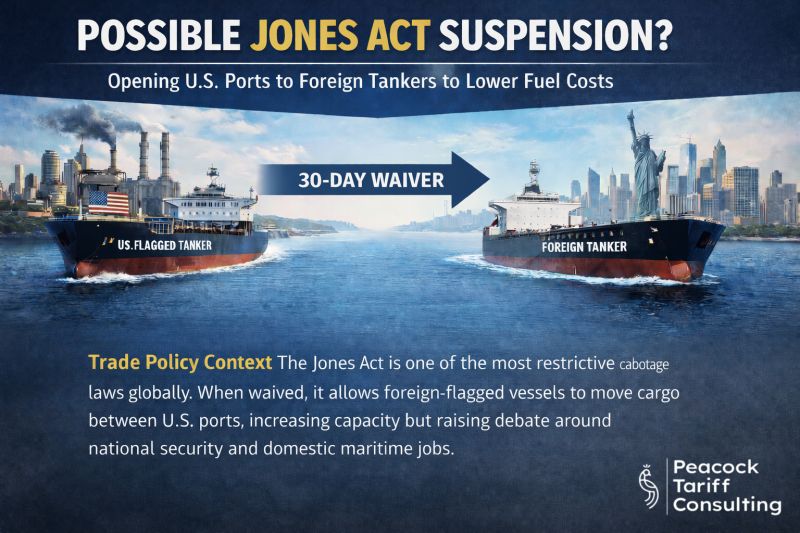
In March 2026, the Trump administration is reportedly considering temporary Jones Act waivers that would allow foreign-flagged vessels to transport oil and refined petroleum products between U.S. ports. This policy consideration reflects recognition of a fundamental challenge in the current energy market: the United States lacks sufficient domestic tanker capacity to efficiently redistribute refined fuel products from the Gulf Coast production region to other U.S. markets during periods of supply stress.
The policy debate around Jones Act waivers involves fundamental tensions between protectionist economic policy, energy security concerns, and practical logistics efficiency. Understanding both the history of Jones Act requirements and the current operational constraints it creates is essential for supply chain professionals managing domestic energy logistics.
- Jones Act mandates domestic cargo move on U.S.-built, U.S.-flagged vessels
- Policy in effect since 1920, designed to protect domestic maritime industry
- Current administration considering temporary waivers for refined fuel products
- Shortage of U.S.-flagged tankers creates bottleneck in fuel redistribution
- Waivers would allow foreign-flagged vessels on domestic routes temporarily
The Capacity Problem: Why U.S. Tanker Fleet Limitations Matter
The immediate policy driver is a straightforward capacity constraint: there are relatively few U.S.-flagged tankers available to move fuel between ports. Most U.S. fuel refining capacity concentrates on the Gulf Coast, in Texas and Louisiana. However, demand for refined products exists nationwide, from heating oil in the Northeast to gasoline in the Mountain West. Transporting these products efficiently requires substantial tanker capacity.
The U.S.-flagged tanker fleet has contracted significantly over recent decades. In 1970, approximately 400 oceangoing tankers flew the U.S. flag. By 2026, that number has declined to fewer than 100. Many of these remaining vessels are aging, specialized for crude oil or niche chemical transport, or committed to long-term government contracts. When fuel supply disruptions occur-due to weather, refinery outages, or supply chain interruptions-the available capacity in the Jones Act-compliant fleet cannot respond to surge demand.
International tankers can move fuel globally at competitive rates because they operate on international routes with multiple service opportunities. A foreign-flagged tanker moving refined products between Singapore and Rotterdam can then shift to the Mediterranean or another profitable route. A U.S.-flagged tanker constrained to domestic routes lacks this flexibility, making American vessel ownership more capital-intensive and operationally less efficient. This structural disadvantage has driven the contraction of the U.S. tanker fleet.
- U.S. tanker fleet contracted from 400 vessels (1970) to under 100 (2026)
- Remaining capacity insufficient for peak seasonal demand periods
- Gulf Coast refining must serve nationwide fuel demand
- Aged fleet reduces available capacity during maintenance cycles
- International vessels have greater route flexibility and profitability
Energy Market Stress and Supply Chain Fragmentation
The current policy debate around Jones Act waivers reflects systemic stress in global energy markets. With global oil supplies subject to geopolitical disruption, refinery capacity constrained by limited investment, and climate-driven weather extremes affecting both production and distribution, the United States faces recurring situations where fuel supply exceeds available domestic transport capacity.
Refined fuel markets in the United States operate with surprisingly thin inventory buffers. The Strategic Petroleum Reserve contains crude oil, not refined products. Regional fuel inventories exist at refineries and major distribution hubs, but they cycle relatively quickly. When demand spikes-due to cold snaps requiring heating oil, hurricanes disrupting Gulf production, or supply disruptions-the cost of fuel redistribution becomes a policy priority.
For supply chain professionals, the policy debate around Jones Act waivers signals recognition that current domestic maritime infrastructure is insufficient to manage energy market volatility. Policymakers are essentially acknowledging that temporary access to foreign vessel capacity may be necessary during periods of supply stress, even though this contradicts established protectionist policy.
- Global oil supplies subject to geopolitical disruption
- Refinery capacity limited by capital constraints and environmental requirements
- Domestic fuel inventories operate with thin margins
- Regional fuel availability varies seasonally and unpredictably
- Policymakers recognizing need for flexible maritime capacity
The Waiver Mechanism: How Temporary Waivers Would Function
If implemented, temporary Jones Act waivers for refined fuel products would likely operate under specific conditions and time parameters. Waivers might be issued when fuel inventory levels in specific regions fall below certain thresholds, when refinery outages prevent normal regional supply, or during declared emergencies. The Department of Homeland Security or the Department of Energy would likely manage the waiver process, issuing specific authorizations for defined cargo movements between specified ports.
Temporary waivers would allow foreign-flagged tankers to accept fuel cargo at Gulf Coast refineries or major distribution hubs and deliver it to coastal regions lacking sufficient domestic tanker capacity. Northeast heating oil distribution and Pacific Coast fuel supply represent the most likely initial applications for foreign tanker deployment.
The scope and duration of waivers would likely remain limited initially. Rather than permanently opening domestic shipping to foreign competition, policymakers would probably implement narrow, time-limited waivers that address specific supply disruptions while preserving the broader Jones Act framework. This approach allows demonstration of the policy’s economic and national security impacts while maintaining the political coalition supporting domestic maritime protections.
- Waivers likely tied to inventory thresholds or emergency declarations
- Authority for waivers probably assigned to DHS or DOE
- Initial waivers likely limited to specific ports or regions
- Time-limited authorization rather than permanent policy change
- Specific cargo tracking and monitoring likely required
Economic Impacts: Cost Reduction and Competitive Effects
If Jones Act waivers allow foreign tankers to redistribute fuel more efficiently, immediate cost reductions would likely follow. Foreign-flagged vessel operating costs are approximately 30-40 percent lower than U.S.-flagged vessels when operating on international routes. On domestic routes where they would compete with scarce U.S. capacity, foreign vessels could potentially offer 20-30 percent cost savings compared to existing Jones Act monopoly pricing.
For consumers, these cost reductions would flow through to retail fuel prices. Energy economists estimate that relaxing Jones Act restrictions on fuel transport could reduce refinery-to-market fuel costs by 2-5 percent, translating to 10-20 cents per gallon in retail pricing when other distribution and retail margins are included. For heating oil consumers in the Northeast or fuel-dependent regions, this price differential becomes significant during winter months.
However, relaxing Jones Act constraints creates economic winners and losers. U.S. tanker owners and domestic maritime companies would face competition from more efficient foreign operators. Crews aboard U.S. vessels would face reduced job opportunities or downward wage pressure. Shipyards dependent on tanker construction and maintenance would experience reduced domestic demand. These distributional effects create political resistance to permanent Jones Act relaxation.
- Foreign vessel operating costs 30-40 percent lower than U.S. vessels
- Fuel cost reductions estimated at 2-5 percent for downstream consumers
- Retail fuel prices could fall 10-20 cents per gallon with sustained competition
- U.S. maritime industry faces reduced profits and employment
- Shipyard capacity for tanker construction at risk from sustained waiver policy
National Security Considerations: The Competing Policy Values
The original Jones Act was designed to protect domestic maritime capacity for national security purposes. The reasoning was straightforward: the United States required a viable domestic shipbuilding and maritime labor force to support military operations and maintain national defense capability during wartime or global conflict. Without domestic maritime capacity, the nation would depend entirely on foreign shipping for military logistics.
However, contemporary national security arguments for Jones Act protection face increasing scrutiny. Modern military logistics depend primarily on air and land transport, with sealift playing a secondary role. The domestic tanker fleet is small enough that it no longer represents a meaningful component of national defense capacity. Further, a significant portion of the U.S.-flagged fleet is relatively old and would require modernization if actually mobilized for military use.
Conversely, energy security itself can be considered a national security concern. Lack of adequate fuel distribution capacity during supply disruptions creates vulnerability to energy price shocks and supply interruptions that affect military and civilian operations. From this perspective, maintaining flexibility to access international shipping capacity during energy market stress serves national security by reducing energy supply risk.
The policy debate reflects this tension between different conceptualizations of national security. Protectionists emphasize maritime industrial capacity and labor force preservation. Modernists emphasize energy supply flexibility and cost efficiency. Temporary waivers represent a pragmatic compromise: preserving the Jones Act framework while acknowledging that inflexible application creates genuine vulnerabilities.
- Jones Act originally designed to preserve wartime sealift capacity
- Modern military logistics reduced reliance on sealift transport
- Domestic tanker fleet too small to significantly support military needs
- Energy supply flexibility arguably more important to national security
- Temporary waivers balance protectionist and market efficiency concerns
Looking Forward: Policy Evolution and Supply Chain Adaptation
The Jones Act waiver discussion signals that U.S. energy logistics policy is entering a transition period. Permanent, inflexible protection of domestic maritime industries is becoming politically less tenable as energy market volatility increases and supply chain efficiency becomes a public policy priority.
If temporary waivers prove successful in reducing fuel costs and improving supply chain resilience during shortage periods, political pressure for more extensive Jones Act reforms will likely increase. Over time, limited waivers might expand to cover additional fuel products, extend to non-emergency periods, or broaden to other cargo types. However, each expansion creates political opposition from maritime labor unions and domestic shipyard operators.
For supply chain professionals, the key implication is that regulatory rigidity is slowly giving way to flexibility. Rather than relying on stable, long-term protection of domestic shipping monopolies, policy is gradually shifting toward market-responsive mechanisms that maintain baseline domestic capacity while allowing temporary international competition during periods of supply stress.
Companies managing domestic energy supply chains should begin scenario planning around possible Jones Act modifications. Develop relationships with both domestic and international tanker operators, build flexibility into fuel sourcing and distribution strategies, and monitor policy developments. The regulatory environment governing domestic maritime transport is entering a period of uncertainty and transition-adaptation will determine supply chain competitiveness.
- Temporary waivers likely to expand if policy demonstrates success
- Political pressure for broader Jones Act reform increasing over time
- Maritime labor opposition likely to persist but gradually moderate
- Energy logistics increasingly subject to market-responsive policy mechanisms
- Supply chain leaders should develop dual-sourcing and flexible transport strategies
- Monitor policy developments for emerging waiver opportunities