
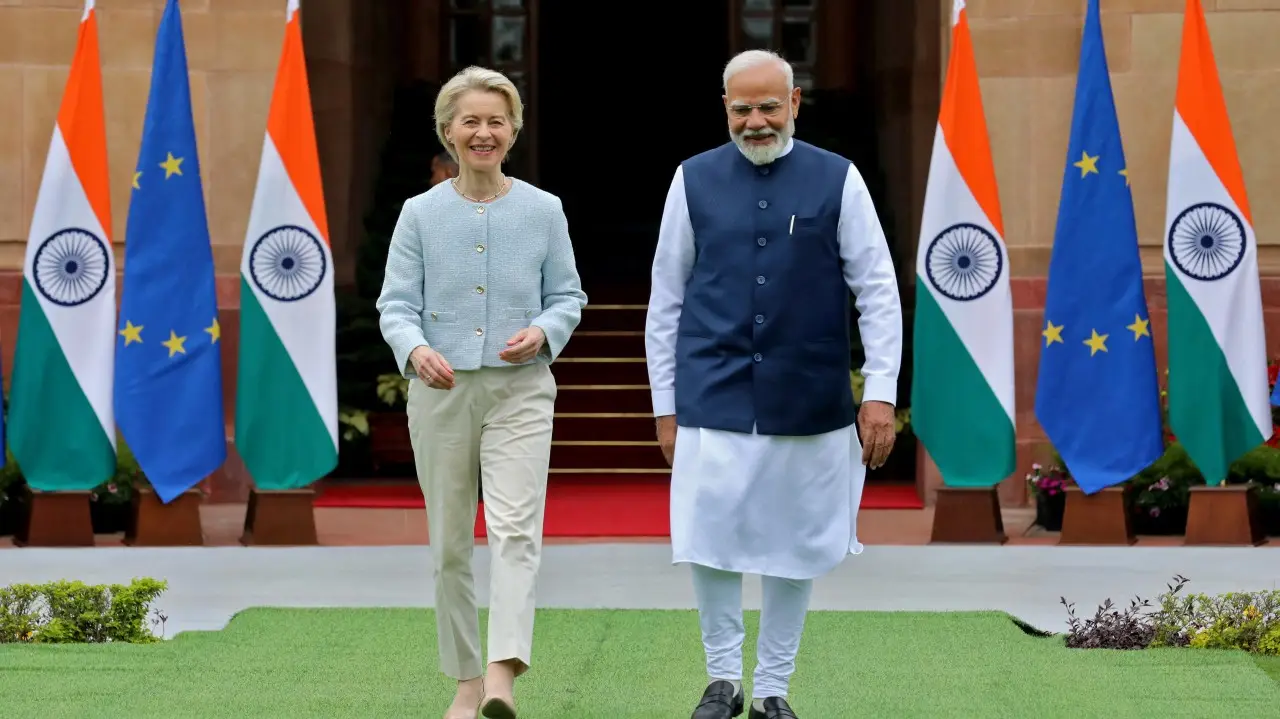
The EU has signed an expanded deal, or “the mother of all deals”, as described by Ursula von der Leyen, with India, aiming to offset some of the losses due to US tariffs, projected to add 19 billion dollars annually to EU exports.
After two decades of negotiations, the free trade agreement was pushed through in an effort to deepen economic ties, leveraging the momentum of shifts caused by the US’ aggressive tariff policy. The deal marks the creation of a free trade zone for 2 billion people with tangible benefits outlined for both sides.
The significance
Europe seeks to diversify export markets and supply chains, and both India and the EU seek to reduce reliance on the US and China. This deal will bring both sides closer to this objective, reshaping the pattern of globalization and the flows of global integration. Greater concessions are signaled on each end than have been given to any single trading partner previously. This is long-term strategic planning, risk reduction, and a hint of desperation – reviving the negotiations after two decades comes from a place of need; as uncertainty in trade grows, both sides aim to secure the livelihoods of their citizens. The deal has the potential to align on value and foster greater cooperation, and the EU is no longer reliant on the ever-mercurial United States to drive cooperative trade liberalization.
For the EU, the deal is expected to open investment pathways into India’s high-tech, labor-intensive digital industries while infusing the export portfolio by 18 billion euros annually. For India, the deal provides vital economic relief to offset the impact of Trump 50% tariffs while accelerating India’s integration & ascension in global value chains. The EU pledge of 500 million euros to enable India’s transition away from carbon-intensive inputs and industries will further propel this objective.
Representing 1.8 – 2 billion people, the changes brought about by the agreement are bound to ripple out into the rest of the world, affecting global prices, sourcing strategies, and investment flows. For scale, this free trade zone will be larger in population than China and North America combined. The agreement will also accelerate the movement of students, researchers, and professionals between the two jurisdictions to offset the impacts of the skyrocketing H1B visa costs. This move will ensure fruitful employment opportunities for the workforce, promoting educational exchanges and deeper economic integration in the long term.
India
India seeks to offset the impact of US’ 50% tariffs and balance its trade relationship with Russia; the agreement is expected to double the volume of EU exports by 2032, backed by the elimination of tariff cuts on 96.6% of shipments. Modi touts the deal as beneficial to the country’s manufacturing and services sectors, granting EU market access to Indian farmers and small businesses; the deal is also expected to drive investor confidence in the third-largest economy in Asia. New Delhi will allow up to a quarter million EU vehicles to enter the market at preferential rates, marking a quota six times larger than any quota previously outlined in existing trade agreements. The deal will allow Indian labor-intensive goods, most affected by Trump tariffs, to regain a competitive edge while guaranteeing access to post-study visas and student mobility. Though concessions were offered across 144 sectors, the discussions on the highly-sensitive dairy sector and other contested agricultural products like beef, sugar, and rice were omitted from the agenda. As India strives to find new markets, the EU deal is the fourth such agreement negotiated since May, following pacts entered into with the UK, Oman, and New Zealand. However, India continues to be affected by the carbon tax implemented under the EU’s CBAM, or Carbon Border Adjustment Mechanism, effective January 1st. The levy, imposed to meet decarbonization goals, will impact India’s steel, cement, electricity, and fertilizer sectors, though the EU pledged 500 million euros to enable India’s greenhouse gas emissions cuts. The agreement also delivers a major boost to India’s textile and apparel sectors by removing import duties, previously 12%, and leveling the playing field with Bangladesh, Turkey, and Pakistan, all of which already enjoy zero-duty access, making India a far more attractive sourcing hub. This shift is especially timely: India has been reeling from the 50% tariff imposed by the United States, its largest textile customer, which led to nearly 60% of US orders once placed in India being redirected to Bangladesh and Vietnam in 2025.
European Union
As the EU strives to lessen reliance on China and the United States, it will cut tariffs on 99.5% of Indian imports over the next 7 years; the pact will eliminate the duties of 4.75 billion euros for European firms. According to the outline, New Delhi will slash auto tariffs from 110% to 10% over 5 years, which will tremendously benefit EU automakers like BMW, Mercedes-Benz, Renault, and Volkswagen. India will also decrease tariffs on alcoholic beverages – from 150 to 75% on wines, effective immediately, and lower tariffs on spirits to 40%. Apart from doubling EU exports, the deal is expected to enhance the EU’s access to India’s financial services, maritime services, and other key sectors, opening new business opportunities and creating jobs. EU service providers are also expected to benefit from the offered concessions, which mark the largest trade opening granted to any partner by India. Simplification of customs procedures and guaranteed compliance with EU IP and trademark laws will further bolster collaboration and integration. Lastly, the deal is expected to benefit European small businesses by removing regulatory barriers, reducing tariffs, and enforcing transparent and consistent rules to make import-export simpler and more effective.
The deal aligns with India’s broader pledge to cut tariffs on 97% of EU exports over the next 5-10 years, including reductions on higher-end fashion, footwear, and apparel, positioning India as a priority market for EU premium brands, albeit with a transition period as companies adapt to local distribution rules, product standards, labeling requirements, and the Goods & Services Tax (GST). With the EU importing roughly 125 billion USD in textiles each year, European fashion brands across fast fashion, mid-market, and private label will gain expanded capacity to source from India, benefiting from lower landed costs, greater sourcing flexibility, and stronger leverage in supplier negotiations, while EU manufacturers in price-sensitive basics and home textiles may face heightened competition as a wave of duty-free Indian imports pressures their margins.
The deal is expected to be finalized after legal reviews, projected to take about 6 months, and is announced against a backdrop of the EU’s recently signed Mercosur agreement, another decisive initiative to decrease the bloc’s reliance on China. The deal garnered a positive response from European CEOs and industry leaders, enthused by the idea of securing access for EU exports to India’s rapidly expanding market. The new partnership also has a security clause and is expected to broaden cooperation in traditional defense through collaborative development of weapons and the establishment of a classified information-sharing mechanism. Increased monitoring on the Indian Ocean will be conducted jointly in light of China’s growing maritime assertiveness.
For centuries, trade has united nations and cultures. This agreement marks another such alliance, promising shared economic gains within the framework of a stable, rules-based trading system. No surprises. No disruptions. Just trade. It also sends a clear message to Washington: global commerce will continue to move forward, with or without U.S. participation, and despite its efforts to obstruct it.
By Maria Pechurina 白玛莎, Director of International Trade Peacock Tariff Consulting