
Introduction: A Policy Gap at the Speed of E-Commerce
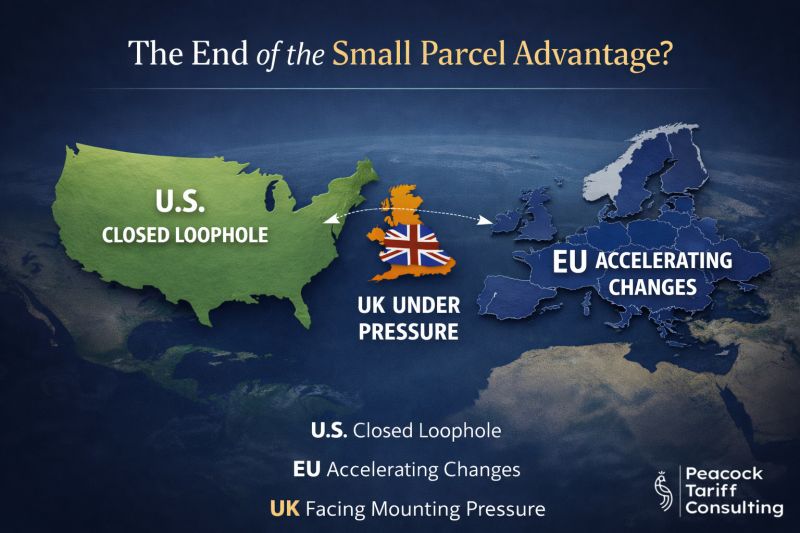
The rise of ultra-low-cost e-commerce platforms has exposed a fundamental misalignment between modern global trade and legacy customs frameworks. While Shein captures headlines with its sub-dollar garments and rapid inventory turnover, the underlying issue runs far deeper into how nations define and regulate the flow of goods across borders. The UK small parcel loophole stands at the center of this debate, representing a policy framework designed for a different era of international commerce. As the United States tightens restrictions and the European Union accelerates enforcement, pressure is mounting on the UK to close what has become an increasingly problematic gap in its trade defenses. At stake is not just consumer pricing or retailer margins, but the fundamental architecture of customs administration in an age of direct-to-consumer global supply chains.
Understanding De Minimis: The Policy That Fueled a Model
The de minimis provision within customs frameworks was originally designed with pragmatism in mind. Rather than processing countless low-value packages through standard duty assessment procedures-an administratively expensive and time-consuming process-customs authorities established value thresholds below which imports entered duty-free. For the UK, this threshold has historically allowed packages below a certain value to bypass traditional duties and VAT assessments. The reasoning was sound in its original context: enforcement costs would exceed collected revenue. However, the economics have shifted dramatically. Global logistics networks have become sophisticated enough to exploit these thresholds at unprecedented scale. E-commerce platforms have engineered their supply chains specifically to maximize the advantages of de minimis treatment. What was once an administrative efficiency measure has become a competitive advantage that distorts trade dynamics. Ultra-low-cost platforms can absorb modest duties in traditional retail channels but maintain razor-thin margins by exploiting duty-free entry. This creates an asymmetrical playing field where domestic retailers and legitimate importers face full tariff obligations while direct-to-consumer shipments from overseas evade assessment entirely.
- De minimis thresholds were designed for administrative efficiency, not as permanent trade advantages
- Modern e-commerce has weaponized these provisions through high-volume, low-value shipment strategies
- The gap between policy intent and market reality has widened significantly since initial framework design
The Global Response: US Action and EU Acceleration
The United States has already moved decisively on this issue. The US Trade Representative’s office recognized the competitive distortion caused by uncontrolled de minimis imports and implemented stricter thresholds and more rigorous assessment procedures. These changes reflected a broader understanding that trade policy must evolve with e-commerce realities. The European Union, meanwhile, has taken an even more aggressive stance. EU members have implemented rules requiring tracking and duty assessment on an expanding range of low-value shipments, recognizing that consumer affordability arguments cannot justify indefinite competitive disadvantages for domestic producers. The EU approach has been particularly stringent regarding goods from specific origin countries, particularly those engaged in rapid-growth e-commerce models. These regulatory moves have created clear momentum internationally. The question facing the UK is whether to align with this global trend or risk becoming the default entry point for duty-free e-commerce flooding into Western European markets. A more permissive approach than the US and EU would likely attract transshipment operations and further entrench the competitive advantages of platforms currently exploiting the gap.
- The US has already tightened de minimis thresholds and enforcement mechanisms
- The EU is implementing comprehensive tracking and duty assessment across member states
- These moves signal a coordinated international shift toward closing the loophole
Beyond Shein: The Broader Policy Implications
While Shein has become the public face of duty-free e-commerce, the issue encompasses a far wider range of categories and business models. Footwear, textiles, accessories, electronics, and household goods all benefit from the current framework. Smaller platforms and independent sellers may be equally dependent on de minimis treatment, though they attract less media attention. The challenge for policymakers is designing rules that address genuine market distortions without unnecessarily restricting legitimate cross-border commerce or consumer access to global products. This is not a simple matter of either closing the loophole entirely or allowing unlimited abuse. It requires nuance in threshold setting, possibly differentiated treatment based on origin country or product category, and robust compliance mechanisms. Some stakeholders argue for raising thresholds modestly rather than eliminating them, allowing small personal shipments and low-value goods to move freely while requiring duty assessment on high-volume commercial shipments. Others advocate for origin-country adjustments, recognizing that competitive distortion differs significantly across trading partners.
The Practical Challenges: Implementation and Enforcement
Closing or tightening the loophole presents significant operational challenges. Customs authorities would need enhanced tracking capabilities to monitor the explosion in small parcel volumes. The infrastructure required to assess duty on millions of additional packages daily creates training, staffing, and systems demands. There are also technology barriers-many customs platforms were not designed for the transaction volume that rigorous de minimis enforcement would generate. A phased implementation approach may be necessary, potentially starting with specific high-risk origin countries or product categories before expanding to a comprehensive regime. Additionally, revenue collection mechanisms must be clarified. Who bears responsibility for duty assessment and payment-the shipper, the platform, or customs? Different models create different incentives and enforcement challenges. International harmonization would reduce complexity for companies operating across multiple jurisdictions, but absent such coordination, businesses must navigate fragmented regulatory landscapes. The UK has an opportunity to learn from US and EU implementation experiences, potentially avoiding early missteps while establishing frameworks that genuinely address competitive distortion.
- Customs infrastructure requires significant investment to handle increased assessment volume
- Responsibility frameworks for duty payment must be clearly established
- Phased implementation may be more practical than immediate wholesale changes
Strategic Considerations for Companies and Trade Policy
For companies currently benefiting from de minimis treatment, closure represents a significant business model adjustment. Importers should begin evaluating alternatives now: tariff engineering strategies, supply chain restructuring, duty mitigation techniques, and potential price adjustments. For domestically-focused retailers and manufacturers, policy tightening represents a potential competitive advantage that may level the playing field. The broader trade policy consideration is whether the UK chooses to harmonize with US and EU standards, creating consistent rules across key trading partners, or maintains a more permissive approach that could attract circumvention activity but also preserve consumer access to lower-priced imports. This decision will influence trading relationships and investment patterns for years. Companies should engage with policy discussions now, providing data on import volumes, cost impacts, and market effects rather than waiting for sudden regulatory changes. Policymakers, in turn, should pursue evidence-based approaches that acknowledge genuine trade distortion while preserving legitimate commerce.
Conclusion: Policy Evolution in an Era of Distributed Supply Chains
The UK small parcel loophole represents more than a Shein controversy. It reflects the fundamental challenge governments face in adapting trade policy to an era of distributed, high-volume, low-value international commerce. Legacy frameworks built for container shipments and bulk imports struggle to govern the reality of millions of direct-to-consumer parcels crossing borders daily. The pressure to close or tighten the loophole is mounting, driven by domestic retail interest, international coordination efforts, and the recognition that current frameworks enable genuine competitive distortions. The question is not whether change will come, but how quickly and in what form. The UK’s decision will shape its competitive position, trade relationships, and customs administration for years. Businesses, policymakers, and trade professionals should begin planning now for a more restrictive de minimis environment, whether that arrives through UK action or through broader international standards.