
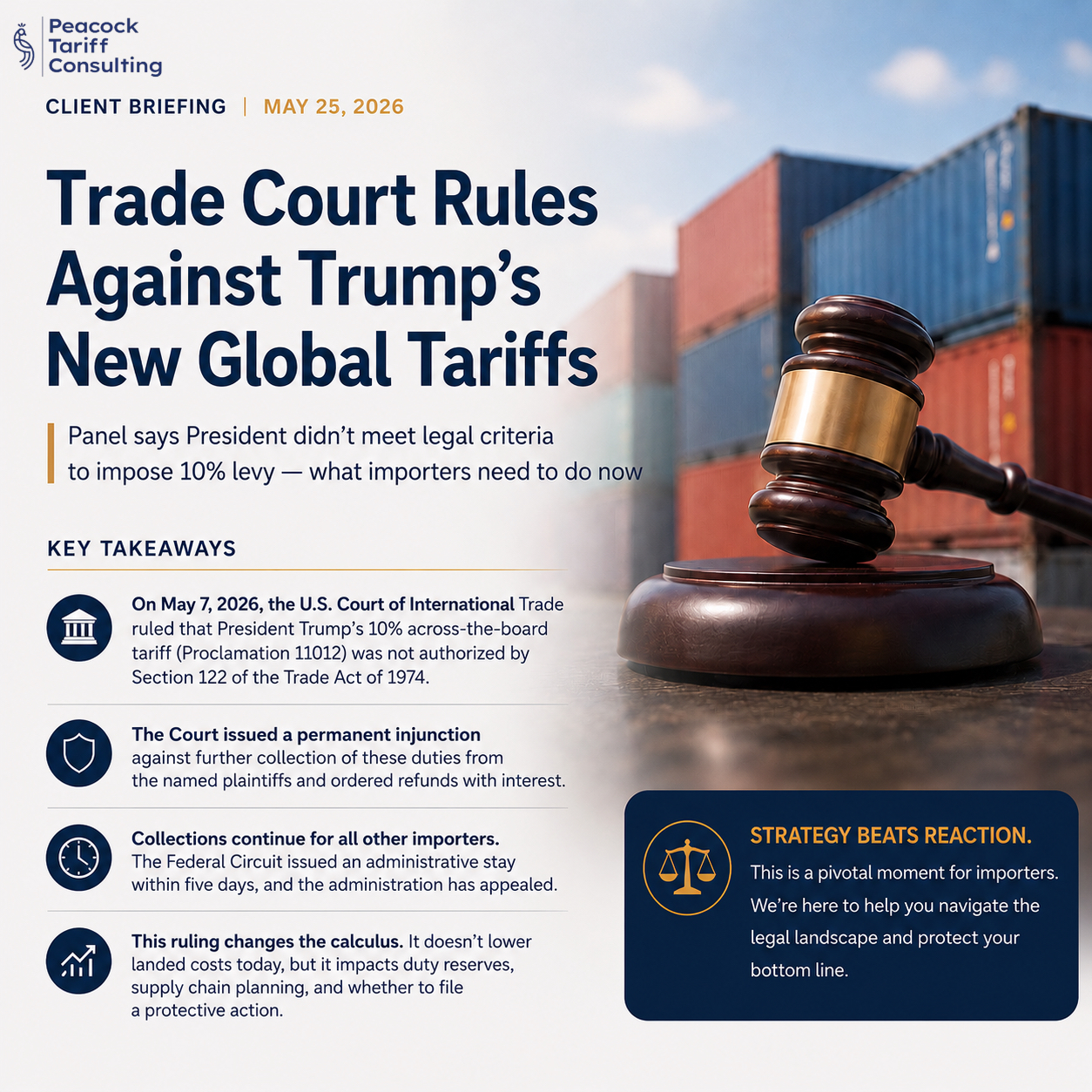
On May 7, 2026, the U.S. Court of International Trade handed the Trump administration its second major tariff defeat of the year. In a 2‑1 decision in the consolidated cases of State of Oregon v. Trump and Burlap and Barrel, Inc. v. Trump, a three-judge panel held that Proclamation 11012 the President’s 10 percent across-the-board “balance-of-payments” surcharge was not authorized by the statute it relied upon. The Court entered a permanent injunction against further collection of those duties from the named importer plaintiffs and ordered refunds, with interest, of amounts already paid.
Within five days, the Federal Circuit issued an administrative stay. Collections from every other importer in the country continue. The surcharge is still being assessed at the border. And the administration has appealed.
For our clients, that combination a clean legal win followed by an immediate procedural pause is precisely the kind of moment where strategy beats reaction. The ruling does not, by itself, lower anybody’s landed cost. But it changes the calculus on duty reserves, on supply-chain planning for the second half of the year, and most importantly, on whether to file a protective action of one’s own. This briefing walks through what the Court actually held, why it matters, how it fits with the broader fragmentation of U.S. tariff authority that has unfolded since the Supreme Court’s February ruling on IEEPA, and what we are advising importers to do over the next sixty days.
How we got here: from IEEPA to Section 122 in a single afternoon
To understand the May 7 ruling, you have to start with February 20.
On that day, the Supreme Court issued its decision in Learning Resources, Inc. v. Trump, striking down the IEEPA-based tariffs that had been the architecture of the President’s trade policy for nearly the entire first year of the second Trump administration. The IEEPA tariffs the universal 10 percent “reciprocal” baseline, the country-specific reciprocal adders, the fentanyl-linked duties on Canada, Mexico and China had pushed the U.S. trade-weighted average tariff from a pre-inauguration baseline of roughly 2.5 percent to a peak of more than 22 percent in May 2025. They generated tens of billions of dollars in collections, an enormous refund-litigation pipeline, and the deepest disruption to U.S. import procedures in living memory.
The Supreme Court held that “regulate … importation” under IEEPA does not stretch to imposing sweeping tariffs of indefinite scope, amount and duration. That holding was clear, and it was final.
What it was not, however, was the end of the story. Within hours of the IEEPA decision, the administration issued Presidential Proclamation 11012, invoking for the first time since the statute came into force in 1975 Section 122 of the Trade Act of 1974. Section 122 permits the President to impose a temporary import surcharge of up to 15 percent ad valorem for up to 150 days “to deal with large and serious United States balance-of-payments deficits.” The proclamation set the rate at 10 percent, applied it to imports from nearly every country, and set an expiration of July 24, 2026, unless Congress extended it.
The administration’s calculation was straightforward. Section 232 (national-security sectoral duties on steel, aluminum and other industries) and Section 301 (unfair-trade-practice duties, mostly on China) remained in force, but neither produces an across-the-board cudgel. Section 122 looked like the only ready-to-hand statutory authority that could replicate the universal reach of the invalidated IEEPA program at least for 150 days, which the White House appeared to believe would buy time for Congress to act or for new sectoral cases to mature.
The choice was novel. Section 122 had been on the books for half a century and had never been used. The 1971 Nixon import surcharge that inspired its enactment was issued under different authority and had already expired by the time Section 122 became law. There was, in other words, no body of administrative practice or judicial interpretation to fall back on. The administration was lighting the candle for the first time, and the candle drew an immediate legal challenge.
Two suits arrived quickly: one from a coalition of U.S. states led by Oregon, and one from a small group of importer plaintiffs led by Burlap and Barrel a New York-based spice importer that had also been a plaintiff in the IEEPA litigation. The CIT consolidated them, heard oral argument in April, and issued its decision on May 7.
What Section 122 actually says and what the Court said it doesn’t allow
Section 122(a) of the Trade Act of 1974, codified at 19 U.S.C. § 2132, authorizes the President to “proclaim … a temporary import surcharge, not to exceed 15 percent ad valorem, in the form of duties (in addition to those already imposed, if any) on articles imported into the United States.” The grant comes with strings attached. The President may act only “to deal with large and serious United States balance-of-payments deficits” and only when those deficits threaten one of three enumerated harms: significant depreciation of the dollar, the prospect of imminent and significant deterioration in the U.S. balance-of-payments position, or the need to cooperate with other countries in correcting an international balance-of-payments disequilibrium. The surcharge cannot remain in force for more than 150 days unless Congress affirmatively extends it.
That language and especially the phrase “balance-of-payments deficits” is where the case was won and lost.
Proclamation 11012 attempted to satisfy the statutory predicate by pointing to two contemporary measures: the U.S. current account balance and the U.S. goods trade deficit. Both, the proclamation argued, had been deeply negative for years, both reflected a structural imbalance in U.S. external accounts, and both therefore qualified as the kind of “large and serious balance-of-payments deficits” Congress had in mind.
The CIT majority rejected that reading. “Balance-of-payments deficit,” the panel held, is a term of art with a specific technical meaning rooted in the Bretton Woods-era financial architecture that prevailed when the statute was drafted. In 1974, the U.S. had only recently left the gold standard, the international monetary system was still organized around fixed exchange rates and managed convertibility, and a “balance-of-payments deficit” was understood in official-settlements terms the gap that had to be closed through reserve transfers between central banks. Once the dollar floated and the post-Bretton Woods system took hold, that specific category of deficit largely ceased to exist as a meaningful policy concept.
A modern current account deficit is not the same thing. Neither is a bilateral or aggregate goods trade deficit. The Court held that the President’s invocation of those modern measures was an attempt to retrofit a 1970s statutory predicate to a 21st-century macroeconomic environment that does not produce the original concept the statute was designed to address. Because the proclamation did not identify a deficit measured consistently with the statute’s original meaning, the Court concluded, the action was ultra vires and the duties imposed under it were unauthorized by law.
The majority went further. Allowing the statutory term to evolve as the administration proposed, the panel reasoned, would effectively grant the President unbounded surcharge authority any external imbalance in any account could be invoked as the trigger which would raise serious questions under the major-questions doctrine and the nondelegation doctrine. The narrower reading, the Court concluded, was both legally correct and constitutionally prudent.
This is a significant holding, but it is also a narrower one than the Supreme Court’s IEEPA ruling. The Justices in February held that the underlying authority did not include the power to impose tariffs at all in the manner attempted. The CIT in May held that Section 122 does authorize a temporary surcharge that is in the statute in so many words but that the predicate facts for invoking it were not present. That distinction matters for what happens next.
The dissent
Judge Timothy Stanceu dissented at length, and the dissent is worth reading carefully because it previews the strongest arguments the government will make on appeal.
Judge Stanceu’s central point is one of legislative history. Earlier drafts of what became Section 122 included a tighter, technical definition of “balance-of-payments deficits.” That definition was struck from the bill before passage. The most natural reading of that drafting history, the dissent argues, is that Congress deliberately left the term open-ended and that it intended to confer broad executive discretion to determine, on the basis of then-current economic methodologies, when a “large and serious” deficit exists.
On that view, the modern current account and goods trade measures the administration relied upon are not foreign to the statutory concept; they are exactly the kind of evidence Congress contemplated the President would weigh. Judge Stanceu also argued that the factual record before the Court did not warrant summary judgment, much less a permanent injunction, because at minimum there were material disputes of fact about the seriousness and persistence of contemporary U.S. external imbalances.
We expect the Federal Circuit to engage seriously with this analysis. The Federal Circuit has, on multiple recent occasions, taken a relatively expansive view of presidential authority under delegated trade statutes. And there is an open question about whether Section 122 which is, after all, a specific authorization to impose tariffs should be read against the same backdrop the Supreme Court used to constrain IEEPA, which is not. Importers betting that affirmance is a foregone conclusion are not reading the same body of appellate law we are.
The remedy: narrow on purpose
The most important practical feature of the May 7 ruling and the feature most easily missed in the headline reporting is the scope of relief the CIT granted.
The Court entered a permanent injunction against further collection of Section 122 duties from the two private importer plaintiffs and from the State of Washington, which was the sole state plaintiff able to demonstrate direct standing (Washington pays Section 122 duties through purchases made by its state-funded university system). For those three plaintiffs, the government is enjoined from collecting and must refund duties already paid, with interest.
Every other state plaintiff in the case was dismissed for lack of standing. The Court held that a state’s interest in the economic welfare of its residents, or in the indirect fiscal consequences of federal trade policy, does not constitute the kind of direct, concrete injury that confers standing to challenge a federal tariff. That holding is consistent with how the CIT has historically treated parens patriae trade challenges and is unlikely to be disturbed on appeal.
No universal injunction was issued. The non-importer state plaintiffs requested one and were denied. The importer plaintiffs did not request one. The result is a ruling that on the merits declares the entire Section 122 surcharge unauthorized, but on the remedy protects only three named parties from its collection.
For every other importer in the country, Section 122 duties continue to be assessed, collected, and deposited at the border. CBP has not paused the program. There is no automatic refund process for non-plaintiff importers and, unlike the IEEPA refund pipeline that Judge Eaton is now overseeing in Euro-Notions Florida, Inc. v. United States, no court-supervised mass-refund mechanism has been established for Section 122. If the CIT decision is affirmed on appeal and the Federal Circuit ultimately permits broader relief, a refund process could follow. But unless and until that happens, every Section 122 dollar paid between February 24 and July 24 is at risk of being non-recoverable for any importer that has not filed its own action.
This is the practical consequence non-plaintiff importers should focus on. The legal victory belongs to three parties. The legal opportunity to preserve refund rights through protective action belongs to anyone willing to file.
The Federal Circuit stay and the July 24 calendar
On May 12, five days after the CIT ruling, the U.S. Court of Appeals for the Federal Circuit entered an administrative stay of the CIT’s order pending its consideration of the government’s motion for a longer-term stay pending appeal.
An administrative stay is a temporary, housekeeping order. It is not a ruling on the merits and it is not even a ruling on the government’s stay motion. It simply preserves the status quo while the Federal Circuit decides whether to issue a substantive stay. The Federal Circuit could lift the administrative stay, deny the substantive stay motion, and let the CIT injunction take effect for the three plaintiffs. It could grant a stay pending appeal and freeze the injunction entirely while the appeal runs. It could expedite the merits briefing and try to issue a decision before the surcharge’s July 24 sunset. Or it could let things drag, in which case the calendar may do more work than the law.
The July 24 expiration date is the second key feature of the litigation timeline. Absent congressional extension which is not in evidence the Section 122 surcharge expires by its own terms 150 days after February 24. If the Federal Circuit does not rule on the merits before July 24, the surcharge simply lapses, and the underlying legal question becomes moot as to going-forward collections (though the refund question for paid duties remains live). The administration has publicly mused about raising the surcharge to the statutory ceiling of 15 percent but has not done so. It has not, as of the date of this briefing, asked Congress for an extension.
In other words, this case may end with a whimper duties expire, the underlying legal question is mooted, refund litigation continues rather than with a Supreme Court showdown of the kind we saw on IEEPA. Whether the administration tries to reinvoke Section 122 under a different factual predicate, or pivots immediately to a different statutory authority, will likely be the more consequential question.
The numbers: where U.S. tariff rates actually stand
It is worth grounding all of this in the actual trade-weighted tariff data, because the political conversation has drifted from the underlying reality.
According to Global Trade Alert’s U.S. Tariff Estimates dataset, the U.S. trade-weighted average applied import tariff stood at 2.48 percent on January 20, 2025 the pre-Trump baseline. It climbed steadily through the spring of 2025 as IEEPA reciprocal duties were layered on, peaking at 22.58 percent on May 3, 2025. It remained in the 13‑17 percent range for the rest of 2025 as deals were struck, tariffs were paused, and Section 232 sectoral duties expanded.
On February 20, 2026, when the Supreme Court invalidated the IEEPA tariffs, the trade-weighted average dropped from approximately 14.3 percent to 7.9 percent in a single day a mechanical consequence of the IEEPA component going to zero. Four days later, the Section 122 surcharge added back roughly 5.9 percentage points on a trade-weighted basis, pushing the average back up to 10.6 percent. As of today, May 25, 2026, the trade-weighted average sits at approximately 9.9 percent: HTS column 1 baseline (~1 percent), Section 232 sectoral duties (~7.4 percent), Section 301 China duties (~1.4 percent), and the Section 122 surcharge (~0.1 percent residual after recent compression in the composition of imports flowing under each regime).
If the Federal Circuit affirms the CIT’s decision and the Section 122 program is dismantled or if it simply expires on July 24 without being replaced the trade-weighted average could fall back toward the 4 percent range, still nearly double the pre-Trump baseline but a meaningful step down from where it sits today. If the administration successfully re-engineers an equivalent program under another authority, the number stays where it is or climbs further.
For sourcing and pricing decisions, that range roughly 4 percent to 10 percent on a trade-weighted basis, with much higher dispersion at the product level is the planning envelope for the back half of 2026 and the first half of 2027.
What comes next: the other tools in the box
Section 122 is not the only authority available. It is not even the most powerful one. Importers and clients should be planning for the very real possibility that even a clean appellate affirmation of the May 7 ruling does not meaningfully lower their exposure, because the administration has multiple alternative pathways available and is actively developing several of them.
Section 232 of the Trade Expansion Act of 1962 the national-security sectoral authority that produced the steel, aluminum, copper, and semiconductor tariffs has no statutory ceiling on the duty rate and has been used aggressively. At least half a dozen Section 232 investigations are currently in flight, including investigations covering pharmaceutical inputs, critical minerals, and several categories of finished goods. Final affirmative determinations in any of these would produce sectoral duties that, unlike the IEEPA or Section 122 programs, sit on much firmer legal ground.
Section 301 of the Trade Act of 1974 the unfair-trade-practice authority that has been the legal basis for the original China tariffs since 2018 likewise has no rate ceiling. The administration initiated two substantial new Section 301 investigations in March 2026: one targeting 16 economies for structural excess manufacturing capacity, and one targeting 60 countries for forced-labor-enforcement failures. Either investigation could produce broad multi-country duty programs that would replicate, in significant part, the geographic reach of the invalidated IEEPA tariffs without depending on emergency or balance-of-payments authority.
Section 338 of the Tariff Act of 1930 a never-used statute permitting the President to impose retaliatory duties of up to 50 percent on goods from countries that discriminate against U.S. commerce has been the subject of public speculation by administration officials. It is the legal equivalent of a loaded but never-fired weapon: untested in court, sweeping on its face, and almost certain to draw the same constitutional challenges that have brought down IEEPA and now Section 122.
The point for planning purposes is that the legal pressure on individual statutory authorities does not, in the aggregate, mean the tariff project is unwinding. It means the administration is being forced to migrate from broad and easily-imposed authorities (emergency, balance-of-payments) to narrower and slower but more durable ones (sectoral, unfair-trade). The pace of new tariff actions may slow. The legal durability of those that survive will probably increase.
What Peacock is telling clients to do now
Three things, in order of urgency.
First, file a protective action if your annual Section 122 exposure is material. The CIT’s ruling does nothing for non-plaintiff importers as a matter of law. Refund rights for duties paid under an invalidated tariff are not self-executing; they require a timely filed claim, ordinarily through a protest under 19 U.S.C. § 1514 followed by a denied-protest action at the CIT. For importers with significant Section 122 collections broadly, our rule of thumb is annual surcharge exposure above $250,000, though smaller importers in concentrated product lines should also evaluate the cost of filing is modest relative to the optionality created. We recommend coordinating with trade counsel within the next thirty days to preserve options before the surcharge sunsets on July 24.
Second, do not unwind your duty reserves. The administrative stay means collections continue. The Federal Circuit will decide on the substantive stay motion in coming weeks, and the merits appeal will run on its own schedule. We are advising clients to maintain their Section 122 reserve accruals at current rates through at least the end of the second quarter and to revisit only once the Federal Circuit acts on the stay motion.
Third, refresh your scenario planning for the second half of 2026. The plausible outcomes range from “Section 122 lapses on July 24 and trade-weighted tariff rates fall toward 4 percent” to “Section 122 is replaced by a Section 232 or Section 301 program that maintains a 10 percent floor on a near-universal basis.” Both endpoints are credible. Sourcing decisions, pricing strategy, FTZ utilization, first-sale planning, and tariff-engineering work that was being held in abeyance for IEEPA clarity should now be evaluated against this wider band of outcomes. The litigation noise will continue, but the underlying tariff burden has crossed a threshold where structural mitigation strategies not just hedging pay for themselves.
The May 7 ruling is a meaningful win for the rule of law in trade policy. It is not, by itself, a meaningful change in your landed cost. Treat it as the legal-strategic opportunity it is and not as the all-clear it is not.