
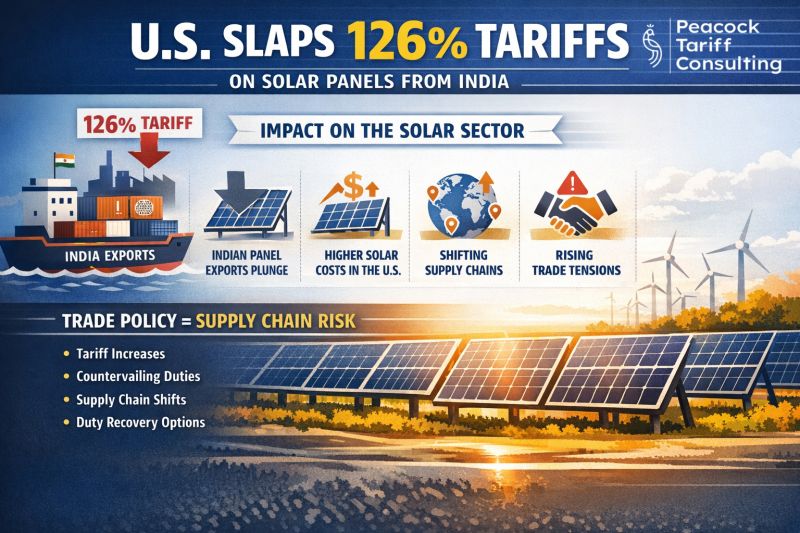
The Tariff Shock: 126% Preliminary Countervailing Duties on Indian Solar Modules
The imposition of preliminary countervailing duties approaching 126 percent on solar cells and modules originating from India represents a seismic disruption to both Indian solar manufacturers and the broader global clean energy transition. These duties, among the highest in recent US trade enforcement history, effectively price Indian solar products out of the American market for most applications. The magnitude of the tariff reflects administration-specific determinations about subsidization and dumping, but the consequences extend far beyond bilateral US-India trade relations.
The 126 percent duty rate transforms what was previously a competitive sourcing option for US solar developers into an economically prohibitive alternative. Where Indian solar modules previously competed primarily on cost, they now face duties that make them uncompetitive against domestic US manufacturers or suppliers from tariff-free jurisdictions. This fundamental shift in cost structures triggers cascading adjustments throughout the solar supply chain and the broader renewable energy sector.
- Preliminary countervailing duties reach approximately 126%
- Solar cells and modules from India most severely affected
- Effective elimination of Indian competitiveness in US market
- Highest duties among recent US trade actions
India’s Solar Manufacturing Expansion and the Oversupply Crisis
The timing of the US tariff action is particularly significant given India’s substantial investments in solar manufacturing capacity expansion over the past several years. The Indian government, through National Solar Mission and related industrial policies, has incentivized massive capital investments in domestic solar cell and module manufacturing. These investments were premised on the assumption that growing global demand, particularly from developed markets like the United States, would provide expanding outlets for Indian production.
The result of these investments was a dramatic increase in India’s solar manufacturing capacity. Indian manufacturers ramped up production, invested in technological improvements, and expanded their export infrastructure with confidence in long-term demand growth. However, the imposition of 126 percent US tariffs has exposed the vulnerability of this growth trajectory. Global solar demand has not expanded at the pace anticipated by capacity planners, and major markets are increasingly implementing domestic content requirements or tariffs that protect home producers. The consequence is a supply-demand imbalance and unsustainable inventories at Indian manufacturing facilities.
- Substantial Indian government investments in manufacturing capacity
- Production ramping driven by anticipated global demand growth
- Global overcapacity emerging across solar manufacturing
- Inventory management challenges facing manufacturers
Competitive Implications and Market Restructuring
The loss of US market access represents an existential threat to many Indian solar manufacturers, particularly smaller producers lacking diversified export markets or technological differentiation. For larger, more sophisticated producers, the US tariff wall forces strategic reorientation toward alternative markets, including Southeast Asia, emerging markets, and potentially supply arrangements with multinational manufacturers operating from multiple jurisdictions.
The tariff also provides explicit market protection for US-based solar manufacturers and module assemblers. Domestic producers can now operate without fear of price competition from Indian imports, enabling them to maintain higher price points and improve margins. However, this protection comes with a cost: US solar developers and downstream consumers will pay higher prices for modules, reducing the competitiveness of solar energy relative to conventional generation and potentially dampening the pace of solar deployment.
- Many Indian manufacturers face market viability challenges
- Larger producers seeking alternative export markets
- US manufacturers gaining explicit market protection
- Downstream costs increasing for solar developers and consumers
The Paradox: Tariffs Protecting Clean Energy While Impeding Transition
The US solar tariffs exemplify a fundamental tension in clean energy policy: protective trade measures may support domestic manufacturers and workers but simultaneously increase the cost of renewable energy deployment and slow the pace of grid decarbonization. This paradox creates policy confusion and potentially undermines climate objectives. A solar module that costs 40 percent more due to tariffs may reduce deployment volume sufficiently to exceed the environmental benefits of supporting domestic manufacturing.
The tension is not merely theoretical. Economists and clean energy advocates have quantified the deployment costs associated with trade protection. Studies suggest that tariff-driven module cost increases may defer solar installations by years and reduce total cumulative deployment. For a technology facing a critical window for rapid scale-up to meet decarbonization targets, even modest deployment slowdowns have significant climate implications. Policymakers face difficult choices about balancing industrial policy objectives against climate goals.
- Trade protection increasing renewable energy costs
- Higher module costs potentially reducing deployment volume
- Conflict between domestic industrial support and climate goals
- Quantifiable trade-off between tariffs and deployment pace
Ripple Effects Through Global Supply Chains
Indian solar manufacturers are not isolated competitors; they are embedded in global supply chain networks that extend backward to input suppliers and forward to customer relationships with multinational developers and financiers. The US tariff action disrupts these networks, creating consequences for suppliers of raw materials, component manufacturers, and downstream project developers.
For project developers planning US solar installations, the tariff shock forces fundamental reassessment of project economics. Capital budgets that were premised on assumptions about module costs must be revised upward. This adjustment may be manageable for well-capitalized developers, but smaller developers and projects on tighter financial margins may become economically unfeasible. The geographic distribution of solar development within the United States may shift as tariff impacts vary by location and developer type. Utility-scale developers with access to capital and long-term power purchase agreements may weather the tariff shock more easily than distributed solar installers serving residential and small commercial customers.
- Supply chain disruption from raw materials to end-users
- Project economics requiring reassessment
- Variable impacts across developer types and project scales
- Geographic redistribution of solar development potential
India’s Strategic Options and Long-Term Implications
Faced with loss of the US market, Indian policymakers and manufacturers must evaluate strategic alternatives. Some manufacturers may seek to relocate production to non-tariff jurisdictions to maintain access to US markets. Others may accelerate diversification toward non-US markets or invest in product differentiation and premium positioning. Government support may take the form of expanded financing, domestic demand stimulus, or assistance with market diversification.
The broader question for India concerns the sustainability of its solar manufacturing expansion given trade barriers and market saturation. If the US market is partially or fully closed through tariffs, and if other major markets impose similar restrictions, the rationale for continued capacity expansion weakens substantially. Long-term, India may face a choice between accepting lower-capacity utilization, relocating to serve alternative markets, or scaling back its manufacturing ambitions and returning to higher reliance on imports. Each option carries different strategic implications for India’s renewable energy independence and industrial development objectives.
- Manufacturer relocation to non-tariff jurisdictions under consideration
- Diversification toward non-US markets accelerating
- Indian government support mechanisms being evaluated
- Long-term viability of manufacturing expansion questioned
Conclusion: Navigating the Clean Energy-Trade Policy Intersection
The US solar tariffs on Indian modules exemplify the complex intersection of clean energy policy, trade policy, and industrial strategy. While protection for domestic manufacturers may serve legitimate policy objectives, the full consequences of tariff action must be weighed against impacts on clean energy deployment, consumer costs, and global supply chains. The India experience demonstrates that even in the context of technologies critical to climate change mitigation, trade barriers remain available and are being deployed with significant economic consequences.
For stakeholders across the solar industry, the tariff regime creates a new operating environment requiring strategic adaptation. Project developers must adjust cost assumptions and timelines. Manufacturers must reassess market strategies. Investors must account for policy risk. Policymakers must grapple with balancing competing objectives. The outcome will shape not only the trajectory of solar energy deployment in the United States but also the viability of India’s solar manufacturing ambitions and the pace of the global clean energy transition.