
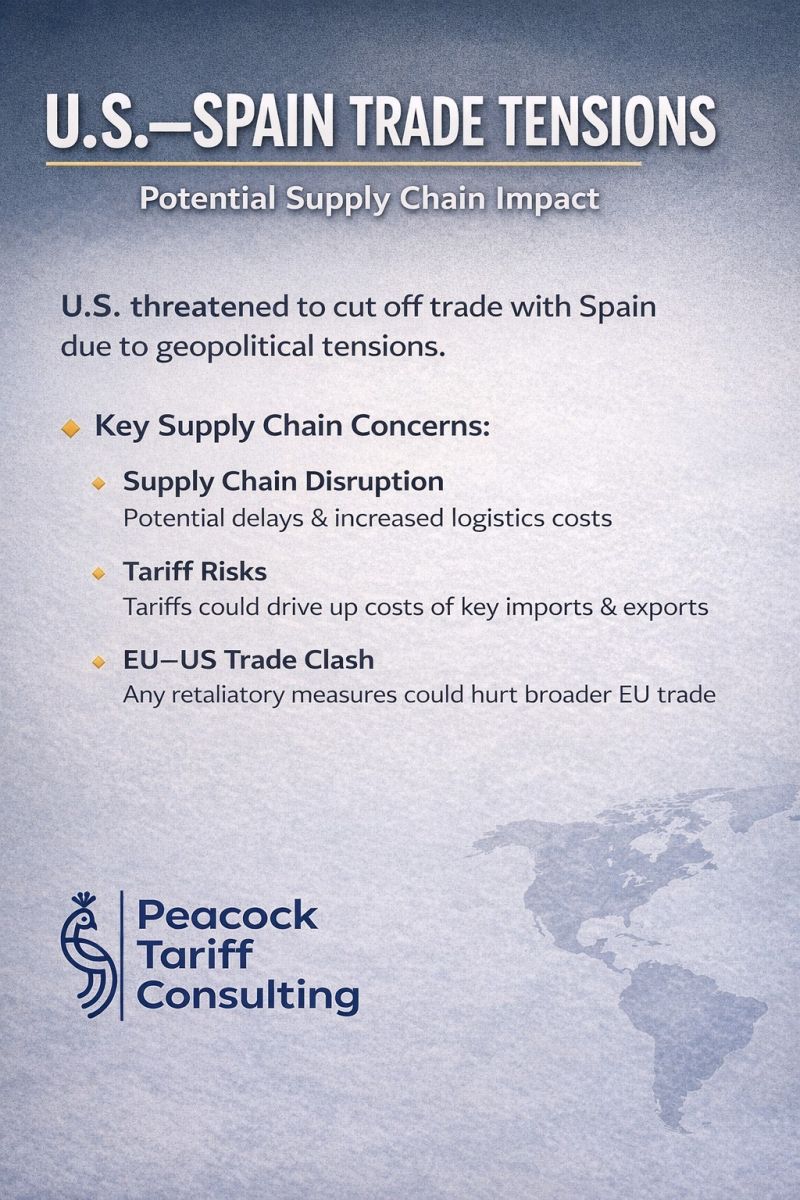
A Precedent-Setting Confrontation: Military Cooperation and Trade Leverage
The Trump administration’s threat to cut off trade with Spain following Spain’s refusal to support US military operations related to Iran conflict represents an unprecedented weaponization of trade policy to coerce cooperation on military matters. Spain’s decision to decline US military base expansions at Rota and Moron—facilities that the US has operated for decades under bilateral agreements—prompted the administration to threaten unilateral trade restrictions. This escalation signals a willingness to use trade policy as a coercive tool for achieving security and military objectives, setting a troubling precedent for future US-ally relationships.
The confrontation between the US and Spain reflects broader tensions about the nature of alliance relationships and the extent to which military cooperation should be compelled through economic pressure. Traditionally, alliance relationships have been understood as voluntary partnerships in which both parties assess their interests and cooperate when mutual benefit is identified. The administration’s approach inverts this logic, suggesting that allies who decline to participate in specific military operations should face economic punishment. This approach carries substantial risks for alliance cohesion and for the broader structure of international security relationships.
- US threatens trade restrictions over Spain’s military refusal
- Spain declined US base expansions at Rota and Moron
- Administration using trade policy as military cooperation leverage
- Unprecedented use of economic coercion on NATO ally
Spain’s Strategic Position: EU Member and European Gateway
Spain’s position within the European Union and its role as a gateway for transatlantic trade give Spain—and the broader EU—substantial leverage in any trade confrontation with the United States. Spain is not an isolated economy easily pressured by bilateral trade threats; it is a member of the world’s second-largest economic bloc. Any unilateral US trade restrictions on Spanish goods would likely trigger coordinated EU responses and potentially cascade into broader US-EU trade tensions.
Spain’s exports to the United States are diverse and substantial. Spanish automotive manufacturers, pharmaceutical companies, machinery producers, and agricultural exporters all depend on access to the US market. Conversely, US companies operating in Spain and throughout the EU depend on access to Spanish and broader European markets. The interconnection of US and European supply chains means that bilateral trade restrictions would impose costs on both US and European businesses, with unpredictable distributional consequences. The EU has demonstrated willingness to respond to US trade restrictions with retaliatory measures, suggesting that escalation between the US and Spain could rapidly evolve into broader US-EU economic conflict.
- Spain as EU member providing leverage in bilateral disputes
- Spanish exports to US including automotive, pharma, machinery, agriculture
- Interconnected US-European supply chains at risk
- EU potential for coordinated responses
Key Spanish Export Sectors and Economic Impact
Spain’s economy depends significantly on exports, with major categories including automotive products, pharmaceuticals, machinery, and agricultural goods. The automotive sector is particularly important, with Spanish manufacturers and suppliers producing vehicles and components for both domestic consumption and export to the United States and other countries. The pharmaceutical sector, including both branded medicines and generics, serves US markets and generates substantial export revenue. Spanish machinery manufacturers produce industrial equipment exported globally. Agricultural products including wine, olive oil, and processed food items constitute important Spanish exports.
Trade restrictions targeting Spanish goods would have highly differentiated impacts across these sectors. Automotive restrictions would threaten employment in manufacturing regions and would potentially disrupt supply chains serving US manufacturers dependent on Spanish components and subassemblies. Pharmaceutical restrictions would affect US consumers and healthcare systems dependent on Spanish-manufactured drugs. Agricultural trade restrictions would harm Spanish farmers and food processors. The cumulative economic impact would be substantial for Spain, but the ripple effects would extend throughout the EU and into US supply chains as well.
- Automotive sector vulnerable to trade restrictions
- Pharmaceutical exports to US facing potential barriers
- Machinery manufacturers dependent on market access
- Agricultural exports including wine and olive oil affected
The Broader EU Dimension: A Trade War With Spain Is a Trade War With Europe
The critical dimension of the US-Spain trade threat is that Spain’s position within the EU means that any unilateral action against Spanish goods would not remain bilateral. The EU’s customs union and common trade policy mean that Spanish trade is inseparable from broader EU trade. Additionally, the EU’s commitment to defending member states against external economic coercion would likely prompt collective action.
Historical precedents suggest that the EU responds to US trade restrictions with coordinated countermeasures. When the Trump administration imposed steel and aluminum tariffs in 2018, the EU responded with retaliatory tariffs on US goods including agricultural products, motorcycles, and other items. The EU’s approach to trade disputes involves protecting member state interests through collective action. A unilateral trade restriction on Spain could trigger EU retaliation affecting a broad range of US exports to European markets. Given the scale of US-EU trade (more than 1 trillion dollars in annual trade flows), escalation from a Spain-focused dispute into broader US-EU trade conflict could have severe economic consequences for both sides.
- Spain’s EU membership making dispute broader than bilateral
- EU customs union integrating Spanish trade with broader EU
- Precedent of EU coordinated responses to US trade actions
- Risk of escalation to broader US-EU conflict
Military Basing and Alliance Implications
The underlying dispute concerns US military base operations in Spain, specifically at Rota and Moron. These bases have been central to US military operations in Europe, the Middle East, and Africa for decades. Spain’s refusal to support base expansion reflects broader concerns about military entanglement in Middle Eastern conflicts and questions about the extent to which Spain should participate in security operations outside the NATO context or against the will of Spanish public opinion.
The basing dispute also reflects evolving European attitudes toward security partnerships and military cooperation. European publics and governments increasingly question the appropriateness of participating in Middle Eastern military operations that lack clear international legal foundation or broad coalition support. Spain’s position reflects this skepticism. The US approach—using trade threats to compel base cooperation—is likely to deepen European resentment and reinforce perceptions that the US is willing to sacrifice alliance relationships for short-term military objectives. This could accelerate Europe’s interest in independent defense capabilities and reduce future European willingness to cooperate with US military initiatives.
- Rota and Moron bases central to US Middle East operations
- Spain questioning participation in conflicts without EU consensus
- European publics increasingly skeptical of military interventions
- US coercion reinforcing European interest in independent capabilities
Trade Policy as Coercion: Precedent and Consequences
The use of trade policy as a tool for coercing military cooperation represents a significant departure from established norms in US-ally relationships. Trade policy has traditionally been understood as addressing commercial and economic concerns, not as a weapon for compelling security cooperation. The administration’s approach inverts this established understanding and opens a dangerous path toward using trade restrictions more broadly for political and military leverage.
If trade restrictions become an accepted tool for compelling political compliance on security matters, the implications for alliance relationships would be profound. Allies would face the prospect that disagreement with US military initiatives could result in economic punishment. This would create perverse incentives for allies to either comply with US wishes regardless of national interest or to reduce their dependence on the US-alliance relationship through alternative partnerships. Either outcome would be damaging to the cohesion and effectiveness of the alliance system. Additionally, the precedent could encourage other countries to use trade restrictions as political weapons, accelerating the fragmentation of the rules-based international trade system.
- Trade policy as security coercion unprecedented among allies
- Alternative of alliance withdrawal or reduced cooperation
- Risk of alliance system fragmentation
- International precedent for trade weaponization
Looking Ahead: Resolution Paths and Escalation Risks
Resolution of the US-Spain trade dispute could follow multiple paths. Spain might reverse its position and consent to base expansion, eliminating the US rationale for trade threats. Alternatively, the US might back down from trade threats, accepting Spanish security preferences without economic penalties. A third path would involve negotiation of alternative arrangements that address both countries’ concerns. Finally, the situation could escalate, with the US implementing trade restrictions and the EU responding with coordinated countermeasures.
The most likely near-term outcome is either Spanish capitulation under economic pressure or US backing down to avoid broader US-EU trade conflict. Either option carries costs. Spanish capitulation would represent a precedent for successful economic coercion and would likely encourage future US administrations to rely on trade threats for political leverage. US backing down would undermine the credibility of the trade threat but would avoid escalation. The long-term challenge is establishing clearer norms about the relationship between trade policy and security cooperation, preventing future disputes from following the same escalatory pattern. For EU member states, the Spain dispute underscores the importance of coordinated collective responses to trade threats and of maintaining clear boundaries between security negotiations and economic relationships.
- Spain capitulation likely outcome due to economic pressure
- EU coordination central to any response
- Precedent set for future trade-security coercion
- Long-term need for clearer policy norms