
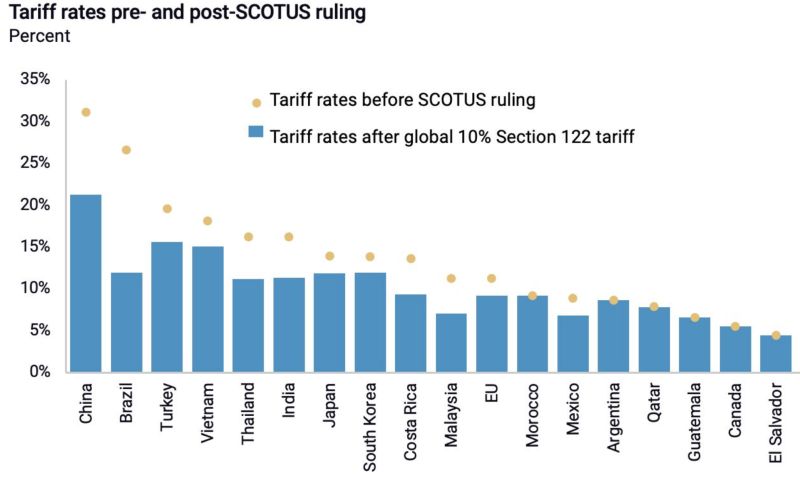
The Tariff De-Escalation
The United States has announced a reduction in applied tariff rates on Indian imports, lowering average tariffs from elevated levels to approximately 18%. This move represents a de-escalation of tariff pressures that have constrained Indian-U.S. trade for the past year and signals a strategic recalibration of U.S. trade policy toward India. While India remains subject to higher tariff rates than some of America’s preferential trade partners, the reduction from prior levels reopens competitive sourcing opportunities and restores India’s viability as a cost-competitive supplier for American companies.
The tariff reduction is particularly significant because it comes at a moment when Indian suppliers have been disadvantaged relative to competitors in Mexico, Canada, Vietnam, and Bangladesh who enjoy either lower tariff rates or preferential trade agreements. The reduction effectively brings Indian suppliers back into competitive consideration for American importers. For Indian manufacturers and exporters, the tariff reduction represents opportunity to restore market share and penetration that was lost during the period of elevated tariffs.
- U.S. tariffs on India reduced to approximately 18%
- De-escalation from prior elevated tariff levels
- Restores India to competitive sourcing consideration
- Indian manufacturers regain market share opportunity
- Tariff reduction signals strategic recalibration of U.S.-India relationship
Competitive Dynamics and Market Share Recovery
At 18% tariff, India remains more expensive than some competing suppliers—Mexico and Canada enjoy tariff advantages under USMCA, Bangladesh benefits from preferences on textiles with U.S. inputs, and Vietnam negotiates favorable rates. However, India’s labor cost advantages are sufficiently substantial that 18% tariffs do not eliminate India’s competitiveness. Indian suppliers can price competitively even with the 18% duty burden because their underlying labor and production costs are lower than many competitors.
The reduction will trigger competitive reassessment across sourcing categories where India competes. Apparel and textiles, where India has substantial production capacity and cost advantages, will be among the primary beneficiaries. Pharmaceuticals and chemicals, where Indian suppliers have strong capabilities and cost advantages, will also see renewed competitive interest. Electronics components, toys, consumer goods, and light manufacturing—categories where Indian suppliers compete on cost—will all see increased competitive activity from Indian exporters seeking to recover lost market share.
- 18% tariff rate enables Indian cost competitiveness
- India remains higher-cost than Mexico/Canada on tariff basis
- Bangladesh and Vietnam have specific preferences in some categories
- Indian suppliers compete on labor cost advantages
- Apparel, textiles, pharma, chemicals positioned for share recovery
Landed Cost Improvement and Sourcing Economics
For American importers, the tariff reduction directly improves landed costs for India-sourced products. A product sourced from India at a landed cost of $10 per unit previously subject to 25% tariffs incurred $2.50 in duties, making the total cost $12.50 per unit. At the new 18% rate, duties are $1.80 per unit, reducing total cost to $11.80 per unit. The $0.70 per unit savings translates to a 5.6% cost reduction—meaningful for high-volume categories with thin margins.
For manufacturers or retailers making sourcing decisions, this cost improvement becomes a factor in the sourcing equation. A supplier that was previously uncompetitive due to tariff burden may now become viable. Importers should reassess their sourcing portfolios, evaluate whether switching to India would reduce costs, and engage with Indian suppliers on pricing and capacity. For companies already sourcing from India, the tariff reduction directly improves margins and profitability without requiring supply chain restructuring.
- Tariff reduction directly reduces landed costs for India sources
- 5.6% cost improvement example: $2.50 to $1.80 per unit in duties
- Meaningful margin recovery in thin-margin categories
- Suppliers previously uncompetitive now potentially viable
- India sourcing becomes more attractive in competitive sourcing decisions
Supply Chain Stability and Predictability
Beyond the immediate tariff rate, the tariff reduction signals a shift toward more stable and predictable U.S.-India trade relationships. During the period of elevated tariffs, American companies faced uncertainty about whether tariff rates would increase further or decline. This uncertainty created disincentive for investment in India-based supply chains because there was risk that tariffs could escalate further. The tariff reduction suggests that this period of escalation has ended and that tariff relationships with India will stabilize.
For companies considering expanding supply chain capacity in India or establishing new sourcing relationships, this tariff stability is valuable. Investment in India-based supplier relationships, capacity expansion, or supply chain development now appears less risky. Companies can commit to multi-year sourcing relationships and supply chain investments with more confidence that tariff environments will not shift dramatically. This stability encourages long-term supply chain development rather than tactical short-term sourcing adjustments.
- Tariff reduction signals period of escalation has ended
- More stable U.S.-India trade relationship implied
- Reduces uncertainty about future tariff escalations
- Enables confident investment in India supply chains
- Encourages long-term supplier relationships and capacity development
Geopolitical and Strategic Dimensions
The tariff reduction on India reflects U.S. strategic interest in strengthening the U.S.-India relationship. India, as a large, democratic, economically growing nation with interests aligned with the U.S. on many geopolitical issues, is increasingly central to American strategic calculations. Reducing trade barriers with India while simultaneously maintaining elevated barriers to China represents a deliberate geopolitical choice to strengthen ties with India as a strategic counterbalance to Chinese influence in Asia.
From India’s perspective, the tariff reduction validates its importance to U.S. strategic planning and signals openness to deepening economic relationships. Indian exporters can market their products in America with the implicit backing of an administration that views India as a strategic partner. This status creates potential for deeper commercial relationships and expanded Indian market share in American imports. The tariff reduction, while economically modest, carries geopolitical weight suggesting that U.S.-India commercial relationships will continue to expand and deepen.
- Tariff reduction reflects U.S. strategic interest in U.S.-India relationship
- India increasingly central to American strategic planning
- Tariff reduction signals counterbalance to Chinese influence in Asia
- India treated as strategic partner rather than tariff target
- Validates potential for deepening economic relationships
Product Categories and Sourcing Opportunities
Specific product categories will benefit disproportionately from the tariff reduction. Pharmaceutical and chemical sectors have particularly strong Indian suppliers and face high tariff exposure. The tariff reduction directly improves the competitive position of Indian pharma and chemical exporters. Textiles and apparel, where India has substantial capacity, will see renewed competitive interest despite Bangladesh preferences for U.S.-input textiles. Electronics and semiconductors, where India is expanding capacity, will see increased sourcing consideration. Agricultural products including spices, seafood, and other commodities will also benefit from reduced tariff barriers.
For importers in these categories, the tariff reduction should trigger sourcing assessments. Evaluate Indian suppliers in your categories, request updated pricing reflecting lower tariff burden, and assess whether sourcing adjustments might improve margins or competitiveness. Build relationships with Indian suppliers who are investing in quality, compliance, and supply chain reliability. The tariff reduction creates opportunity for importers willing to actively engage with Indian suppliers.
- Pharmaceuticals and chemicals: strong Indian suppliers benefit
- Textiles and apparel: renewed sourcing consideration despite Bangladesh preferences
- Electronics and semiconductors: India expanding capacity
- Agricultural products: spices, seafood benefit from lower barriers
- Importers should trigger sourcing reassessments and supplier engagement
Margin Recovery and Competitive Advantage
For American companies already sourcing from India, the tariff reduction provides direct margin recovery without requiring cost reductions from suppliers. A company that was previously absorbing the tariff cost difference between Indian and alternative suppliers can now reduce prices to customers or retain the margin improvement. In competitive markets, companies may need to share the tariff benefit with customers through price reductions, but the option to improve margins or prices is now available.
Companies with significant India sourcing will see measurable improvements in profitability if they can retain the tariff benefit. In some cases, the margin improvement may be sufficient to justify investment in additional India sourcing or supply chain expansion. The tariff reduction creates window of opportunity to improve margins while Indian suppliers also benefit from improved competitiveness. This alignment of benefits for both Indian suppliers and American importers suggests that the period ahead may see substantial expansion in India-U.S. trade volumes.
- Existing India sourcing generates direct margin recovery
- Tariff benefit can improve margins or support customer pricing
- Competitive markets may require sharing tariff benefit with customers
- Margin improvement may justify expanded India sourcing
- Alignment of benefits for both suppliers and importers creates expansion opportunity
Recommendations for Sourcing and Supply Chain Managers
American importers should immediately initiate sourcing assessments focused on Indian suppliers. For each major product category or component category you source, identify what Indian suppliers exist, what capacity they have, what quality standards they maintain, and what pricing they can offer with the new tariff environment. Request updated quotations from Indian suppliers reflecting the tariff reduction and evaluate competitiveness relative to current suppliers.
Second, for categories where sourcing from India could meaningfully reduce costs, develop transition plans for switching suppliers. Evaluate cost reduction potential, quality risks, delivery timeline implications, and supply chain resilience considerations. Consider pilot programs sourcing small volumes from Indian suppliers to test quality and reliability before committing large volumes.
Third, develop supplier relationships with Indian exporters who meet quality standards and compliance requirements. Share expectations about product quality, certifications, documentation, and supply chain compliance. Invest in understanding Indian supplier capabilities and building relationships that can support long-term sourcing partnerships. The tariff reduction creates temporary competitive advantage for Indian suppliers, but sustained sourcing relationships require confidence in quality, reliability, and compliance.
Finally, monitor ongoing tariff policy developments with India. The tariff reduction may be followed by additional policy shifts, trade negotiations, or tariff adjustments. Maintain awareness of U.S.-India trade relationship developments and how they might affect tariff environments in future. The tariff environment is now more favorable for India, but it remains subject to policy change. Sourcing decisions should account for tariff policy uncertainty and maintain flexibility to adapt if tariff environments shift.
- Initiate immediate sourcing assessments focused on Indian suppliers
- Request updated quotations reflecting new tariff environment
- Evaluate competitiveness relative to current suppliers
- Develop transition plans for categories where India offers cost reduction
- Consider pilot programs with Indian suppliers
- Develop long-term supplier relationships with quality-compliant exporters
- Monitor U.S.-India tariff policy developments
- Maintain supply chain flexibility for policy changes