
The Fraying of North American Trade Relations
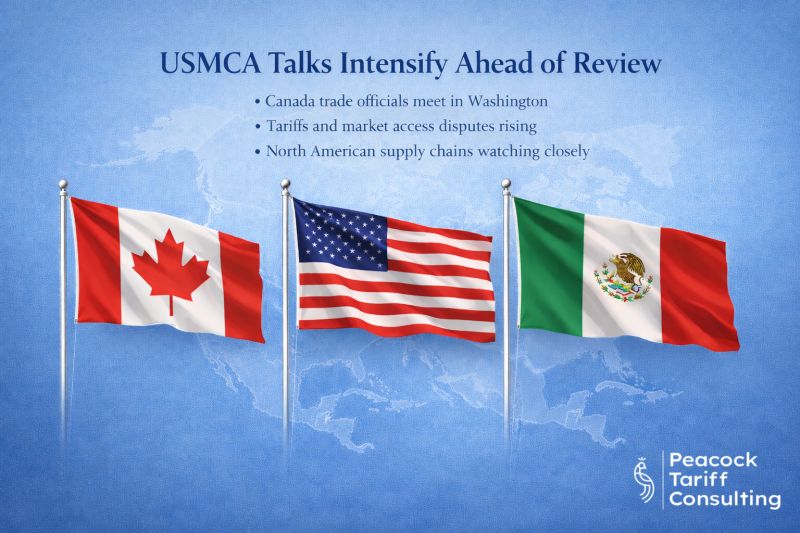
As Canada sends a senior trade official to Washington for discussions with the U.S. Trade Representative, the underlying message is clear: the United States-Mexico-Canada Agreement (USMCA), which serves as the foundation for North American trade, is under unprecedented strain. While the agreement remains formally intact and technically the backbone of cross-border commerce, the relationship between the parties is deteriorating in ways that could fundamentally reshape how business operates across the region.
Recent developments paint a picture of escalating tensions. The United States has imposed targeted tariffs on key Canadian sectors, including steel, aluminum, and automobiles-precisely the sectors most critical to integrated North American supply chains. Disputes over Canadian dairy market access continue to simmer. Tensions around digital services and cultural protections have emerged as new points of friction. Most critically, the mandatory review process built into the USMCA agreement is approaching, creating a moment of potential renegotiation or deepened conflict.
For supply chain operators, manufacturers, and logistics companies, the deteriorating trade relationship creates acute uncertainty. The USMCA framework, despite its limitations, has provided the regulatory predictability and tariff certainty that companies depend upon when making long-term investment decisions. A breakdown in the agreement or significant renegotiation of its terms could force supply chains to reorganize in ways that would be enormously costly and disruptive.
The Economic Stakes: Nearly $2 Trillion in Annual Trade
To understand the magnitude of what is at stake, one must grasp the scale of North American trade. The United States, Canada, and Mexico conduct nearly $2 trillion in annual trade under the USMCA framework. This figure encompasses goods crossing the border multiple times as they move through integrated supply chains. A single automotive component might be manufactured in Mexico, undergo secondary processing in the United States, and final assembly in Canada before reaching consumers in all three countries. The $2 trillion figure reflects the cumulative value of all these cross-border flows.
This level of trade integration did not emerge by accident. It developed over decades as companies rationalized their manufacturing footprint based on comparative advantage, labor costs, proximity to markets, and regulatory certainty. Supply chains were optimized assuming tariff-free or low-tariff access across North American borders. Distribution networks, manufacturing plant locations, and logistics hubs were positioned assuming the USMCA framework would persist.
A significant disruption to the USMCA agreement would force a fundamental reorganization of these supply chains. Companies would need to reevaluate manufacturing locations, reconsider supply sourcing, potentially reshore some operations, and develop contingency plans for tariff exposure. These reorganizations would take years to implement and would impose substantial costs on affected companies.
Sector-Specific Vulnerabilities
The strain in the U.S.-Canada trade relationship affects different sectors with varying severity. The automotive sector represents the most significant vulnerability. North American automotive manufacturing is deeply integrated, with components sourcing, assembly, and distribution all optimized around tariff-free trade. U.S. tariffs on Canadian steel and aluminum directly impact automotive manufacturing costs. If tariffs were to escalate or new restrictions imposed, automotive companies would face either dramatically higher input costs or the need to reorganize their supply chains-both outcomes that would be severely disruptive.
Energy and metals sectors face comparable vulnerability. Canada is the largest source of imported oil, natural gas, and mineral commodities for the United States. These sectors operate on thin margins where even modest tariffs or trade restrictions would significantly impact economics. A deterioration in trade relations could lead to higher energy prices and resource costs throughout the U.S. economy.
Agriculture and food supply chains, while less integrated than automotive, also face significant exposure. Tariff disputes around dairy and agricultural products reflect deeper tensions around market access. Canada is a major exporter of beef, grains, and other agricultural commodities to the United States. Trade restrictions would affect food prices and supply availability for North American consumers.
Cross-border logistics networks, which facilitate the movement of goods across North American borders, would face increased border processing times, higher compliance costs, and logistical uncertainty if trade relations deteriorate. Trucking companies, shipping lines, and third-party logistics providers would all face increased operational complexity and costs.
- Automotive manufacturing and component sourcing
- Energy, metals, and mineral resources
- Agriculture and food supply chains
- Cross-border logistics and transportation networks
The Inevitability of Policy Shifts
For companies operating integrated North American supply chains, one reality has become abundantly clear: policy shifts in trade relationships are no longer a matter of if but when and how quickly. The trade relationship between the United States and Canada has become politicized in ways that transcend traditional partisan divisions. Both political parties in the United States have adopted more skeptical stances toward existing trade agreements. Canadian policymakers, meanwhile, face domestic pressure to protect key industries and assert Canada’s interests in trade negotiations.
The mandatory USMCA review process creates a formal opportunity for renegotiation, but even absent formal review, the Trump administration and subsequent administrations have demonstrated a willingness to impose tariffs and trade restrictions outside existing agreement frameworks. This unpredictability is perhaps the most challenging aspect for supply chain managers. It is difficult to plan long-term supply chain strategy when policy could shift significantly with a change in administration or in response to short-term political pressures.
The reality is that supply chain managers cannot assume the USMCA will persist in its current form. They also cannot assume tariff levels will remain stable. Instead, they must recognize that trade policy will evolve in response to political cycles, geopolitical considerations, and domestic policy priorities. This recognition should inform how companies structure their supply chains and manage their risk exposure.
Strategic Adaptation and Risk Management
For supply chain operators in integrated North American industries, strategic adaptation is essential. First, companies should develop multiple supply chain scenarios based on different trade policy outcomes. One scenario should assume continued USMCA-like preferential access. Another should assume significant tariffs and trade restrictions. A third should model worst-case scenarios including export restrictions or supply chain disruptions. By modeling these scenarios, companies can identify vulnerabilities and develop contingency plans.
Second, companies should evaluate opportunities to regionalize or nearshore supply chains in ways that reduce exposure to trade policy uncertainty. This might include establishing manufacturing or distribution facilities in the United States to reduce reliance on cross-border logistics, or developing supplier relationships with companies operating in multiple regions to reduce exposure to any single country’s tariff policy.
Third, companies should actively monitor and participate in trade policy discussions. Industry associations and lobbying efforts can shape how trade disputes are resolved and influence the severity of any tariff regime that emerges. Companies that engage with policymakers and demonstrate the consequences of trade disruption on their operations may be able to influence outcomes.
Fourth, companies should develop pricing strategies and customer communication approaches that allow for adjustment if trade policy changes. Some companies have been able to pass through tariff costs to customers, while others have absorbed costs to maintain market share. Understanding which approach is viable for your business and communicating proactively with customers about potential cost impacts is important.
Finally, companies should consider diversification beyond North America. While North American supply chains offer proximity, familiarity, and integration benefits, investing in supply chain capacity outside North America reduces exposure to North American trade policy risks. This is particularly important for companies whose products are exported globally or whose suppliers are globally distributed.
The Broader Context: Geopolitical Considerations
The strain in U.S.-Canada trade relations must be understood within a broader geopolitical context. The United States is increasingly focused on competition with China and other strategic rivals. Trade policy is being viewed not merely as an economic tool but as a geopolitical instrument. In this context, the United States may prioritize reshoring critical supply chains, reducing dependence on other countries, and using trade policy to advance broader strategic objectives.
This geopolitical reorientation has implications for Canada’s role in North American supply chains. If the U.S. administration views Canada’s trade policies as insufficiently aligned with American strategic interests, or if Canadian companies are seen as conduits for technology or supply chain access by non-allies, trade tensions could intensify further.
For supply chain managers, this geopolitical dimension is important because it suggests that trade tensions will not be resolved through traditional negotiation alone. Instead, they will be shaped by how both governments perceive their strategic interests and competitive positioning. Understanding this broader context helps companies anticipate how trade policy might evolve and adjust their strategies accordingly.
Conclusion: Preparing for an Uncertain Trade Future
The USMCA agreement, while still formally intact, is under real strain. U.S. tariffs on Canadian sectors, ongoing disputes over market access, and the approaching mandatory review process all signal that the trade relationship faces genuine challenges. For supply chain operators in automotive, energy, agriculture, and logistics sectors, the imperative is to recognize that the stable trade environment of the past is no longer assured.
The path forward requires companies to move beyond assuming policy stability and instead develop strategies that are resilient to multiple possible trade policy futures. This means scenario planning, supply chain diversification, strategic facility investments, and active engagement with policymakers. It also means accepting that adaptation costs and supply chain reorganization are increasingly inevitable costs of doing business in North America.
The key question for supply chain managers is not whether policy changes will occur but how quickly you can adapt when they do. By taking action now to build resilience and flexibility into your North American supply chains, you can position your company to navigate whatever trade policy future emerges. Those that wait for certainty will find themselves reactive and disadvantaged. Those that anticipate change and prepare for multiple scenarios will have the competitive advantage.