
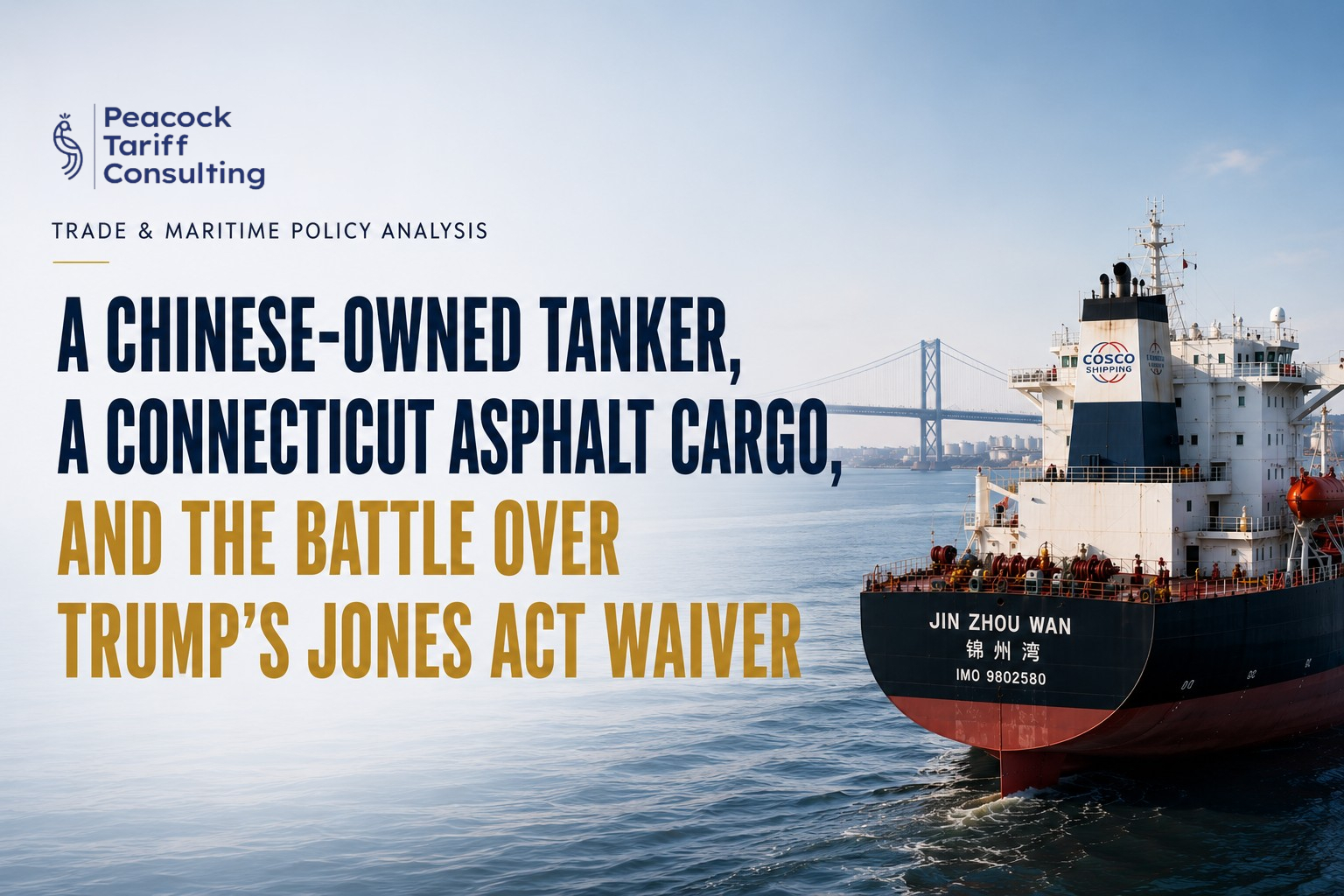
How a single coastwise voyage by the COSCO-operated JIN ZHOU WAN crystallized a national-security and economic fight over the broadest Jones Act suspension in seventy-five years.
A Routine Cargo Becomes a Political Flashpoint
When a 13,265-deadweight-tonne asphalt tanker slipped into New Haven harbor on May 28, 2026, after a week-long run up the U.S. coast from New Orleans, the cargo itself was unremarkable. Liquid asphalt, the heavy bituminous residue of crude oil refining, is the literal foundation of American roadbuilding, and the spring construction season generates predictable demand for it along the Eastern Seaboard. What turned this otherwise ordinary coastwise voyage into a Washington controversy was not the asphalt, but the ship carrying it and the legal instrument that allowed it to move at all.
The vessel was the JIN ZHOU WAN (IMO 9802580), a Chinese-flagged asphalt and bitumen carrier built in 2017 and owned, managed, and operated by COSCO Shipping Asphalt Hainan, a subsidiary of the state-owned China COSCO Shipping Corporation. Under ordinary circumstances, no foreign-flagged ship of any nationality could legally carry cargo from one U.S. port to another. That transport is reserved, under the Merchant Marine Act of 1920 universally known as the Jones Act for vessels that are U.S.-built, U.S.-flagged, U.S.-owned, and crewed by Americans. The JIN ZHOU WAN moved Louisiana asphalt to Connecticut only because the Trump administration had suspended that century-old requirement through an emergency national-security waiver.
On Friday, May 29, the American Maritime Partnership (AMP) the principal trade and lobbying organization for the U.S. domestic maritime industry seized on the voyage in a pointed social-media post. “A Department of War designated ‘Chinese Military Company’ just used the 501a national security Jones Act waiver to deliver asphalt to New Haven, CT,” the group wrote, questioning how a shipment of paving material could possibly advance any immediate American defense need. The juxtaposition was deliberately jarring: a waiver justified on national-security grounds was being used by a company that another arm of the U.S. government has flagged as a Chinese military entity. For an industry already waging a public campaign against the waiver, the optics were close to perfect.
This analysis examines what actually happened, why the asphalt cargo has become a rhetorical fulcrum, the competing economic and security arguments now colliding in Washington, and how the episode fits into a much larger and increasingly tense contest between the United States and China over the future of global shipping.
The Vessel and the Voyage
Vessel-tracking data reviewed by maritime outlet gCaptain show the JIN ZHOU WAN departing New Orleans on May 21, 2026, and arriving in New Haven on May 28 a roughly week-long transit consistent with a laden coastal tanker rounding Florida and steaming up the Atlantic seaboard. New Haven is one of the principal deep-water terminals serving southern New England’s asphalt and fuel markets, and Connecticut, like much of the Northeast, depends on waterborne deliveries to keep paving plants supplied through the construction season.
The ship’s lineage is what gives the story its charge. COSCO Shipping Asphalt Hainan is a specialist operator within the sprawling China COSCO Shipping Corporation, the state-controlled conglomerate that ranks among the largest shipping groups in the world. China COSCO Shipping has appeared on the U.S. Defense Department’s list of “Chinese military companies” operating in the United States a designation maintained under Section 1260H of the National Defense Authorization Act that flags firms judged to contribute to China’s military-civil fusion strategy. The precise legal consequences of that listing for COSCO’s commercial subsidiaries remain contested, and inclusion on the list does not, by itself, impose trading sanctions. But the label is potent, and it allowed AMP to frame the asphalt delivery not merely as foreign competition but as a national-security contradiction.
It is worth being precise about what the waiver did and did not authorize. It did not hand COSCO any special privilege; the waiver is origin-neutral, opening qualifying coastwise routes to foreign-flagged tonnage generally. The JIN ZHOU WAN was simply one of many foreign vessels that have taken advantage of the opening industry analysis has identified at least 60 waiver-approved voyages moving crude and refined products between U.S. ports since March. But because it is Chinese-flagged and tied to a state conglomerate on a Pentagon watch list, this particular voyage offered the clearest possible illustration of a tension critics had been warning about from the start.
The Waiver: Origins, Scope, and Timeline
The waiver at the center of the dispute traces back to the spring 2026 crisis in the Strait of Hormuz. Following a sharp escalation of the conflict involving Iran and the U.S. military operation tied to it tanker traffic through the world’s most important oil chokepoint was severely disrupted, sending energy markets into turmoil. On March 17, 2026, the Department of Homeland Security issued what analysts have described as the broadest and longest Jones Act waiver since at least 1950.
The original order ran for 60 days and was set to expire on May 17, 2026. As the Hormuz disruption persisted, the administration extended it by a further 90 days, pushing the expiry to August 16, 2026, and producing a cumulative 150-day suspension. The waiver’s product scope is sweeping: it covers energy commodities and fertilizer inputs across roughly 659 product categories, including crude oil, refined petroleum products, natural gas, coal, ammonia, and fertilizers, and it applies across U.S. territories. The administration’s stated rationale was straightforward to stabilize domestic energy supplies and blunt price spikes while global oil and product flows were disrupted by the Middle East conflict.
Asphalt sits at the edge of that energy-products universe. As a refinery bottom product closely tied to crude processing, it falls within the broad commodity categories the waiver addresses, which is why the JIN ZHOU WAN’s cargo was eligible. That technical eligibility, however, is exactly what critics dispute on policy grounds: a barrel of gasoline diverted to a fuel-short region is one thing; a parcel of paving asphalt bound for a New England construction season is, in their telling, a much harder fit with the “immediate national-security necessity” that the emergency authority is supposed to serve.
Why Asphalt Became the Flashpoint
The genius of AMP’s framing lies in the choice of cargo. Crude oil and gasoline moving under the waiver can be plausibly defended as energy-security measures: they speak directly to fuel availability and pump prices, the very justifications the White House has offered. Asphalt does not. It is difficult to construct a narrative in which delivering road-paving material from Louisiana to Connecticut mitigates a Strait of Hormuz shipping emergency. By spotlighting the asphalt voyage rather than a crude cargo, AMP shifted the debate from “is the waiver lowering energy prices?” to “what does this emergency power actually cover, and who is benefiting?”
That reframing matters because it attacks the legal and rhetorical foundation of the waiver rather than its economic results. If the public accepts that the waiver is being used to move ordinary commercial cargoes that have nothing to do with the Hormuz emergency and that the beneficiaries include a Chinese state shipping group on a military watch list then the “national security” label that insulates the policy from criticism begins to erode. The asphalt cargo, in other words, is being used to argue that the emergency justification has become a flag of convenience for routine displacement of American carriers.
AMP’s Campaign and the Economic Case Against the Waiver
The asphalt post did not arrive in isolation. Days earlier, on May 26, AMP launched a national advertising campaign explicitly calling on President Trump to terminate the waiver. The effort spans television, connected TV, radio, and digital advertising, concentrated in maritime-heavy states including Louisiana, Mississippi, Florida, Virginia, Alabama, Georgia, South Carolina, and Tennessee. Its first spot, titled “End the Waiver,” features a Jones Act vessel captain casting domestic maritime as the original “America First” industry and urging the President to “put Americans back to work.”
AMP President Jennifer Carpenter put the political argument bluntly: “Clearly, President Trump has been led to believe that waiving the Jones Act is an effective way to lower gas prices, when we all see that prices have not gone down with the waiver. What the waiver does is put America last by allowing foreign operators and mariners to take American business and jobs.” She framed the waiver as a contradiction of the administration’s own buy American, hire American commitments an attempt to turn the President’s stated principles against the policy his advisers had adopted.
The economic case AMP advances rests on a contrast between negligible benefits and real costs. Citing independent analysis from the Center for Maritime Strategy, the group pegs the waiver’s fuel-price impact at roughly $0.000157 per gallon, and notes that the total volume of fuel moved under the waiver in its first 60 days amounted to only about 11 hours of national consumption. AMP’s own running dashboard, drawing on U.S. Energy Information Administration data, estimated that waiver shipments had moved approximately 14.9 million barrels of fuel since March 17 the equivalent, by the group’s calculation, of roughly 17.7 hours of total U.S. demand.
Against those marginal benefits, AMP arrays a list of costs. It argues that broker data show American vessels were available for roughly 90 percent of the routes that foreign ships ended up serving, undercutting the claim that the waiver merely filled a capacity gap. It contends that foreign carriers operate free of U.S. immigration, minimum-wage, and taxation requirements, giving them an inherent cost advantage over Jones Act operators on the very routes now opened to them. And it warns of an investment chill: the uncertainty around the waiver’s duration, AMP says, has already prompted at least one investment platform to halt a planned $1 billion capital raise for the maritime sector, jeopardizing more than $2.6 billion in active U.S. shipyard contracts and billions more in planned expansion. The domestic industry, by AMP’s accounting, sustains nearly 650,000 American jobs, $41.6 billion in labor compensation, and more than $154.8 billion in annual economic output.
The National-Security Paradox
The sharpest edge of the controversy is the apparent contradiction at its core. The waiver derives its legal authority from national-security grounds the statutory mechanism for suspending the Jones Act in the interest of national defense. Yet the JIN ZHOU WAN voyage put that authority to work on behalf of a company tied to a state conglomerate that the Department of Defense has identified as a Chinese military company. Critics ask, reasonably, how an instrument premised on protecting American security can be used to channel domestic transportation revenue to such an entity.
The administration’s answer rests on a different conception of security. In its framing, the immediate threat is to energy supply and price stability in the wake of the Hormuz disruption, and the waiver is a temporary, targeted tool to keep fuel flowing to American consumers during an acute shock. From that vantage point, the nationality of any particular carrier is incidental to the goal of maximizing available tonnage. The two sides are, in effect, arguing about which national-security interest takes precedence: the long-run strategic value of a domestic merchant fleet and shipbuilding base, or the short-run imperative of cushioning an energy-supply emergency.
That tension is not merely rhetorical. The Jones Act has long been defended on precisely the grounds AMP now invokes that a sovereign maritime industrial base, with American ships and trained mariners, is itself a national-security asset, especially relative to a rising Chinese maritime power. To watch a Chinese state carrier perform domestic U.S. transportation under a national-security waiver is, for the law’s defenders, to see the policy turned on its head.
A Skirmish in a Larger U.S.–China Maritime Contest
The asphalt episode lands in the middle of an escalating U.S.–China confrontation over shipping itself. Washington has spent the past two years building policy tools aimed squarely at China’s dominance of global shipbuilding and ocean logistics, including a Section 301 action targeting China’s maritime, logistics, and shipbuilding sectors and a framework of fees on Chinese-built and Chinese-operated vessels calling at U.S. ports. The strategic logic is explicit: to slow the expansion of Chinese maritime power and rebuild an atrophied American shipbuilding base.
Beijing has answered in kind. According to Global Trade Alert’s records, China’s Ministry of Transport adopted Announcement 2025/54 on October 10, 2025, imposing special port fees on vessels linked to the United States a direct retaliatory measure mirroring the U.S. approach. The result is a tit-for-tat fee war layered on top of the broader tariff confrontation between the two economies, with each side now penalizing the other’s ships at its ports.
A note on data coverage is warranted here. Global Trade Alert, the authoritative tracker of discriminatory trade measures, captures China’s retaliatory port-fee announcement, but the U.S. maritime measures themselves Section 301 service-sector actions and vessel-entry fees sit at the margins of GTA’s product-based taxonomy, which is organized around goods (HS codes) rather than shipping services. Searches for the U.S. vessel-fee regime return sparse direct records as a result; this reflects how the measures are classified, not their absence. The asymmetry is itself instructive: the headline contest is not over tariffs on goods so much as over the vessels and services that carry them a domain where conventional tariff data offer only partial visibility.
Seen against that backdrop, the JIN ZHOU WAN voyage is more than an isolated embarrassment for waiver supporters. It encapsulates the strategic incoherence critics perceive: at the very moment the United States is erecting fees to penalize Chinese ships and revive its own shipbuilding, an emergency waiver is allowing a Chinese state carrier to perform protected domestic transportation. For an industry framing itself as the front line against Chinese maritime dominance, that contradiction is the entire argument.
The Case for the Waiver
The waiver is not without serious defenders, and a fair analysis must give their arguments weight. Free-market analysts, most prominently at the Cato Institute, have long argued that the Jones Act imposes substantial costs on American consumers and businesses by restricting coastwise shipping to a small, expensive, and aging domestic fleet. To these critics, the emergency waiver is a window onto how much trade the law normally suppresses. Cato’s tracking found that in the waiver’s first 50 days, foreign-flagged tankers moved roughly 1.59 million barrels of energy products from the Gulf Coast to the West Coast about four times the volume that moved by water on that route in the entire previous year.
That surge, waiver supporters contend, reveals latent demand for coastwise shipping that the Jones Act has long thwarted. In their reading, foreign vessels did not displace a fully employed Jones Act fleet so much as supplement it, carrying cargoes that simply would not have moved by sea otherwise. They point to Puerto Rico, which had effectively been barred from bulk U.S. propane purchases for want of suitable U.S.-flagged LPG tankers; the waiver opened the global LPG fleet to the route, allowing bulk propane to reach the island from the mainland for the first time. The National Taxpayers Union and like-minded groups have similarly defended the waiver as a sensible, temporary response to a genuine supply disruption, arguing that expanding the pool of available ships is exactly the right move during an energy emergency.
Supporters also read the administration’s decision to extend the waiver as evidence that it is working. If the policy were delivering no benefit, the argument runs, there would be little reason to prolong it through mid-August. And they note that the very competitive advantages AMP decries foreign carriers unburdened by U.S. wage, tax, and crewing rules are simply the market revealing the true cost of the protection the Jones Act provides.
The empirical disagreement is real and unresolved. The two camps cite different metrics AMP emphasizing the trivial per-gallon price effect and the availability of American ships, waiver supporters emphasizing the surge in cargo volumes and routes that had been economically foreclosed. Both can be partly right: the consumer price effect may indeed be small while the structural revelation of suppressed trade is large. What neither side disputes is that the waiver has materially reshaped who carries cargo between American ports, at least for now.
The Waiver in Numbers
The competing claims are easier to weigh side by side. The figures below are drawn from the sources cited at the end of this analysis and reflect the state of the debate as of early June 2026.
What Is at Stake and What Comes Next
With the waiver due to expire on August 16, 2026, the immediate question is whether the administration lets it lapse, extends it again, or narrows its scope. The political pressure now runs in both directions. AMP and its allies including more than 100 leaders who have urged Congress to let the waiver expire are betting that the combination of a high-profile Chinese cargo, a sympathetic shipbuilding-and-jobs narrative, and the President’s own “America First” rhetoric will prove decisive. Waiver supporters are betting that continued energy-market fragility, and the demonstrated capacity gains, will keep the policy alive.
The asphalt voyage is unlikely to change the underlying economics, but it has changed the terms of the argument. By attaching a vivid, easily grasped image a Chinese military-linked tanker delivering paving material to a New England port under a national-security waiver to an otherwise technical dispute about coastwise shipping, AMP has given the anti-waiver case a story that lobbying statistics alone could never supply. Whether that story moves the President is the open question.
For trade and maritime stakeholders, several considerations follow. First, the episode underscores that the future of U.S.–China economic competition is being fought not only over tariffs on goods but over the ships and services that move them a domain where standard tariff databases offer incomplete coverage and where bespoke monitoring of vessel fees, waivers, and sanctions lists is increasingly essential. Second, the legal scope of “national-security” waivers is likely to face fresh scrutiny; the asphalt cargo is precisely the kind of edge case that invites litigation and congressional attention. Third, the investment-chill argument deserves close watching: if waiver uncertainty genuinely stalls shipyard financing, the long-run cost to U.S. maritime capacity could dwarf any short-run consumer savings, complicating the administration’s parallel goal of reviving American shipbuilding.
What began as a routine delivery of asphalt has become a proxy for one of the more consequential debates in American trade policy: how to balance the immediate pressures of an energy emergency against the long-term strategic value of a domestic maritime industry, all while the United States and China escalate a contest for control of the world’s shipping lanes. The JIN ZHOU WAN has long since discharged its cargo and moved on. The argument it touched off is only beginning.