
Category: Tariff News & Policy Updates
-
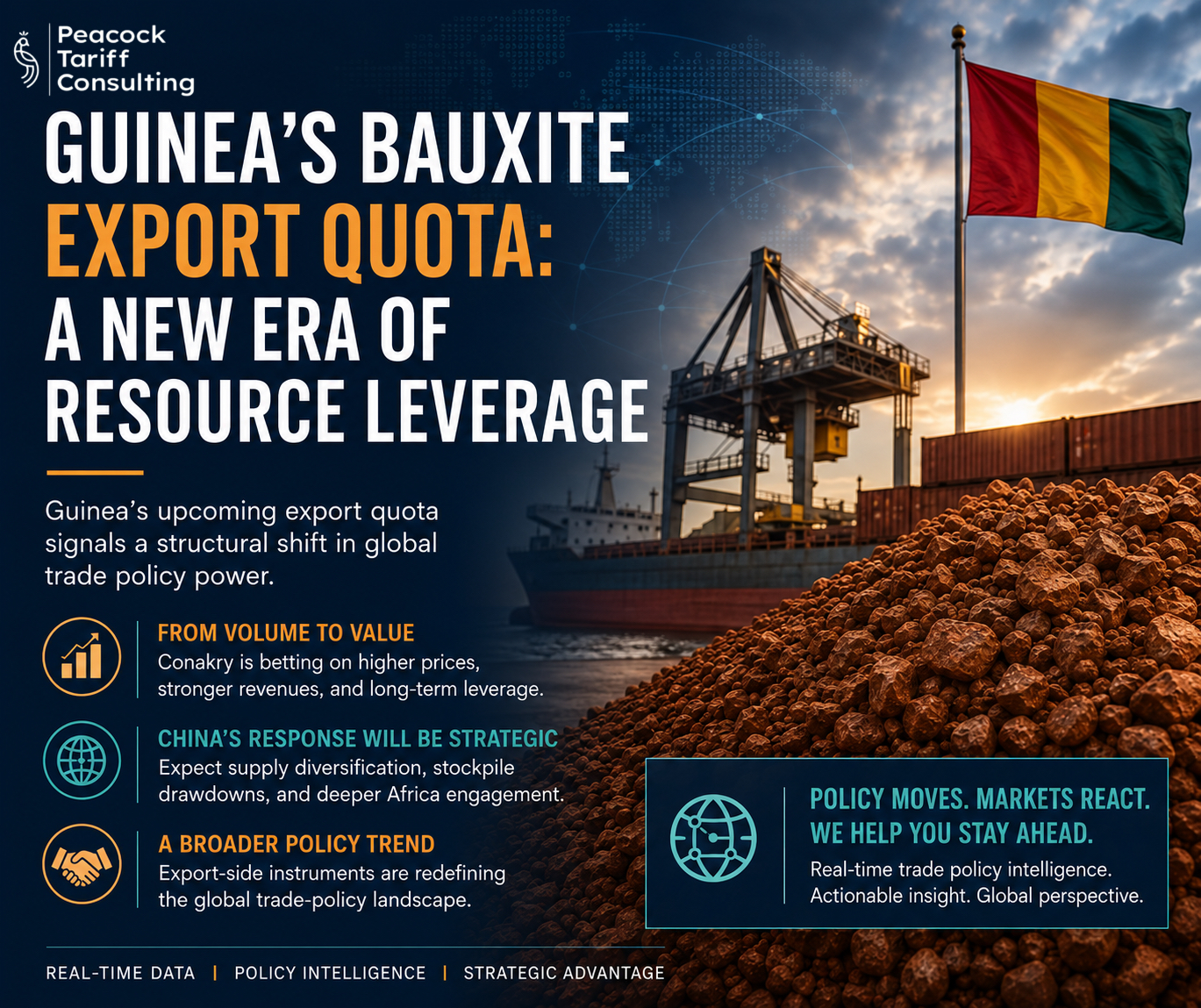
Peacock Tariff Consulting | Trade Policy & Critical Minerals Brief | 26 May 2026 China’s aluminum industry is preparing for significant disruption to its raw materials supplies after Guinea, the world’s biggest bauxite producer, said it is finalizing plans to limit exports of the ore. The headline is simple. The downstream consequences for alumina margins,…
-

Prime Minister Narendra Modi and Vietnamese President To Lam met in New Delhi in early May 2026 and walked out with thirteen memoranda of understanding, an upgraded “Enhanced Comprehensive Strategic Partnership,” and a stated goal of pushing bilateral trade from a record $16.46 billion in 2025 to $25 billion by 2030. The headlines were artificial…
-

On May 4, 2026, Canadian Pacific Kansas City (CPKC) and CSX flipped the switch on a fully dedicated Southeast Mexico Express (SMX) intermodal train, a single-line, premium service connecting the U.S. Southeast directly with Texas and Mexico. The launch caps eighteen months of joint work that began in December 2024, when the two Class I…
-

Peacock Tariff Consulting | Insights for U.S. Importers The Refund Opportunity Most Importers Are Missing For most U.S. importers, the duties paid at the border feel like a closed chapter. The entry is filed, the broker invoices clear, and the goods move on into the supply chain. What very few companies realize is that those…
-
In April 2026, Beijing rolled out two new regulations that raise the cost of doing what foreign companies have been doing for years: trying to comply with Western law and de-risk their supply chains. Equating Supply Chain to National SecurityState Council Order 834, issued April 7, gives the Chinese government broad authority to penalize any…
-
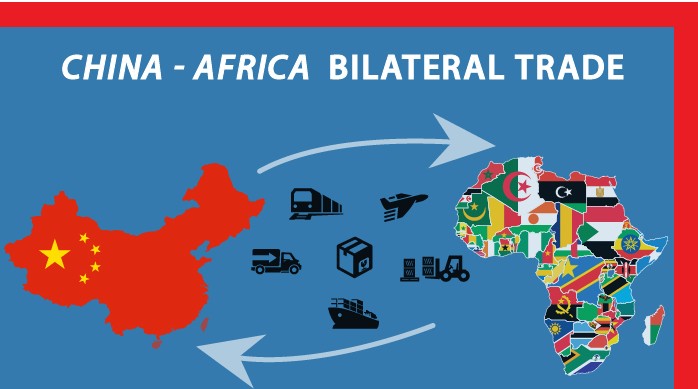
What Beijing’s new zero-tariff architecture means for trade, geopolitics, and the global pushback against protectionism. On May 1, 2026, China’s customs barriers fell for almost an entire continent. Imports from 53 of Africa’s 54 countries now enter the Chinese market at a zero tariff across 100 percent of tariff lines, an unusually broad preference that…
-

In April 2026, Maersk issued an urgent advisory telling its vessels to avoid the Strait of Hormuz entirely. The notice landed four months after the same carrier had cautiously resumed Red Sea transits following the late-2025 Gaza ceasefire. This sequence of events captures the condition of global shipping this year. Recovery in one corridor is…
-
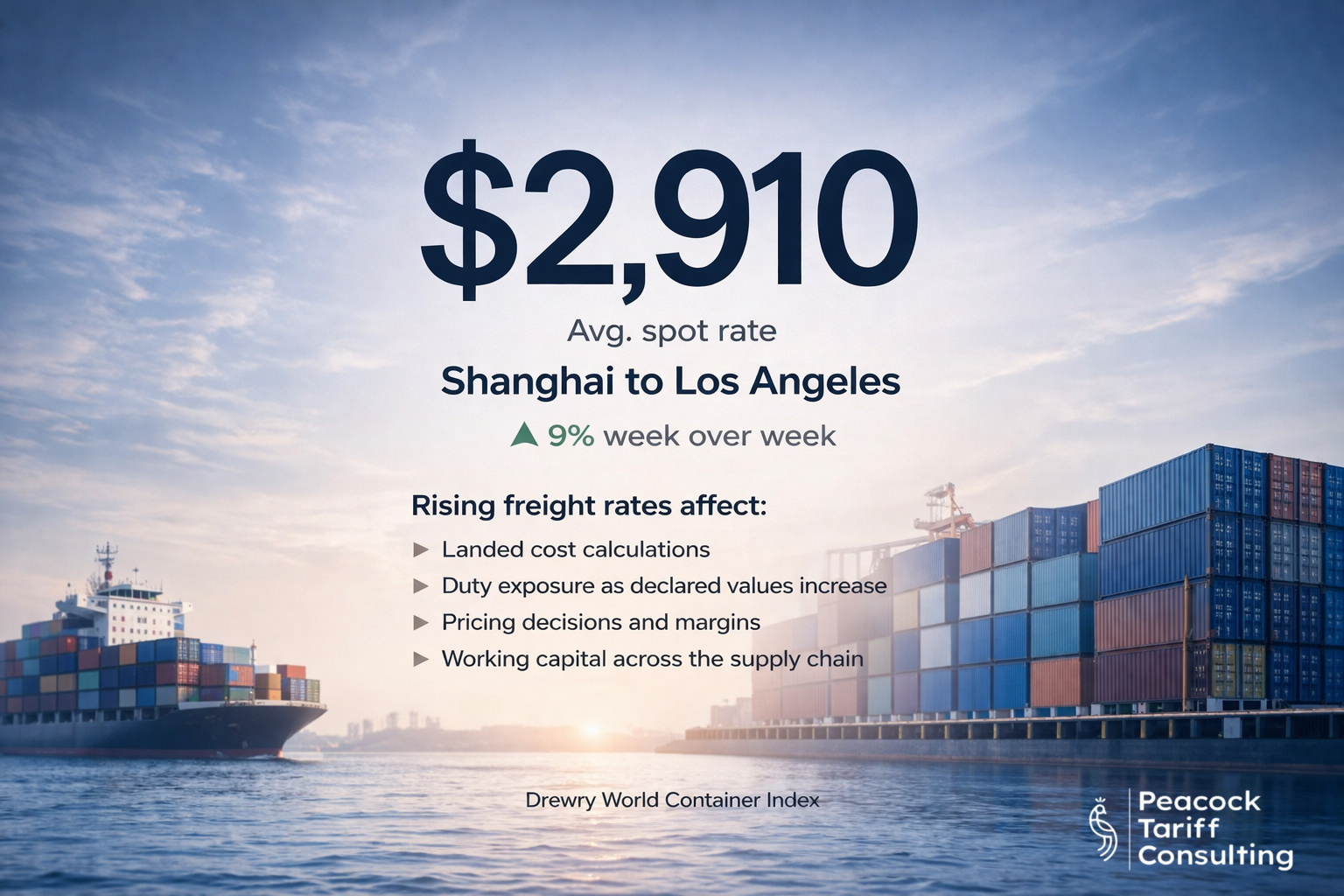
The cost of moving goods across the Pacific is surging once more. Last week, the average spot rate to ship a 40-foot container from Shanghai to Los Angeles reached $2,910, a 9% jump in just seven days. For anyone who lived through the volatility of 2021 to 2022, this number carries a familiar sting. But…
-
The Reciprocal Tariff Era Reciprocal tariffs mirror the rates other countries impose on U.S. exports. In practice, they have created a complex, multi-layered environment that changes frequently and affects different products and countries differently. Current State of Reciprocal Tariffs Actions have been taken against a broad range of trading partners under several legal authorities. Some…
-
The Price on the Invoice Is Not the Cost By the time goods reach your warehouse, additional costs have been added: freight, insurance, customs duties, processing fees, broker fees, inland transportation, and more. Many importers either do not calculate landed cost or calculate it incorrectly. Components of Landed Cost Product cost (varies by Incoterms), international…