
COSCO’s Operational Suspension: From Policy to Practice
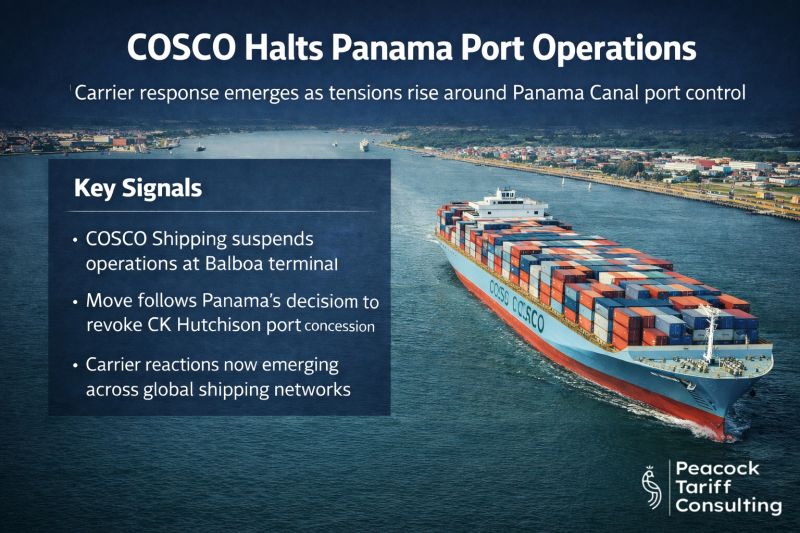
In a significant escalation of Panama Canal port disputes, Chinese state-backed shipping giant COSCO Shipping has suspended operations at the Balboa port terminal on the Pacific side of the Panama Canal. This move represents a critical transition point in the ongoing dispute over Panamanian port control, shifting the issue from theoretical policy debates to immediate operational consequences affecting global container flows.
COSCO’s decision to halt operations at Balboa was not made lightly. The company operates some of the world’s largest container ships and maintains strategic positioning across nearly every major global trade lane. Voluntarily withdrawing from a major transshipment hub carries significant costs-foregone revenue, disrupted service commitments, and reduced competitive positioning on Pacific-to-Atlantic routes.
The suspension follows Panama’s decision to revoke the concession previously held by Hutchison Port Holdings, a Hong Kong-based operator that had maintained terminal operations in Panama for decades. In its place, Panamanian authorities moved to shift control to new operators perceived as more aligned with Panamanian national interests. For COSCO, a state-backed Chinese entity facing increasing geopolitical scrutiny globally, the political environment surrounding port operations had become untenable.
- COSCO suspended Balboa terminal operations citing management transition
- Triggered by Panama’s revocation of Hutchison Port Holdings concession
- Shift to new operators perceived as more nationalistic
- Reflects broader geopolitical tension between China and Western-aligned nations
Balboa’s Strategic Importance: Why This Port Matters for Global Supply Chains
Balboa, located on the Pacific side of the Panama Canal, functions as one of the world’s most critical transshipment hubs. Its geographic position creates a natural hub for connecting Asia with both the U.S. East Coast and Latin American markets. Containers arriving from Shanghai, Singapore, or Hong Kong can be transferred to smaller feeder vessels at Balboa for distribution throughout the Caribbean and Eastern Seaboard.
The Pacific side of the Panama Canal typically handles approximately 5-6 million containers annually across its major terminals. Balboa, managed under the concession structure that Hutchison previously held, represented a significant portion of this traffic. The terminal’s efficiency, modern equipment, and established service relationships with major carriers made it an integral component of most Asia-to-Atlantic service loops.
For supply chains moving electronics, apparel, automotive components, and machinery from Asia to North America, Balboa offers compelling economics. The alternative-direct routing to U.S. East Coast or Gulf Coast ports-requires larger container ships, longer transit times, and canal transit fees that often exceed transshipment costs. Balboa’s removal from service forces carriers to reconsider established routing patterns and invest in alternative infrastructure.
- Balboa handles 5-6 million containers annually
- Central transshipment hub for Asia-to-Atlantic routes
- Efficient container handling enables cost-competitive service loops
- Serves as connection point for 40+ country destination networks
- Loss of capacity forces route optimization across industry
The Domino Effect: How Carrier Withdrawals Disrupt Established Service Networks
COSCO’s withdrawal from Balboa is not an isolated incident but rather a visible symptom of broader reconfiguration in global container shipping. When a major carrier reduces presence at a critical port, downstream effects cascade through the entire shipping network. Container flows that previously moved through established service loops must be rerouted, requiring new arrangements with competing carriers, extended transit times, and operational inefficiency.
Service loops in container shipping are carefully engineered networks designed to maximize vessel utilization and minimize port turnaround time. A typical Asia-to-Atlantic loop involves loading cargo in Asian factories, moving north to Southeast Asian consolidation ports, transiting the Panama Canal, transshipping at Balboa or competing Atlantic ports, and final delivery to U.S. or European destinations. When a carrier withdraws from a critical node, the entire loop becomes less efficient.
MSC and Maersk, the two largest container carriers, have both demonstrated willingness to shift their port strategies based on geopolitical considerations and operator reliability. Their patterns of service adjustment provide templates for COSCO’s decision. When operators change, uncertainty increases about service quality, equipment availability, and turnaround times. Rather than accept this uncertainty, COSCO prefers operational withdrawal.
- Service loops depend on established port relationships
- Carrier withdrawal forces loop reconfiguration
- Alternative routing increases transit times 3-7 days
- Operational uncertainty drives carrier decisions away from Balboa
- Industry leaders MSC and Maersk have demonstrated similar adaptive behavior
Geopolitical Considerations: State-Backed Carriers and Port Control
Behind COSCO’s operational decision lies a fundamental geopolitical reality: state-backed carriers now operate within constrained diplomatic and political spaces. COSCO, as a subsidiary of China State Shipping, faces reputational and operational risks from any perceived compliance with or benefit from geopolitically sensitive arrangements.
Panama’s decision to shift port control away from Hutchison reflects broader concerns about foreign corporate control over strategic infrastructure. However, the new operators have not yet achieved the operational track record or international reputation that attracted carriers to Hutchison-managed ports. For COSCO, bearing the reputational cost of operating within a contested governance structure was not acceptable, particularly given escalating scrutiny of Chinese corporate involvement in critical global infrastructure.
This dynamic extends beyond Panama to other strategic chokepoints. Port authorities worldwide are reassessing concessionaire arrangements, particularly when they involve foreign operators or foreign-backed shipping lines. COSCO’s withdrawal signals that geopolitical considerations now rank equally with economic efficiency in carrier port selection strategies.
- COSCO faces diplomatic constraints as state-backed carrier
- Geopolitical considerations compete with economic optimization
- Infrastructure control increasingly seen as strategic national asset
- Foreign operators facing scrutiny at major chokepoints globally
- Carriers withdrawing to avoid contested governance arrangements
Supply Chain Implications: Routing Flexibility and Port Redundancy
For logistics managers and supply chain planners, COSCO’s withdrawal from Balboa reinforces a critical lesson: port concentration creates vulnerability. When a single port becomes essential to cost-optimized supply chains, any disruption to that port immediately creates network-wide impact.
Companies relying on Balboa as their sole transshipment point for Asia-to-Atlantic routes now face three primary options. First, they can accept higher-cost direct sailings to U.S. East Coast ports. Second, they can shift cargo volume to alternative transshipment hubs such as Santos (Brazil), Kingston (Jamaica), or Cartagena (Colombia), accepting longer transit times or higher transshipment fees. Third, they can diversify across multiple transshipment points, accepting operational complexity in exchange for network resilience.
The strategic implication is that true supply chain resilience requires redundancy. For companies moving significant cargo across the Panama Canal, maintaining relationships with multiple ports, multiple carriers, and multiple service loops provides flexibility to absorb disruptions. COSCO’s withdrawal, while potentially creating short-term friction, accelerates this realization across the supply chain industry.
- Single-port concentration creates network vulnerability
- Diversification across multiple transshipment points increases resilience
- Alternative routes available but at higher cost or longer transit
- Supply chain leaders evaluating port redundancy strategies
- Carrier diversity reduces exposure to individual carrier decisions
The Panama Canal as Strategic Chokepoint: Broader Implications for Global Trade
COSCO’s withdrawal from Balboa must be understood within the broader context of Panama Canal geopolitics. The canal itself remains a strategic chokepoint through which approximately 5 percent of global maritime trade transits. The canal’s importance has only increased as containerization consolidated, making efficiency at Panama essential for global supply chain optimization.
However, the canal’s governance and operator relationships are increasingly contested. Nicaragua has proposed alternative canal proposals funded by Chinese investors. Chinese entities have invested in port infrastructure at both ends of the canal. These developments create perceptions-whether justified or not-of Chinese strategic interest in controlling or influencing canal operations.
The U.S. government has expressed concerns about Chinese influence over Panama Canal operations and infrastructure. These geopolitical tensions create an uncomfortable operating environment for Chinese carriers. COSCO’s withdrawal should be read as a recognition that maintaining presence at contested facilities carries reputational and operational risks that outweigh economic benefits.
- Panama Canal handles 5 percent of global maritime trade
- Chinese investment and involvement increasingly visible at canal
- U.S. security concerns about Chinese influence over chokepoint
- Geopolitical tensions creating operational uncertainty for all carriers
- Canal governance structure becoming focal point of great power competition
Forward Outlook: Adaptation and New Equilibrium
As the logistics industry adjusts to COSCO’s withdrawal and the broader instability in Panama port operations, several developments seem likely. First, other carriers will adjust their routing and port strategies based on evolving political conditions. Second, alternative transshipment hubs will experience increased investment and traffic as shippers diversify away from Panama. Third, container shipping alliances will reconsider network topology to reduce dependence on single chokepoints.
For supply chain professionals, the critical takeaway is that geopolitics increasingly determines logistics network structure. Efficiency metrics alone no longer determine optimal routing-geopolitical risk, operational stability, and governance arrangements now rank equally in port and carrier selection decisions.
Looking ahead, expect continued carrier portfolio adjustments at strategically contested ports globally. Companies should proactively develop multi-modal and multi-carrier strategies that incorporate geopolitical risk assessment. The era of treating port infrastructure and carrier relationships as stable, long-term commitments has passed. Adaptive capacity, scenario planning, and network redundancy now define supply chain sophistication.
- Alternative transshipment hubs will capture displaced Balboa traffic
- Carriers developing geopolitically-informed routing strategies
- Alliances optimizing networks around stable, uncontested infrastructure
- Shippers evaluating carriers based on geopolitical stability, not just efficiency
- Long-term contracts increasingly including political risk assessment clauses