
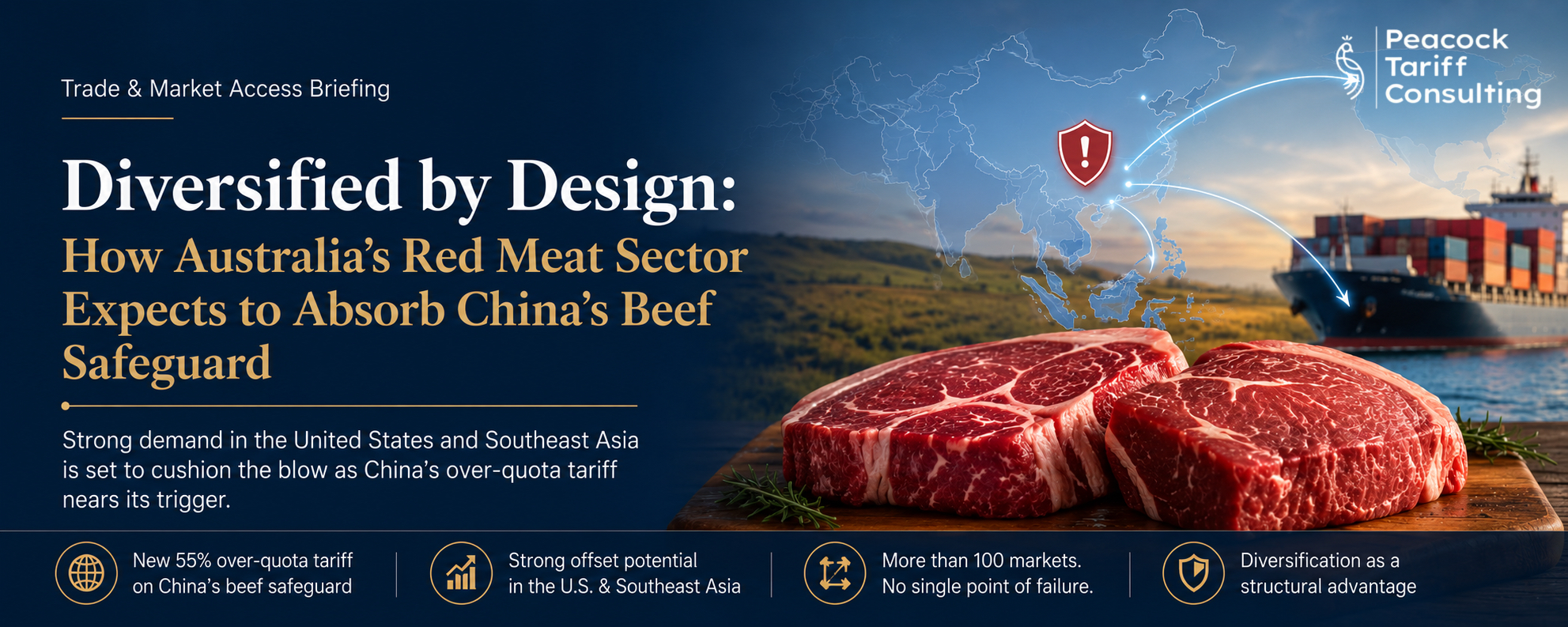
Australia’s red meat industry is entering the second half of 2026 with an unusual mix of confidence and caution. A new Chinese safeguard measure on imported beef capable of imposing a punishing 55 percent over-quota tariff once Australia’s annual allocation is exhausted is widely expected to bite as early as mid-June. Yet the prevailing message from exporters, processors and the sector’s peak marketing body is not one of crisis. It is that buoyant demand in the United States and across Southeast Asia should largely offset the disruption, allowing producers to reroute product that would otherwise have gone to China and to do so into markets that are, for now, hungry for every tonne Australia can ship.
That confidence rests on a simple structural fact: Australia sells beef to more than 100 countries, and no single market not even China is large enough to dictate the fortunes of the whole industry. The episode is shaping up as a real-world test of the diversification thesis that Australian agricultural exporters have repeated since the trade frictions of the early 2020s. This briefing sets out what China has actually done, why its design hits Australia harder than the headline rate suggests, when the tariff is likely to trigger, and how robust the case for offsetting demand really is.
What China announced
On 31 December 2025, China’s Ministry of Commerce concluded a year-long safeguard investigation into imported beef and announced a package of trade restrictions effective from 1 January 2026. The investigation, launched in December 2024 after complaints from domestic cattle breeders, found that a surge in imports had caused serious injury to China’s domestic industry. The numbers are stark: Chinese beef imports rose 73.2 percent between 2019 and 2024, climbing from 1.66 million tonnes to a record 2.87 million tonnes.
The remedy is a three-year safeguard built around a country-specific tariff-rate quota system. For 2026, the aggregate import quota across covered exporters is set at 2.7 million tonnes roughly in line with the record 2024 trade. Each major supplier receives its own in-quota allocation; once that allocation is filled, any further shipments face an out-of-quota tariff of 55 percent. The measure covers chilled and frozen beef but excludes offal and beef variety meats, and it is scheduled to expire after three years. A small group of lesser suppliers, including Russia, Belarus, Colombia and Paraguay, sits outside the regime.
For Australia the design is doubly painful. The China-Australia Free Trade Agreement, in force since December 2015, had progressively eliminated tariffs on Australian beef and was understood to cap any safeguard at 12 percent. The new measure overrides that expectation, applying the same 55 percent over-quota rate that hits non-FTA suppliers. Australia’s 2026 safeguard quota is 205,000 tonnes equivalent to only about 75 percent of the volume it shipped to China in 2025 rising marginally to 209,000 tonnes in 2027 and 213,000 tonnes in 2028. In practice, that means a meaningful slice of established trade has no tariff-free home in China this year.
The episode also needs to be read against the broader arc of the Australia-China trade relationship. Beef is one of the last major Australian agricultural exports to face a Chinese barrier after a turbulent period that earlier saw restrictions on barley, wine, coal, timber and lobster, most of which were subsequently unwound as diplomatic relations stabilised. Unlike those earlier measures, the beef safeguard is framed not as a bilateral dispute but as a broad, multi-country industry-protection action a distinction the Australian government has been keen to emphasise. That framing matters for the offset argument: a measure aimed at protecting China’s domestic cattle herd is less likely to be reversed by diplomacy than a politically motivated, country-specific block, which means the industry is treating diversification as a structural adjustment rather than a temporary detour.
Why the allocation stings
China set its country allocations using import data from July 2021 to June 2024, a reference window that rewards suppliers who aggressively expanded volume during that period and penalises those whose trade was steadier. The result is a set of quotas that industry bodies have called inconsistent and, in Australia’s case, unfair. The table below shows how the allocations compare with recent trade.
| Exporter | 2026 safeguard quota | Recent annual volume | Headroom vs. trade |
| Australia | 205,000 t | ~250,000 t (2025, China + HK) | Tight ~75% of trade |
| Brazil | 1.106 mt | ~1.38 mt (2025) | Tight ~80% of trade |
| Argentina | 511,000 t | ~435,000 t (2025) | Ample headroom |
| Uruguay | 324,000 t | ~188,000 t (Jan-Nov 2025) | Ample headroom |
| New Zealand | 206,000 t | ~109,000 t (2025) | Ample headroom |
| United States | 164,000 t | ~55,000 t (Jan-Nov 2025) | Ample, but plant access limited |
Sources: China Ministry of Commerce safeguard schedule; Beef Central; Meat & Livestock Australia. Volumes approximate and rounded.
The pattern is telling. South American exporters which together account for nearly 80 percent of China’s beef imports and therefore did the most to displace domestic Chinese product emerged comparatively favoured. Argentina received a 2026 safeguard of 511,000 tonnes against roughly 435,000 tonnes of actual trade, and Uruguay was handed 324,000 tonnes against about 188,000 tonnes shipped in the first eleven months of 2025. New Zealand’s 206,000-tonne quota is close to double its 2025 volume. By contrast, Brazil the dominant single supplier, sending well over half of its total beef exports to China was squeezed to about 80 percent of its recent trade, and Australia to roughly 75 percent.
Australia supplied just 8 percent of China’s beef imports in 2024, yet finds its access curtailed more sharply than several larger-volume competitors. The Australian Meat Industry Council described the outcome as rewarding countries that surged their exports while penalising a long-standing, reliable trading partner. The practical upshot is that, on 2025 volumes, around 50,000 tonnes of Australian beef that historically flowed to China and Hong Kong will need to find alternative buyers this year, or accept the 55 percent impost a burden trade sources uniformly describe as prohibitive.
The mid-2026 trigger point
The quota operates on a first-come, first-served basis administered by China’s General Administration of Customs, which creates an unusual front-loading dynamic. Because exporters have an incentive to ship before the allocation closes, the quota fills faster than steady-state trade would imply. By 25 March 2026, Australian shipments had already reached 50 percent of the 205,000-tonne allocation. By May, Beijing was signalling that Australia sat at around 80 percent. On current trajectories, the quota is expected to be exhausted somewhere between mid-May and early June, which is why analysts widely expect the 55 percent over-quota tariff to begin applying to Australian beef as early as mid-June.
From that point, the economics flip abruptly. Australian beef arriving in China after the trigger would carry a tariff that no commercial buyer or seller can absorb, effectively closing the market for additional volume for the remainder of the calendar year. The question for the industry is therefore not whether trade to China will be interrupted it almost certainly will be from mid-year but whether the displaced product can be absorbed elsewhere without collapsing prices. That is where the offsetting-demand argument does its work.
The United States: a structural pull
The single most important reason the Australian industry is sanguine is the state of the United States market. The US cattle herd sits at multi-decade lows by some measures the smallest in around 70 years after years of drought-driven liquidation, and rebuilding the herd will, if anything, tighten domestic slaughter further before it loosens. The US Department of Agriculture expects American beef production to stagnate or fall in 2026, even as consumer demand remains strong. The arithmetic of that gap is simple: the United States must import.
USDA’s Foreign Agricultural Service forecasts US beef imports rising again in 2026, on top of a double-digit increase in 2025, driven by tight domestic supply and persistent demand for lean manufacturing beef used in ground-beef blends. Australia is the natural supplier of those lean trimmings. Australian beef exports to the United States have surged accordingly, exceeding 40,000 tonnes a month for three consecutive months and cementing Australia as the leading foreign supplier to the US market. The US was already Australia’s largest beef market in 2025, taking 453,292 tonnes up 15 percent year on year.
Crucially, Australia enjoys a competitive edge even after accounting for US trade barriers. A 10 percent US import tariff applies broadly, but because it is levied on competitors too, Australian product retains a decisive advantage over Brazilian and other South American beef in the US market, while New Zealand competes in a similar but smaller niche. US beef prices, meanwhile, have been climbing to record levels USDA has pointed to an annual increase on the order of 12 percent, the largest since the late 1970s which both reflects the supply squeeze and signals how much value imported lean beef can command. For Australian exporters weighing where to send product diverted from China, the US offers not just volume but margin.
There is a competitive twist that works in Australia’s favour. The United States has been slow to restore export access for its own beef into China Beijing delayed reissuing approvals for more than 300 American processing plants so even though the US received a generous 164,000-tonne Chinese quota against just 55,000 tonnes of trade, it cannot easily fill it. That keeps a major rival’s product in the domestic US market and out of Australia’s other destinations, while simultaneously deepening America’s reliance on imported lean beef. In effect, the same herd cycle that makes the US a voracious importer also blunts its ability to compete with Australia for third-country sales, reinforcing the pull that makes the US such a reliable home for redirected volume.
Southeast Asia: premium demand and proximity
If the United States is the volume outlet, Southeast Asia is the strategic one. Australian grainfed beef exports to the region grew more than 18 percent in 2025, propelled by recovering tourism and a foodservice sector that prizes premium, consistent, traceable product. Thailand and Indonesia have both risen into Australia’s top ten grainfed beef markets, joining established destinations such as the Philippines, Vietnam and Malaysia. The region’s appeal is threefold: it is geographically close, lowering freight cost and time; it skews towards the higher-value chilled and grainfed segments where Australia is differentiated rather than merely competitive; and its demand is being driven by structural trends a growing middle class, urbanisation and tourism recovery rather than one-off factors.
Southeast Asia matters for a second, subtler reason. The product most exposed to the China disruption is not uniform. Some of it is frozen manufacturing beef that can be redirected to the United States; some is higher-value chilled product that found a natural home in Chinese restaurants and retail. Southeast Asia’s premium foodservice channel is one of the few alternatives capable of absorbing that chilled, higher-margin volume without a steep discount. For that reason, industry analysts have repeatedly identified the region more than any single large market as the most likely destination for the specific tonnage displaced from China.
Does the offset claim hold up?
The scale of the reallocation challenge is significant but not overwhelming when set against Australia’s record production base. Total Australian beef exports reached 1,545,784 tonnes in 2025, up 15 percent on the prior year, and 2026 is shaping as another record, with shipments projected to climb towards 2.3 million tonnes carcase weight on the back of a large herd and abundant supply. Against that backdrop, redirecting roughly 50,000 tonnes the volume that loses tariff-free China access on 2025 figures is a demanding logistical exercise but a manageable fraction of total trade, provided alternative markets have appetite. On present evidence, they do.
The estimated financial hit frames the stakes. The Australian Meat Industry Council and Cattle Australia have warned the measure could reduce exports to China by about a third and put more than A$1 billion of trade at risk over its duration. That figure is real, and it represents lost value rather than purely lost volume, because China was an outlet for certain cuts and grades that command strong prices there. But the phrase largely offset is a claim about net effect, not a claim that the disruption is costless. The industry’s position is that strong pricing and volume in the US and Southeast Asia, arriving at precisely the moment China closes, should recover most not necessarily all of the value at risk.
Risks and caveats
Several factors could erode the offset. The first is the prospect of global market distortion late in the year. Australia is not the only supplier facing a binding quota; Brazil, with far greater volume committed to China, will hit its own ceiling and must divert product somewhere. If large volumes of South American beef are simultaneously rerouted into the same alternative markets, the resulting oversupply could depress prices precisely when Australian exporters are leaning on those outlets. The US Meat Export Federation has flagged exactly this risk of distortion in the latter part of the calendar year, when multiple safeguards are expected to trigger.
The second caveat is value composition. China was not simply a volume buyer; it absorbed particular cuts, offal-adjacent products and chilled grades whose value is not perfectly replicated elsewhere. Even if total tonnage finds a home, the blended price Australia realises on diverted product may be lower than what China paid, leaving a residual margin gap that headline volume figures obscure. Third, the first-come-first-served administration creates execution risk: without a transparent, timely system for tracking quota fill, exporters face uncertainty about exactly when the tariff wall goes up, complicating contracts and shipments scheduled around the trigger date.
Finally, there is concentration risk in the very solution being proposed. Leaning more heavily on the United States deepens Australia’s exposure to a single market whose own trade policy has proven volatile, and whose import appetite is a function of a cyclical herd low that will eventually reverse as rebuilding takes hold. Diversification away from China that simply re-concentrates risk in the US would leave the industry exposed to the next shock. The Southeast Asian channel mitigates this, but it cannot by itself absorb the full volume the US currently takes.
Industry and policy response
Australia’s institutional response has combined disappointment with pragmatism. Meat & Livestock Australia, the sector’s marketing and research body, stressed that it had engaged with China throughout the investigation, argued consistently that Australian exports were not the cause of injury to China’s domestic industry, and committed to keep promoting Australian beef in China through its in-market offices signalling that the relationship is being managed for the long term rather than abandoned. The Australian Meat Industry Council was sharper, calling the restrictions unfair and inappropriate and pledging strong representations to both the Australian and Chinese governments.
At the political level, Prime Minister Anthony Albanese sought to frame the measure as a broad Chinese policy rather than a targeting of Australia, noting that officials were in contact with Beijing and emphasising the global demand for Australian product. The opposition was more pointed, with Nationals leader David Littleproud citing the A$1 billion risk and pressing for urgent diplomatic intervention. Beneath the political exchange, the operational priority for industry is clear: stand up workable quota-tracking and market-diversion processes quickly, and accelerate market-development work in Southeast Asia and other growth destinations to lock in the demand the offset thesis depends on.
Outlook
The most likely path through 2026 is a sharp interruption to Australia-China beef trade from around mid-June, followed by a redistribution of displaced volume that the market absorbs without a severe price collapse though not without friction, and not without a measurable value cost concentrated in the higher-grade product China favoured. The strength of US import demand at a multi-decade herd low, combined with structural growth in Southeast Asian premium consumption, gives the diversification thesis a credible foundation. Australia enters this disruption from a position of record production, record exports and a genuine competitive edge in its two largest growth markets.
The risks are equally real: simultaneous diversion by Brazil and others could distort prices in the back half of the year, the value mix of diverted product may not fully match what China paid, and an over-reliance on a cyclically tight US market carries its own hazards. For trade and policy professionals, the episode is best read not as an isolated tariff event but as a stress test of supply-chain diversification under a politically driven, quota-based barrier. On the evidence available in mid-2026, Australia’s red meat sector looks well placed to pass that test bruised at the margin, but broadly intact, and arguably less dependent on any single market than before the safeguard was imposed. The phrase to watch through the second half of the year is the industry’s own: not unaffected, but largely offset.