
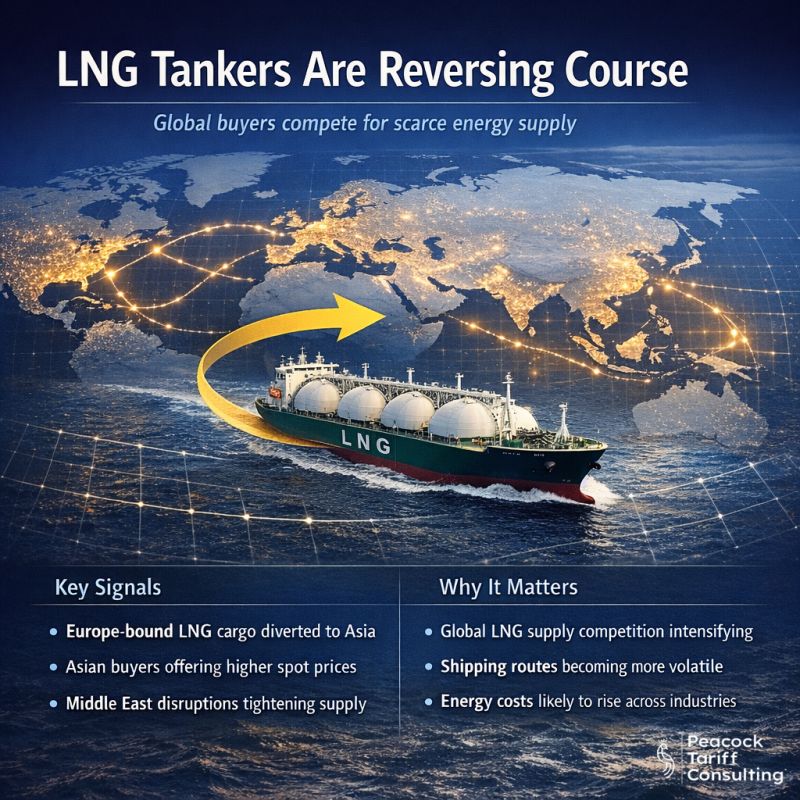
Mid-Voyage Cargo Redirection and Price Arbitrage Dynamics
Liquefied natural gas tankers that were originally destined for Europe have literally reversed course mid-voyage and are redirecting to Asian markets, seeking higher prices for LNG cargo. A significant Europe-bound LNG tanker recently turned around to pursue Asian spot market demand after evaluating relative prices in competing markets. This dramatic mid-voyage reversal reflects extreme price differentials between European and Asian LNG markets, where Asian spot prices exceed European prices by sufficient margins to justify the operational costs of changing course, altering delivery schedules, and rerouting cargo.
The mid-voyage reversal is extraordinary because it involves deviation from contractual arrangements, rerouting of vessels, and substantial operational complexity. Tankers carrying LNG must maintain extremely low temperatures during transport, and rerouting involves accessing different port infrastructure and unloading facilities. The fact that operators are willing to incur the operational costs and logistical complexity of mid-voyage reversal indicates that the price differential between European and Asian markets has become extreme. The arbitrage opportunity is sufficiently valuable that rerouting is economically justified despite the operational disruption.
- Europe-bound LNG tanker reversed course mid-voyage
- Cargo redirected to Asia for higher spot prices
- Mid-voyage rerouting reflects extreme price differential
- Arbitrage opportunity justifying operational costs and complexity
Energy Market Disruptions Constraining European Supply
The redirection of LNG cargo away from Europe reflects Middle East energy disruptions constraining normal supply flows. The Strait of Hormuz disruption has constrained LNG exports from Qatar and other Gulf producers that normally supply European markets. This supply constraint has pushed European LNG prices upward as buyers compete for limited available supply. Simultaneously, Middle East disruptions have not similarly affected Asian markets, where alternative supply sources from Australia, Indonesia, and other Pacific suppliers provide competitive supply. The divergence between European supply constraint and Asian supply availability creates the price differential driving cargo redirection.
European natural gas prices have spiked as buyers compete for constrained LNG supplies and as alternative gas pipeline supplies face disruption. The combination of supply constraint and geopolitical uncertainty has elevated European natural gas prices to levels significantly above Asian prices. This price divergence creates arbitrage opportunity: buy LNG at Middle East prices, redirect to Asia where prices are higher, and capture the price differential. The economics of arbitrage are sufficiently attractive that operators are willing to breach contractual arrangements with European customers.
- Strait of Hormuz disruption constraining Qatar LNG exports
- European LNG supply constrained relative to demand
- Asian LNG supply more abundant from multiple sources
- Price divergence creating profitable arbitrage opportunity
Asian Demand Competition and LNG Supply Redirection
Asian demand for LNG is surging as Japan, Korea, India, and other Asian economies compete aggressively for spot market cargo. Japan’s post-winter demand has not normalized as quickly as historically typical, with Japanese buyers maintaining elevated purchasing to ensure adequate inventory buffers. South Korea faces industrial demand for natural gas and is competing for available spot cargo. India is aggressively developing natural gas infrastructure and increasing spot market purchases. This competitive demand from multiple Asian buyers is driving Asian LNG prices to levels exceeding European prices.
The Asian competition for spot market LNG is being driven by multiple factors. Post-winter inventory rebuilding in Japan, industrial demand in Korea, development of new gas markets in India, and general economic growth supporting energy demand are all driving Asian LNG purchases. Simultaneously, Middle East supply constraints have reduced available spot market cargo. The combination of surging Asian demand and constrained global supply has created a situation where Asian spot prices exceed European prices, attracting supply redirection from Atlantic to Pacific basin.
- Japan rebuilding inventories post-winter at elevated volumes
- South Korea industrial demand supporting elevated purchases
- India expanding natural gas markets and purchasing aggressively
- Multiple Asian buyers bidding up spot market prices
Shipping Route Economics and Longer Distances
The redirection of LNG cargo from Europe-bound routes to Asia involves dramatically longer shipping distances and higher transportation costs. A tanker redirecting from Europe-bound journey to Asian delivery must traverse additional thousands of kilometers, adding weeks to voyage duration and increasing fuel consumption. The substantial increase in voyage distance increases shipping costs and extends transit time. However, the price differential between European and Asian markets is currently sufficiently large that the additional shipping costs and extended voyage time are economically justified.
The longer shipping routes from Middle East to Asia versus Europe reflect the geographic distribution of LNG markets. The traditional arbitrage was Europe receiving Middle East LNG via Suez Canal route, but current price differentials have reversed the economics. Instead of flowing to Europe, cargoes are now being redirected to Asia via longer routes. This represents a fundamental shift in LNG flow patterns driven by price signals. The new routing pattern will persist as long as Asian prices exceed European prices by sufficient margin to compensate for additional distance and time.
- Middle East to Asia routes 4,000+ km longer than to Europe
- Additional distance increasing fuel consumption and transit time
- Higher shipping costs reflected in final delivered prices
- Price differential currently compensating for additional distance
Rising Energy Costs and Global Competition for Constrained Supply
The redirection of LNG cargo and resulting supply constraint in Europe reflect the broader reality that global energy markets are increasingly competitive. When energy is constrained, buyers with higher willingness to pay can attract supply away from lower-praying regions. Asian economies with strong industrial demand and developing energy infrastructure are demonstrating higher willingness to pay for spot market LNG than European buyers accustomed to lower historical prices. This competitive dynamic is reshaping global energy supply patterns.
The higher energy costs that result from this competition are being felt throughout European supply chains. Natural gas prices directly affect industrial production costs, heating costs, electricity generation costs, and countless downstream processes. European manufacturers competing against global competitors are facing higher energy costs, creating competitive disadvantage. This competitive disadvantage is being particularly felt in energy-intensive industries including chemicals, petrochemicals, metals refining, and fertilizer production. The supply redirection is therefore creating competitive pressure on European manufacturers.
- European buyers facing supply competition from Asian markets
- Higher prices deterring some European consumption
- Energy-intensive industries facing elevated production costs
- European competitiveness pressured by higher energy costs
Structural Shift in Energy Supply Patterns
The mid-voyage cargo redirection and supply pattern shift may represent more than a temporary response to short-term price signals. If the Strait of Hormuz disruptions persist and Middle East supply remains constrained, LNG supply patterns may experience lasting shift from Atlantic to Pacific basin. Suppliers may prefer selling to Asian markets at higher prices rather than committing cargo to European markets. European buyers may need to develop alternative supply sources or accept permanently higher energy costs. The current disruption may be catalyzing a permanent restructuring of global energy flows.
The implications for European energy security are significant. If LNG supply increasingly flows to Asia rather than Europe, European energy security becomes more dependent on alternative sources including Russia (geopolitically problematic), North Africa (logistically limited), and domestic renewable development. The redirection of energy supply away from Europe is creating strategic pressure on European energy policy. This pressure may accelerate investment in renewable energy, nuclear power, and energy efficiency, but near-term adjustment costs are substantial.
- Supply pattern shift potentially permanent if disruptions persist
- European energy security becoming dependent on alternatives
- Renewable and nuclear investment becoming more urgent
- Near-term energy costs likely to remain elevated
Market Outlook and Resolution Scenarios
The persistence of LNG cargo redirection depends on the duration of Strait of Hormuz disruptions and the resulting constraint on Middle East supply. If disruptions resolve within weeks or months, normal supply patterns can normalize and European supply can recover. If disruptions persist longer, the structural shift to Asian markets may cement permanently. The critical variable is the resolution of Middle East energy constraints.
Short-term outlook expects continued Asian price premium for LNG, continued cargo redirection from Europe to Asia, and continued high European energy costs. European energy-intensive industries are adjusting production and sourcing to compensate for higher energy costs. If conditions persist through 2026, permanent changes to supply patterns are likely to occur. If conditions resolve by summer 2026, supply patterns may normalize, but the episode will have demonstrated European energy vulnerability to Middle East disruptions.
- LNG cargo redirection likely to persist through Q2 2026
- European energy costs expected to remain elevated
- Permanent supply pattern changes possible if disruptions extend
- Alternative supply development becoming strategic priority