
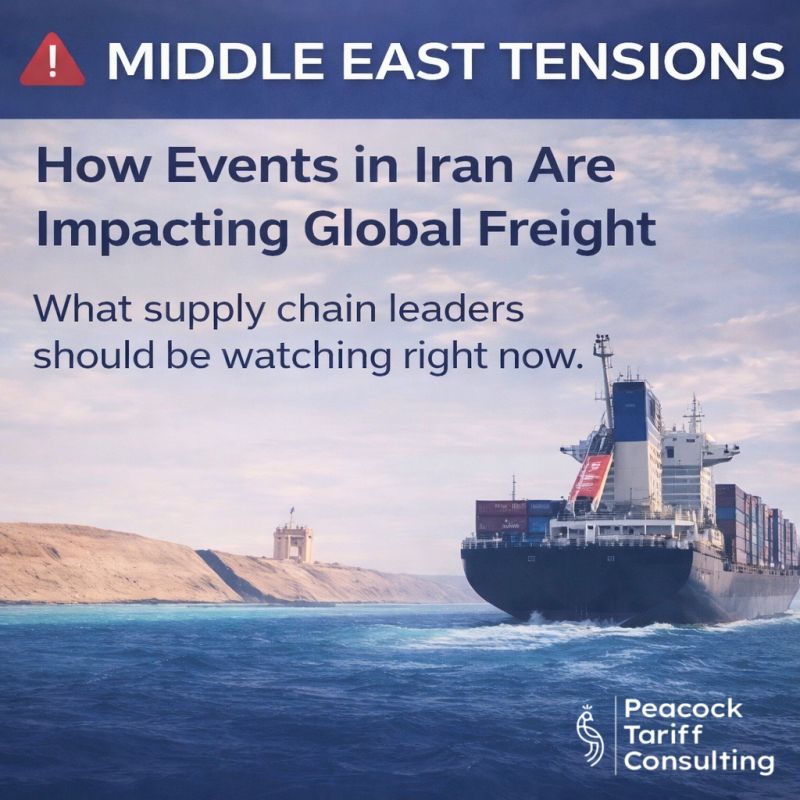
Four Cost Categories Reshaping Global Logistics Economics
Middle East instability now functions as a direct cost driver for global shippers, operating through four distinct but interconnected cost categories that collectively transform the economics of international supply chains. Understanding these categories is essential for any importer or manufacturer sourcing goods from Asia, Europe, or global manufacturers that rely on Middle Eastern logistics corridors.
The four categories-chokepoint volatility, airspace closures, energy price pressure, and insurance/security surcharges-do not operate independently. An incident affecting chokepoint security likely triggers airspace closures, which increases bunker fuel consumption for ships rerouting around closed corridors, which in turn elevates fuel surcharges embedded in freight rates. Understanding the linkages between these categories is essential for modeling total supply chain impact.
Chokepoint Volatility: Strait of Hormuz and Bab el-Mandeb Disruption Risk
The Strait of Hormuz and Bab el-Mandeb represent two of the world’s most critical maritime chokepoints. Approximately one-third of all seaborne trade passes through these straits, making them economically central to global commerce. Instability in these regions creates shipping disruption risk, which shippers price into freight rate calculations through risk surcharges.
When security incidents occur at these chokepoints-reports of attacks on commercial vessels, military activity, or political tensions-shipping companies immediately increase risk premiums built into quoted freight rates. These premiums reflect insurance cost increases, additional security personnel and equipment, rerouting allowances, and potential transit delays. For a single container transiting the Suez Canal to reach North American ports, chokepoint instability can add 5-15% to base freight rates depending on incident severity and frequency.
- Strait of Hormuz: 20-30% of global seaborne oil trade, significant container volume
- Bab el-Mandeb: critical gateway for Red Sea and Suez Canal access
- Risk surcharges: 5-15% freight rate premiums during periods of elevated tension
- Transit delay allowances embedded in rate quotations
Airspace Closures and Extended Shipping Routes: Hidden Fuel Burn Costs
Airspace closures over the Middle East directly impact ocean shipping by forcing vessels to circumnavigate closed corridors, extending transit distances and increasing fuel consumption. When normal routing through shorter corridors becomes impossible due to military activity or security restrictions, ships must select alternate routes adding days of transit and corresponding fuel expenses.
The hidden cost in airspace closures lies in fuel consumption compounding over extended routes. A vessel that normally transits from the Persian Gulf to the Suez Canal in 7-10 days may require 14-18 days if forced to route around closed airspace corridors. Additional days at sea multiply fuel costs (bunker fuel consumption is typically $40,000-80,000 per day depending on vessel size). A 4-8 day extension represents $160,000-640,000 in additional fuel costs for a single vessel, multiplied across fleet operations involving dozens or hundreds of transits during extended closure periods.
- Normal corridor distance: 5,000-7,000 nautical miles
- Extended reroute distance: 8,000-11,000 nautical miles
- Additional fuel consumption: 40,000-80,000 gallons per additional day
- Cumulative cost: $160,000-640,000 per vessel per extended routing
Energy Price Pressure: Bunker and Jet Fuel Escalation
Middle East instability transmits directly into energy markets through supply disruption risk and geopolitical risk premiums embedded in petroleum pricing. Bunker fuel for ocean shipping and jet fuel for air cargo are both petroleum products whose prices incorporate Middle East supply risk. When instability increases, oil prices typically increase in response to perceived supply disruption risk.
The transmission mechanism works through several channels: actual supply disruptions reduce available petroleum supply; anticipatory risk premiums increase fuel prices absent actual supply disruptions; alternative routing and security measures increase fuel consumption for equivalent cargo movement; and investment in strategic reserves and inventory buildup compete with commercial fuel availability. For importers relying on air cargo (time-sensitive electronics, perishables, high-value goods), jet fuel price escalation directly affects transportation cost and transit time economics.
- Oil price premium: 5-20% depending on incident severity and market sentiment
- Bunker fuel impact: $40-80/metric ton surcharges during periods of instability
- Jet fuel impact: 15-35% price increases during significant Middle East events
- Energy surcharges embedded in all freight rate quotations
Insurance and Security Surcharges: The Risk Premium Multiplier
Shipping companies, insurers, and security providers all increase charges in response to Middle East instability. War risk insurance (covering political violence and military action) becomes more expensive. Hull and machinery insurance incorporates elevated risk premiums. Crew insurance reflects increased danger pay for transit through high-risk regions. Private security company charges for armed escorts or onboard security personnel multiply across fleets.
These insurance and security surcharges compound the cost impact of chokepoint volatility, airspace closures, and energy price pressure. A single shipment might bear chokepoint volatility surcharges ($100-300 per container), war risk insurance increases ($500-2,000 per container for high-value goods), crew security premium contributions, and private security company charges. For large shipments or time-sensitive goods, total insurance and security surcharges can exceed $5,000-15,000 per container.
- War risk insurance: $500-2,000 per container during periods of elevated instability
- Additional hull insurance: 0.5-1.5% of cargo value
- Crew security and training: per-vessel charges multiplied across schedules
- Armed escort or onboard security: $5,000-25,000 per vessel transit
Impact on North American SMEs: Higher Freight, Longer Transit, Increased Inventory Costs
The cumulative impact of these four cost categories falls heavily on North American small and medium-sized enterprises that source goods from Asia or rely on global supply chains incorporating Middle Eastern logistics. An SME importing consumer goods from China or Southeast Asia must navigate freight rates that now incorporate chokepoint volatility premiums (5-15%), fuel surcharges reflecting energy price pressure (2-5%), and insurance/security surcharges (1-3%), totaling 8-23% freight cost increases relative to historical baselines.
Beyond freight rate increases, SMEs face operational complexity from transit time uncertainty. Rerouted shipments arriving weeks late disrupt inventory management, requiring either increased safety stock holdings or accepting stockout risk. Inventory carrying costs (storage, insurance, financing) compound as SMEs maintain larger buffers to absorb transit time variability. An SME that previously planned 30-day inventory cycles may now operate 45-50 day cycles, increasing average inventory investment by 30-50%.
- Total freight cost increase: 8-23% above historical baseline rates
- Transit time variability: normal 28-32 days vs. extended reroute 40-60 days
- Inventory carrying cost increase: 30-50% from safety stock expansion
- Working capital requirement increase: compounded across multiple SKUs and product categories
Strategic Response Options for Supply Chain Managers
Supply chain managers responding to Middle East instability cost pressures must evaluate multiple strategic options. Source diversification-identifying alternate suppliers in low-instability regions-reduces Middle East corridor dependence but may involve higher manufacturing costs or quality trade-offs. Inventory optimization-maintaining optimized safety stock levels that balance carrying cost against stockout risk-requires sophisticated demand forecasting and supply chain visibility. Mode optimization-shifting time-insensitive shipments to ocean routes and reserving air cargo for time-critical goods-can reduce total transportation cost despite higher per-unit air freight rates.
Forward contracting with freight carriers provides cost certainty by locking in rates before energy price spikes or insurance surcharge increases, at the cost of losing rate reductions if market conditions improve. Diversified shipping schedules-spreading orders across multiple carriers and sailing dates-reduce exposure to single-carrier reroutes or schedule disruptions. Each option involves trade-offs between cost, risk, and operational flexibility that must be evaluated against company-specific circumstances.