
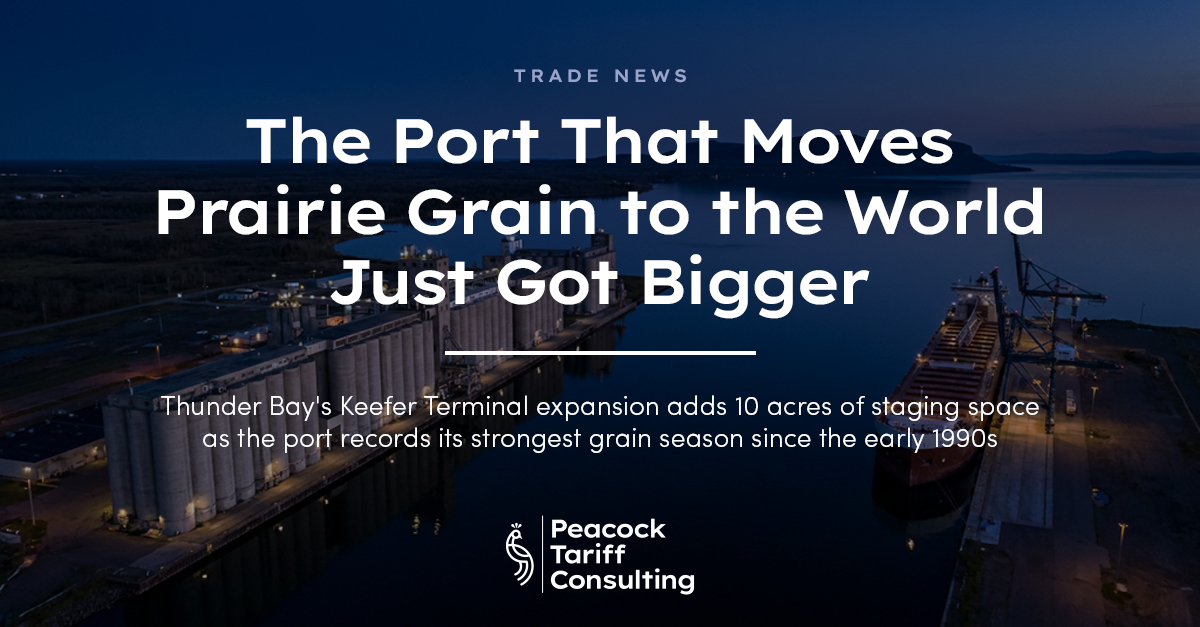
The Port of Thunder Bay is the western terminus of the St. Lawrence Seaway System, the largest inland waterway in the world, and is the furthest inland port in Canada. It is one of the 19 port authorities established under the Canada Marine Act of 1998 as among the most economically significant ports in the country. By volume, Thunder Bay is a mid-sized Canadian port, typically handling between 10 and 11 million metric tonnes of cargo a year and seeing roughly 400 to 430 vessel calls annually. What distinguishes it is not scale but role: it is the primary gateway connecting Western Canadian grain, mineral, and industrial production to international markets, and it operates with far less congestion than Canada’s major coastal ports.
The port’s cargo is dominated by grain, typically accounting for approximately 85% of total tonnage. The remaining cargo consists of coal and potash, alongside a growing volume of general and project cargosuch as wind turbine components.
Critically, the port itself produces almost none of what passes through it. By the port’s own account, roughly 95% of the cargo that transits Thunder Bay has no origin or destination in the Thunder Bay region. The port functions as a transfer point between rail-based inland transportation and ocean-going lakes and vessels. Grain, potash, and other bulk commodities arrive by rail from Saskatchewan, Alberta, and Manitoba and are loaded onto vessels for export. International cargo arrives by ship and is transferred onto rail or truck for distribution into Western Canada. This rail-to-marine handoff is the port’s core function, and it’s what gives a mid-sized port outsized strategic importance. It links inland production directly to the Great Lakes–St. Lawrence Seaway system and on to the Atlantic, without requiring westbound rail traffic to cross the Rockies to reach a coastal port.
The Thunder Bay Port Authority coordinates the activities of stevedores, trucking companies, equipment operators, railways, and fabricators to ensure cargo is handled efficiently through the port. Their stated strategy is to diversify and increase marine cargo, invest in strategic infrastructure, and promote partnerships and engagement, backed by a five-year capital plan that includes the expansion and reconfiguration of the general cargo terminal to capitalize on future cargo growth. The port positions itself as the preferred marine route for European trade with Western Canada.
What the Port Ships, and Where It Goes
Outbound: Prairie Production to Global Markets
Grain is the port’s signature export. Millions of tonnes of Prairie wheat, durum, canola, oilseeds, and other grains move through Thunder Bay’s elevators each year, which collectively hold the largest grain storage capacity in North America. From Thunder Bay, that grain travels east through the Great Lakes, into the St. Lawrence Seaway, and out to the Atlantic Ocean on its way to its final markets in Europe, the Middle East, North Africa, and Latin America. Regions where Canadian grain plays a significant role in global food security and agricultural trade. The sharpest recent growth has been in direct exports to France, Italy, and Morocco during COVID 19 times, which the port attributes to a reliable supply chain and its commitment to partners along that chain.
Potash is the port’s other major export. Thunder Bay is the only export port on the Seaway for potash, and the closest access point to Eastern markets for potash mined in Western Canada. It moves to Europe, North Africa, and South America.
Coal and other dry bulk commodities, sourced from Western Canada, round out the bulk of outbound tonnage, alongside general cargo.
Inbound: Supplying Western Canada’s Resource and Industrial Sectors
The port also functions as an import gateway. International cargo arrives by ship at Thunder Bay and is then moved by rail or truck into Western Canada, supplying the region’s mining, oil sands, and construction sectors. This inbound traffic increasingly includes project cargo such as wind turbine components, steel pipe, structural steel, and heavy mining and industrial machinery and equipment. These are types of cargo that benefit the most from the port’s available laydown space and its direct rail connections via CN and CP.
This two-way flow matters for the port’s economics as attracting more inbound cargo allows more outbound vessels to load full export volumes on the return trip, making shipping more economical for carriers and supporting the broader network of terminal facilities in the region.
Cargo Volumes
More than 10.7 million metric tonnes of cargo moved through the Port of Thunder Bay in 2025, with most of that cargo moving domestically or to international markets other than the United States. The 2026 shipping season opened strongly, with more than 2.3 million tonnes of grain moving through the port by the end of May. This was the highest point in terms of volume for that point in the season since records began in the early 1990s, according to Port of Thunder Bay CEO Chris Heikkinen. Potash volumes, meanwhile, have settled into what the port’s director of corporate and commercial affairs, Emily Price, has described as a new normal.
Ontario’s $2.8 Million Funding Announcement
On June 16, 2026, Ontario Premier Doug Ford announced a combined $2.8 million in provincial funding for port infrastructure at Thunder Bay and Marathon, framed as support for supply chains, trade, and the role of marine transport in the Canadian economy.
The funding breaks down as follows:
The Thunder Bay Port Authority is receiving $804,955 to expand the staging and storage area at Keefer Terminal by 10 acres. The province says the added space is intended to increase capacity for cargo such as wind turbine components, steel, and oversized freight, helping the port handle larger volumes, retain existing business, and strengthen its role as a gateway for interprovincial and international trade.
The Peninsula Harbour Port Authority in Marathon is receiving $2 million through the Northern Ontario Heritage Fund Corporation to retrofit docks at the former Marathon Pulp mill site, creating a new marine terminal and increasing cargo options on the Great Lakes.
Ford cited the Ring of Fire, forestry products, grain, and potash as examples of cargo categories that could see increased volumes through both ports as a result of the investment. He described the Port of Thunder Bay as “one of Canada’s critical inland” ports and “a gateway to the western provinces and to Europe.”
Chris Heikkinen, CPA, CEO of the Thunder Bay Port Authority, noted the port has previously turned away cargo opportunities due to a lack of staging space. He said the expansion will improve efficiency of cargo flows within the terminal, reduce handling costs for shippers, and increase the volume of cargo the terminal can bring in. Heikkinen has also stated that the port has an annual economic impact of roughly $400 million and supports about 1,000 direct jobs.
Ontario Northern Development Minister George Pirie and Transportation Minister Prabmeet Sarkaria also spoke at the announcement, framing the investment as part of a broader effort to strengthen supply chains, support jobs in Northern Ontario, and position the region as a competitive gateway for provincial, interprovincial, and international trade.
Broader Context: Diversifying Trade with Europe
The funding announcement came in the same week that Prime Minister Mark Carney completed his first official bilateral visit to Ireland. This meeting represents the first visit by a Canadian prime minister in nearly a decade. During the visit, Carney and Taoiseach Micheál Martin signed a new bilateral cooperation framework covering trade and investment, life sciences, research and innovation, and security and defence. Bilateral trade between Canada and Ireland has grown nearly 150% over the past decade, and the two countries committed to deeper agri-food investment and supply chain partnerships, among other areas.
This visit was specific to Canada-Ireland relations and was not directly tied to the Port of Thunder Bay funding announcement. However, both developments reflect a broader federal and provincial push to diversify Canadian trade toward European markets, at a time when reliance on U.S. trade is viewed as a vulnerability. The Port of Thunder Bay’s own strategic positioning, as the preferred marine route for European trade with Western Canada, sits within that same context.
Authored by Alyanna Jones, International Trade Economist at Peacock Tariff Consulting.