
The Timeline Paradox: When Delays Serve Strategic Purposes
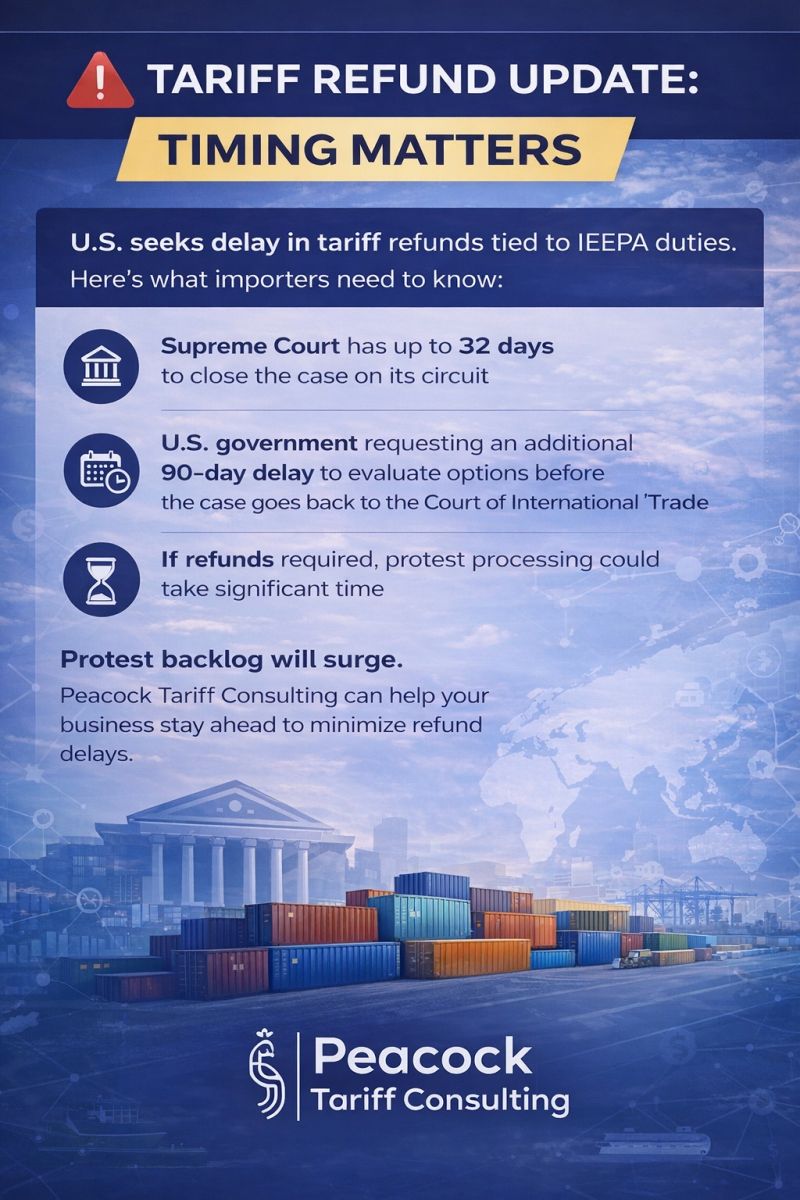
The United States administration’s request for a 90-day delay in IEEPA refund litigation represents a calculated strategy to postpone the administrative burden of processing refund claims. The Supreme Court retains the theoretical authority to conclude the case within 32 days from the current moment, but the government is seeking additional time, presumably to prepare for the logistics of refund administration. This delay request reveals a critical truth: the government is not disputing the legal merits so much as preparing for the operational consequences of legal defeat.
When the Supreme Court ultimately decides the IEEPA case and potentially orders refunds, the administrative machinery must suddenly process millions of refund claims from companies seeking recovery of tariff payments. The volume of claims will be unprecedented in the history of tariff administration. The Customs and Border Protection agency, which has never processed refunds on this scale, will face operational challenges that require substantial advance preparation. The 90-day delay request reflects recognition that this preparation is necessary.
- US administration requesting 90-day delay in IEEPA litigation
- Supreme Court theoretically can conclude within 32 days from current date
- Government preparing for operational burden of refund claim processing
- Delay reflects recognition that CBP needs time to establish refund administration infrastructure
Volume Surge: Understanding the Administrative Wave
Refund claims will not trickle in gradually; they will surge catastrophically once the legal entitlement is established. Companies that have paid tariffs over multiple years will simultaneously file refund claims seeking recovery of entire accumulated liability periods. Large importers with significant transaction volumes will submit claims involving thousands of individual shipments. The volume spike will overwhelm standard administrative processes designed for routine tariff claims.
The practical implications are profound. Customs brokers will need to organize tariff payment documentation for their clients, compile claims, and submit them to CBP. CBP will need to verify claim documentation, match claims to entry records, and issue refund checks or wire transfers. The timeline from legal decision to actual refund receipt could extend to many months or even years if the volume surge exceeds administrative capacity. Companies that begin preparing refund claims immediately will have substantial advantage over companies that wait for the formal decision.
- Refund claims will surge simultaneously rather than trickling in gradually
- Large importers will submit claims for thousands of individual shipments
- Customs brokers must organize documentation for clients seeking refunds
- CBP will face unprecedented volume of claim verification and processing
The Advantage of Preparedness: Documentation and Claim Organization
Companies with tariff refund exposure should begin preparing now, before the legal decision is final. This preparation involves organizing documentation of tariff payments by entry, date, amount, and product category. For companies with large transaction volumes, this organizational work could require substantial effort. Beginning this work now, rather than waiting for the legal decision, provides enormous advantage in the subsequent claim surge.
Companies that have already organized their tariff payment documentation will be able to submit claims immediately upon legal decision. Companies that wait until after the decision will face delays in documentation compilation while others are already in the CBP claims queue. Given that CBP will process claims on a first-come, first-served basis (or other priority system), companies that submit early will receive refunds earlier than companies that submit late. For a company with millions of dollars in refund exposure, this timing advantage could translate to hundreds of thousands of dollars in time-value-of-money impact.
- Companies should begin organizing tariff payment documentation immediately
- Organization by entry, date, amount, and product category enables rapid claim submission
- Early claim submission provides advantage in CBP processing queue
- Time-value-of-money impact significant for companies with substantial refund exposure
Protective Filing: Securing Your Place in the Claims Queue
An important strategic consideration for companies is whether to engage in protective tariff claims filing before the Supreme Court decision is final. Some jurisdictions and administrative systems allow parties to file protective claims that preserve their rights even if the underlying legal basis for the claim is not yet established. If CBP permits protective IEEPA refund claims, companies should consider filing them to secure their place in the administrative queue.
Protective claims function as a form of legal insurance. They preserve the company’s claim priority and ensure that the documentation is on file before the legal decision and the subsequent surge of competing claims. Even if the protective claim cannot be processed until the legal decision is final, the act of filing preserves the claim’s temporal priority. For companies with substantial refund exposure, filing protective claims is a low-cost way to secure advantage in the anticipated refund surge.
- Protective tariff refund claims may preserve legal rights before Supreme Court decision
- Protective filing secures claim priority in CBP processing queue
- Protective claims preserve temporal priority even if processing is delayed
- Low-cost strategy for companies with substantial refund exposure
Customs Broker Relationships: Coordinating Complex Claim Administration
Companies should have detailed conversations with their customs brokers about refund claim procedures, documentation requirements, and timelines. Most companies rely on customs brokers to manage tariff entries and documentation. When refund claims become necessary, the broker will be the critical intermediary between the company and CBP. Brokers with experience in tariff refund administration will be more effective than brokers without this experience.
The strategic conversation should address how the broker will organize claim documentation, what information the company needs to provide, what timeline to expect from claim filing to refund receipt, and what the broker’s charges will be for refund administration. Companies should clarify expectations before the refund surge occurs, ensuring that both the broker and the company have aligned understanding of procedures and responsibilities. This coordination will reduce delays and friction once refund claims are actually filed.
- Customs brokers will serve as intermediaries in refund claim administration
- Companies should clarify refund procedures and documentation requirements with brokers
- Brokers with refund administration experience more effective than inexperienced brokers
- Advance coordination reduces delays and friction in claim filing process
Volume Forecasting: Estimating Your Refund Claim Size
Companies seeking to prepare for refund claims should develop reasonable estimates of their refund entitlement based on tariff payment history. This requires analyzing historical tariff entries, calculating the duties paid on each entry, and estimating potential refund amounts. For companies with large transaction volumes, this exercise is substantial but essential for financial planning.
The refund estimate will inform financial planning, accounting treatment, and cash flow projections. A company that estimates significant refund exposure needs to prepare for sudden large cash receipts, the tax implications of refund income, and the potential uses of refund proceeds. For some companies, refunds will represent significant capital that can be deployed toward business expansion or debt reduction. Understanding the scale of potential refunds allows companies to plan strategically for deployment of this capital.
- Companies should estimate refund claims based on historical tariff payment analysis
- Refund estimates inform financial planning and accounting treatment
- Large refunds represent significant capital with tax and deployment implications
- Strategic planning for refund capital deployment maximizes business benefit
The Business Advantage of Timing Precision
The delay in Supreme Court decision creates a window of opportunity for companies to prepare thoroughly for refund claims. Rather than viewing the delay as frustrating, companies should recognize it as an opportunity to organize documentation, develop systems, and coordinate with brokers and advisors. The company that begins preparation immediately will capture disproportionate advantage when the refund surge occurs. The company that waits for the Supreme Court decision will face the subsequent surge along with all other importers seeking refunds simultaneously. In a volume surge scenario, timing advantage translates directly to financial advantage through earlier refund receipt and deployment of capital.