
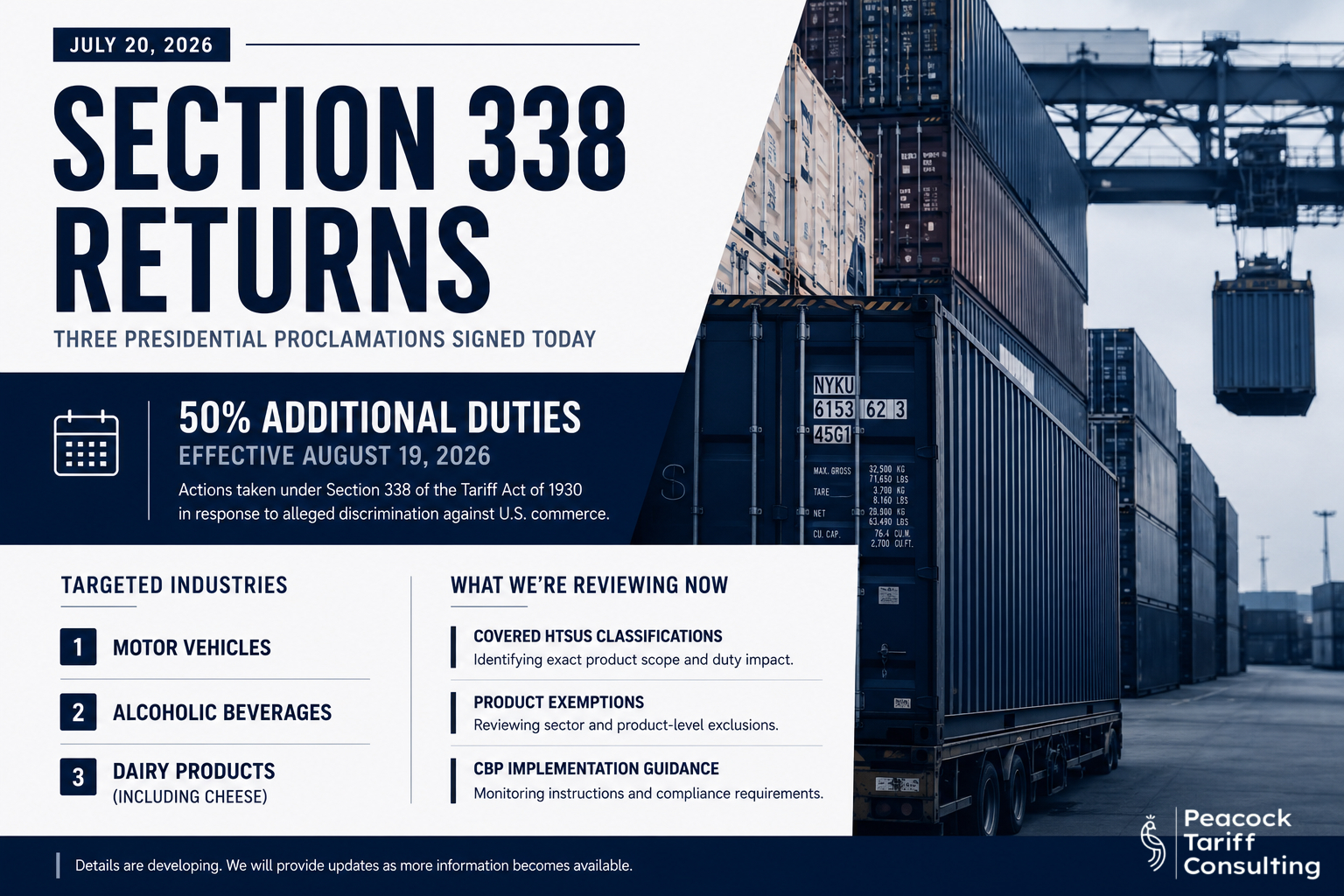
What Happened on July 20, 2026
On July 20, 2026, President Trump signed three proclamations imposing an additional 50 percent ad valorem tariff on a wide range of Canadian goods, invoking Section 338 of the Tariff Act of 1930 a Depression-era statute that, by most accounts, has never before been used to actually impose duties in its 96-year history. The tariffs take effect at 12:01 a.m. Eastern time on August 19, 2026, exactly thirty days after signing, the minimum delay the statute allows. According to the Office of the U.S. Trade Representative (USTR), the three actions together cover nearly $20 billion in annual imports from Canada.
The three proclamations respond to three separate Canadian measures that the Administration has found to discriminate against U.S. commerce: Canada’s retaliatory tariff and quota scheme on U.S. motor vehicles, the removal of U.S. alcoholic beverages from provincial liquor store shelves, and the design of Canada’s cheese tariff-rate quotas, which the U.S. says favor European exporters over American ones. But the goods actually hit by the new 50 percent duty go far beyond cars, whisky, and cheese. The covered lists sweep in hundreds of tariff lines from natural honey, cut flowers, and Portland cement to plywood, furniture, smartphones, toys, hockey sticks, fishing rods, jewelry, and original works of art. As the White House fact sheet itself puts it, the products range “from wine to hockey sticks to cement.”
Two features make this action fundamentally different from every previous round of the U.S.–Canada tariff conflict. First, the duties apply to covered goods regardless of whether they qualify as originating under the United States–Mexico–Canada Agreement (USMCA, known in Canada as CUSMA). Since March 2025, USMCA-compliant goods had been shielded from the broad U.S. tariff actions against Canada; that shield does not apply here. Second, Section 338 contains an escalation mechanism unlike anything in the more familiar trade statutes: if the President finds that the foreign country maintains or increases its discrimination after duties are imposed, the statute authorizes him to exclude the country’s products from importation into the United States entirely in effect, an embargo authority.
For any business that imports covered Canadian goods, the practical question is immediate: there is a roughly four-week window before the duties attach, and duties are assessed based on the date goods are entered for consumption in the United States not the date they are ordered, shipped, or cross the border in transit. Whether and how aggressively to pull shipments forward into that window is the central operational decision this briefing addresses in its final sections.
What Is Section 338? A Dormant Weapon in the Tariff Act of 1930
Section 338 of the Tariff Act of 1930, codified at 19 U.S.C. § 1338, is part of the same statute popularly known as the Smoot-Hawley Tariff Act. While Smoot-Hawley is remembered for its across-the-board duty increases, Section 338 is a targeted retaliation provision. It empowers the President to act when he finds that a foreign country either:
- imposes an “unreasonable charge, exaction, regulation, or limitation” on U.S. goods that is “not equally enforced upon the like articles of every foreign country”; or
- “discriminates in fact” against the commerce of the United States in a way that places U.S. commerce “at a disadvantage compared with the commerce of any foreign country.”
Where such a finding is made and the President determines the public interest will be served, he may proclaim “new or additional duties” on some or all products of that country, capped at 50 percent ad valorem the exact rate chosen here. The proclamation cannot take effect earlier than thirty days after it is issued, which is why the August 19 effective date sits precisely thirty days after the July 20 signing. The President may suspend, revoke, supplement, or amend a Section 338 proclamation at any time he deems the public interest requires meaning these tariffs can be dialed up, down, or off as negotiating leverage without any new process. And if the discrimination continues or worsens, the statute’s ultimate sanction is exclusion: a proclamation barring the offending country’s goods from entry altogether, with goods imported in violation subject to forfeiture.
Several features distinguish Section 338 from the tariff authorities that have dominated the last eighteen months:
- No investigation is required. Section 301 of the Trade Act of 1974 requires a USTR investigation, public comment, and often hearings. Section 232 of the Trade Expansion Act of 1962 requires a Commerce Department national-security investigation and report. Section 338 requires only a presidential finding of fact. The July 20 proclamations recite the findings in a few paragraphs each and cite Canadian government trade data no notice-and-comment process preceded them.
- No time limit. Unlike Section 122 balance-of-payments surcharges (150 days without Congressional approval) or safeguard measures under Section 201 (time-limited by statute), Section 338 duties continue indefinitely “unless expressly reduced, modified, or terminated.”
- An express statutory delegation. After the Supreme Court’s February 2026 decision striking down the use of the International Emergency Economic Powers Act (IEEPA) to impose tariffs, the Administration has migrated to statutes in which Congress expressly delegated tariff-setting power. Section 338 says “duties” on its face a deliberate choice of legal ground that the Administration evidently believes is more defensible in court.
Historically, Section 338 has been a threat rather than a tool. The State Department and Tariff Commission examined potential Section 338 cases against European countries in the 1930s, and the last public record of any Section 338 proceeding dates to 1949. Most trade historians conclude that no President has ever actually imposed duties under it until now. Trade practitioners have long called it a “nuclear option” precisely because its findings are easy to make, its process is minimal, and its escalation endpoint is total exclusion. Reports that the Administration was studying Section 338 circulated as early as the first weeks of 2025; on July 20, 2026, it finally pulled the trigger, and it chose Canada as the first target.
Why Section 338, and Why Now?
The timing is not accidental. Three converging developments explain why this authority, dormant for three-quarters of a century, was activated this summer.
First, the Supreme Court took IEEPA off the table. On February 20, 2026, the Supreme Court held that IEEPA the statute underpinning the 25 percent (later 35 percent) “border security” tariffs on Canada imposed in March 2025, as well as the global “reciprocal” tariffs does not authorize the President to impose tariffs. The Administration responded within days by terminating the IEEPA actions and imposing a temporary 10 percent global import surcharge under Section 122 of the Trade Act of 1974, effective February 24, 2026. But Section 122 is a stopgap: it is capped at 15 percent, limited to 150 days unless Congress extends it, and the Administration exempted USMCA-compliant goods from it. That 150-day clock runs out in late July 2026 within days of the Section 338 announcement. The Administration needed durable tariff authority that does not depend on emergency powers or Congressional renewal. Section 338, with its express delegation and indefinite duration, fits that requirement.
Second, the USMCA joint review has stalled. July 1, 2026 marked the treaty-mandated joint review of USMCA under Article 34.7. In the weeks before the Section 338 action, USTR publicly stated that the United States would not “rubber stamp” the agreement and did not agree to renew USMCA “in its current form.” Ambassador Greer has been conducting bilateral negotiating rounds with Mexico pointedly, with Mexico and not Canada. The Section 338 tariffs land squarely in the middle of this review period and are best understood, at least in part, as leverage in the renegotiation.
Third, Canada is the designated example. The White House fact sheet is explicit: over the past year and a half, “only two countries have chosen to retaliate against President Trump’s tariffs rather than negotiate a deal with the United States: the People’s Republic of China and Canada.” Canada’s counter-tariffs on U.S. autos, the provincial liquor bans, and its dairy quota administration are the three “discriminations” recited in the proclamations. Section 338’s legal test treatment of U.S. goods worse than the goods “of any foreign country” maps neatly onto retaliation, because retaliatory measures by definition single out the United States. In that sense, Section 338 is being deployed as an anti-retaliation weapon: a message to every trading partner that country-specific countermeasures against U.S. tariffs will themselves trigger a 50 percent response under a statute with an embargo at the end of it.
The Three Proclamations: Autos, Alcohol, and Dairy
Each proclamation makes a separate finding of discrimination and attaches its own product list. Understanding the underlying grievances matters, because Section 338 duties can be suspended or revoked the moment the President deems it in the public interest meaning each of these three disputes is, in principle, independently negotiable.
Motor vehicles
The first proclamation targets Canada’s retaliatory auto tariff regime. Since April 9, 2025, Canada has applied a 25 percent surtax on imports of U.S. motor vehicles that do not qualify for USMCA preferential treatment, and for U.S. vehicles that do qualify a 25 percent tariff on the value of all non-Canadian, non-Mexican content, up to 85 percent of the vehicle’s value, under the United States Surtax Order (Motor Vehicles 2025), SOR/2025-118. Canada layered on top of this a tariff-rate quota (TRQ) system that grants each automaker duty-free in-quota quantities quantities Ottawa does not publicly disclose and, per the proclamation, has reduced for companies that moved production from Canada to the United States. The U.S. finding: this scheme applies only to U.S.-origin vehicles, no other country’s, and is administered to compel investment in Canada. The proclamation cites the results comparing April 2025–March 2026 to the prior year, Canadian imports of U.S. motor vehicles fell approximately 22 percent, from roughly $25.9 billion to $20.3 billion, while imports of Mexican vehicles rose 23.6 percent and imports from Japan, Korea, and Germany rose between 10.1 and 13.5 percent. Imports from countries other than the U.S. rose about $2.85 billion, with Mexico accounting for almost $2 billion.
Alcoholic beverages
The second proclamation targets the provincial liquor bans. Beginning March 4, 2025, Canadian provinces and territories which control alcohol wholesale and much of retail through liquor boards halted the purchase, distribution, and retailing of U.S. alcoholic beverages. The Liquor Control Board of Ontario cancelled existing orders, stripped U.S. products from wholesale catalogues, e-commerce, and stores; Quebec directed the Société des alcools du Québec to do the same. Only Alberta and Saskatchewan later lifted their bans, in June 2025. The proclamation finds that no similar restriction was applied to any other country’s products, and cites the damage: comparing March 2025–February 2026 to the prior year, Canadian imports of U.S. alcoholic beverages fell approximately 81 percent, from about $718 million to about $137 million, while imports from Chile, Japan, Argentina, Ireland, New Zealand, and Australia grew 13 to 26 percent and EU suppliers picked up over $100 million in sales.
Dairy
The third proclamation is the narrowest and most technical. Canada maintains cheese TRQs under both USMCA and its trade agreement with the European Union (CETA). Under the CETA cheese TRQ, retailers are eligible to hold and use quota; under the USMCA cheese TRQ, they are not. The U.S. finding: by giving EU cheese a distribution channel that U.S. cheese is denied, Canada treats materially similar EU commerce more favorably precisely the “disadvantage compared to the commerce of any foreign country” that Section 338 addresses. This grievance is long-standing; the U.S. previously pursued Canada’s dairy TRQ allocation practices through USMCA dispute panels with mixed results, and the fact sheet describes Canada’s dairy system as “complicated and protectionist.” ## What Products Are Covered
Here is the critical structural point: the retaliation lists do not mirror the grievances. Canada discriminated against U.S. cars, liquor, and cheese; the United States is answering with 50 percent duties on three lists of Canadian products chosen to create economic and political pressure. The lists are defined by eight-digit Harmonized Tariff Schedule (HTSUS) subheadings in new U.S. Note 51 to Subchapter III of Chapter 99, under three new tariff headings 9903.03.12 (the alcohol action), 9903.03.13 (the dairy action), and 9903.03.14 (the motor vehicles action). Coverage is determined entirely by whether a good is (a) a “product of Canada” under ordinary country-of-origin rules and (b) classified in a listed subheading. If both are true, the entry pays the regular duty plus 50 percent, and the new duty stacks on top of most other applicable duties, taxes, and fees, including antidumping and countervailing duties.
The alcohol list (heading 9903.03.12) covers essentially the entire Canadian beverage-alcohol export book: beer (2203), wine of all formats (2204), vermouth (2205), cider, perry, mead, and other fermented beverages (2206), undenatured ethyl alcohol for beverage purposes (2207.10.30), and the full spirits range whiskies, gin, vodka, rum, brandy, liqueurs, and other spirituous beverages (2208). Canadian whisky is the obvious casualty. The list also includes a short tail of other goods, among them coniferous wood continuously shaped (4413), certain wooden tableware and kitchenware, certain papers, and notably subheading 9506.99.25, ice-hockey and field-hockey articles other than skates. Yes: hockey sticks are in the alcohol proclamation.
The dairy list (heading 9903.03.13) covers roughly fifty tariff lines of dairy and dairy-adjacent products: milk powders and concentrated milk (0402), whey and milk-protein products (0404), lactose and lactose syrup (1702.11, 1702.19), various other sugars and syrups, molasses (1703), certain baking mixes with dairy content (1901.20.35), milk-based non-alcoholic beverages (2202.91 area), casein and caseinates (3501), milk albumin (3502.20), and protein concentrates (3504.00.50). Businesses importing Canadian dairy ingredients for U.S. food manufacturing infant formula inputs, bakery pre-mixes, whey protein, lactose are directly in scope.
The motor vehicles list (heading 9903.03.14) is the big one, and its name is misleading: it contains almost no motor vehicles, because passenger vehicles and parts are already covered by Section 232 tariffs and are expressly carved out of Section 338 (more below). Instead it is a roughly 380-line basket of Canadian consumer, agricultural, and industrial goods, including:
- Food and agriculture: natural honey; cut flowers and flower bulbs; live plants; hop cones and hop extracts; maple-adjacent sugar chemistry (mannitol, sorbitol, glycerol); seeds for sowing; salt; essential oils.
- Building materials and wood: Portland cement (2523.29.00); gypsum/plaster boards; concrete articles; plywood, veneered panels, and laminated wood across dozens of lines; particle board; MDF and fiberboard; wood mouldings and millwork; wooden doors and frames; fence pickets; edge-glued lumber; wood charcoal and fuel wood.
- Paper and packaging: dissolving-grade wood pulp; writing paper; tissue and towel stock; corrugated cartons and boxes; paper sacks, envelopes, notebooks and diaries; wallpaper; paper tableware; plastic packaging (bottles, caps, bags, boxes) and plastic tableware and household articles.
- Consumer goods: cosmetics (lip, eye, manicure preparations), perfumes, hair preparations; candles; luggage, travel bags, and cases; fur apparel; leather goods, belts, and gloves; a substantial apparel list (T-shirts, sweaters, dresses, trousers, down jackets, outerwear, hats); certain footwear; jewelry of silver, gold, and imitation jewelry; wigs.
- Machinery, electronics, and tools: refrigeration and freezing equipment; distilling and brewery machinery; packing and wrapping machinery; hand tools (wrenches, pliers, hammers, saw blades, tool sets); safes and locks; vacuum cleaners; smartphones (8517.13.00); network switching and routing equipment, base stations, and related parts; radar and radio-navigation apparatus; television and digital cameras; monitors and projectors; printed circuits and printed circuit assemblies; optical fiber cables; insulated copper conductors.
- Vehicles and vessels outside Section 232: motorcycles over 800cc (8711.50.00 think Can-Am); vessels, lifeboats, floating docks, and floating structures.
- Furniture and lighting: metal, wood, and plastic furniture; seats and seat parts; mattress-adjacent lines; LED lighting fixtures and chandeliers; furniture parts.
- Sports, toys, and culture: the entire toy heading (9503.00.00); video game consoles; arcade and table games; golf equipment; ice skates; exercise and gym equipment; swimming pools; general sports equipment; fishing rods; festive and Christmas articles; and, remarkably, original paintings, sculptures, prints, stamps, collectors’ pieces, and antiques between 100 and 250 years old.
The Annexes to the proclamations, published on the White House website, contain the authoritative HTS-line lists with product descriptions, and CBP is directed to issue implementing guidance (expect Federal Register notices and CSMS messages before August 19). Classification questions are referred to CBP and with a 50-point rate differential riding on eight-digit classification, precise classification review is now worth real money.
What Is Exempt
Exemptions come in several distinct layers, and it pays to be precise about which layer applies to a given product.
1. Goods not on the lists. Section 338 duties apply only to the enumerated subheadings. Everything else the majority of the roughly $420 billion in annual U.S. imports from Canada is untouched by this particular action. The White House fact sheet highlights the deliberate omissions: energy products (crude oil, natural gas, electricity), potash, fish and seafood, and critical minerals are not on any list. Most food products, fertilizer, chemicals, plastics in primary forms, and aerospace goods are likewise absent. If your product’s HTS line is not in an Annex, nothing changes on August 19.
2. Goods already covered by Section 232 national-security tariffs. The proclamations state that the Section 338 duties “shall not apply to articles subject to duties pursuant to section 232 of the Trade Expansion Act of 1962.” Note 51 spells this out: steel, aluminum, and copper articles and their derivatives; passenger vehicles and light trucks and their parts; medium- and heavy-duty vehicles, buses, and their parts; timber, lumber, and wood products covered by the 232 wood action; semiconductor articles; and patented pharmaceutical articles. These goods keep paying their existing 232 rates (for example, 50 percent on steel and aluminum, 25 percent on non-U.S. content of autos, 10 percent on softwood lumber) they do not additionally pay the 338 duty. This creates classification cliff edges: a wood product covered by the 232 lumber proclamation pays 232 rates, while a plywood line listed in the 338 Annex but outside 232 coverage pays 50 percent. Which side of the line a product falls on is now a five-figure question per container.
3. Civil aircraft. Articles covered by the WTO Agreement on Trade in Civil Aircraft aircraft, engines, parts, components, subassemblies, and ground flight simulators meeting General Note 6 criteria are exempt, except unmanned aircraft (drones). This preserves the deeply integrated U.S.–Canada aerospace supply chain.
4. Personal-use goods in accompanied baggage of arriving travelers are exempt.
5. Chapter 98 provisions. Goods properly entered under most special provisions of HTSUS Chapter 98 (U.S. goods returned, for example) avoid the duty, with important exceptions: for repairs or alterations abroad (9802.00.40–.60) the 50 percent applies to the value of the Canadian processing, and for assembly abroad (9802.00.80) it applies to the assembled value less U.S. content.
6. What is not exempt: USMCA-originating goods. There is no originating-goods carve-out. There is also no de minimis relief the $800 de minimis exemption was suspended for all countries effective August 29, 2025 and no announced product-exclusion process of the kind that accompanied the 2018 Section 301 tariffs. Foreign-trade-zone admissions on or after August 19 must take “privileged foreign status,” locking in duty liability at the classification applicable on admission; an FTZ cannot be used to wait out the tariff.
Why USMCA/CUSMA Does Not Protect These Goods
For eighteen months, the answer to almost every Canada-tariff question was: “Is the good CUSMA-compliant?” The March 7, 2025 amendment to the IEEPA tariffs exempted USMCA-originating goods; the Section 122 surcharge that replaced IEEPA in February 2026 likewise does not apply to CUSMA-compliant goods; Canada, in September 2025, rolled back its own retaliatory tariffs on CUSMA-compliant U.S. goods. Origin certification became the central compliance shield on both sides of the border.
Section 338 breaks that pattern deliberately. The White House fact sheet states flatly that the tariffs “apply to all covered goods regardless of whether a good originates under the U.S.-Mexico-Canada Agreement (USMCA).” Why can the United States do that, and why doesn’t the agreement stop it?
As a matter of U.S. domestic law, a later-in-time statute or proclamation controls. USMCA’s tariff commitments are implemented in U.S. law through the USMCA Implementation Act and the “Special” rate column of the HTSUS. But trade agreements are not self-executing constraints on Congress’s or, where delegated, the President’s tariff power. Section 338 predates USMCA by 90 years, and the proclamations amend the HTSUS directly (via the Section 604 authority), layering the Chapter 99 duty on top of whatever preferential rate the good otherwise enjoys. Note 51 is explicit: products eligible for special tariff treatment (i.e., USMCA preference) “shall be subject to the additional ad valorem rate of duty imposed by this heading.” A USMCA certificate of origin still eliminates the base MFN duty where applicable it simply does nothing about the additional 50 points.
As a matter of treaty law, Canada calls this a violation and the U.S. has effectively stopped defending the agreement’s status quo. Prime Minister Carney’s July 20 statement describes the action as “the latest in a series of unilateral U.S. trade actions that began with the U.S. imposing a series of tariffs in direct violation of the Canada-United States-Mexico Agreement (CUSMA),” and notes that Canada “has merely matched those measures.” Canada could, in principle, pursue state-to-state dispute settlement under USMCA Chapter 31, as it and Mexico did successfully against U.S. positions in the past. But the remedy at the end of a Chapter 31 panel is authorized retaliation which Canada is already doing, and which is precisely the conduct the U.S. cites as the Section 338 “discrimination.” Meanwhile, the United States declined to agree to renew USMCA in its current form at the July 1, 2026 joint review, and USTR frames the agreement itself as under renegotiation. In short: the legal architecture that would normally discipline a tariff like this is the very thing being renegotiated, and the Administration’s position is that Canada’s own conduct (auto surtaxes, liquor bans, dairy quotas) breached the spirit of the deal first.
The practical upshot for importers: USMCA origin work remains valuable it still governs base duty rates, the Section 122 surcharge exemption while that lasts, metals-content calculations under the 232 regimes, and Canada-side treatment. But for the goods on these three lists, certifying origin will not reduce the Section 338 duty by a single basis point. Do not let anyone in your supply chain assume otherwise; we expect that to be the single most common and most expensive misconception between now and August 19. ## How We Got Here: An Eighteen-Month Escalation in Brief
A short chronology puts August 19 in context. In February–March 2025, the U.S. imposed 25 percent IEEPA tariffs on Canadian goods (10 percent on energy), then exempted USMCA-originating goods on March 7. Canada retaliated with 25 percent surtaxes on roughly C$60 billion of U.S. goods, and in March 2025 the provinces pulled U.S. alcohol from their shelves. In April 2025, U.S. Section 232 auto tariffs took effect, and Canada answered on April 9 with its motor-vehicle surtax order the measure now cited in the autos proclamation. Through 2025 the U.S. layered on Section 232 actions: steel and aluminum doubled to 50 percent in June; copper in August; timber, lumber, and wood furniture in October; medium- and heavy-duty vehicles in October; the IEEPA rate on non-originating Canadian goods rose to 35 percent in August. The de minimis exemption ended globally in August 2025. In September 2025, a thaw: Canada removed its counter-tariffs on CUSMA-compliant U.S. goods, keeping them on U.S. steel, aluminum, and autos. Then the ground shifted on February 20, 2026, the Supreme Court struck down the IEEPA tariffs; the Administration pivoted within days to a temporary 10 percent Section 122 surcharge (CUSMA-compliant goods exempt) and leaned harder on the Section 232 sectoral programs, extending and adjusting them through the spring of 2026. The USMCA joint review opened July 1, 2026, with USTR announcing the U.S. would not renew the agreement in its current form and beginning bilateral rounds with Mexico. On July 20, 2026, the Section 338 proclamations were signed, with duties effective August 19, 2026 the first-ever use of the statute to impose duties, and the first broad U.S. tariff action against Canada with no USMCA carve-out.
Where it goes next is genuinely uncertain in both directions. Section 338 lets the President suspend or revoke the duties instantly if a deal is reached and Ottawa says it is ready to “intensify” negotiations. It also lets him escalate to full exclusion of Canadian goods if he finds Canada has maintained or increased the discrimination. Canadian retaliation is possible; Ontario’s premier has already called for it, while the federal government has so far emphasized negotiation. Legal challenges in the U.S. Court of International Trade are widely expected, and the Supreme Court’s IEEPA ruling shows courts will police the boundaries of delegated tariff power but Section 338 is an express tariff delegation, so importers should not plan on judicial rescue arriving before the effective date.
Should You Increase Shipments to the U.S. Before August 19?
The proclamations apply the 50 percent duty to covered goods “entered for consumption, or withdrawn from warehouse for consumption, on or after 12:01 a.m. eastern time on August 19, 2026.” That single sentence defines the front-loading opportunity, and its limits. What matters is the date of entry for consumption in the United States not the purchase-order date, the ship date, the export date, or the date the truck crosses the Ambassador Bridge into secondary inspection. As published, the proclamations contain no in-transit exception (unlike some earlier tariff actions that grandfathered goods already on the water), so a container that arrives August 18 but enters August 19 pays the duty. Watch CBP’s implementing guidance for any clarification, but plan conservatively: goods must be entered, not merely shipped, before the deadline.
The case for accelerating. For covered goods, every dollar of customs value entered before August 19 saves fifty cents of duty. That is an enormous, known, near-term return. Acceleration makes clear sense where the following align: the product is on a list (confirm the eight-digit line do not assume); it is non-perishable and storable (spirits, wine, beer, furniture, plywood, sporting goods, toys, tools, packaged consumer goods are ideal; cut flowers obviously are not); you have reliable U.S. demand over the next one to two quarters; and you have or can secure warehouse capacity and working capital. Practical to-dos this week: pull forward every confirmed order Canadian suppliers can produce and ship; book cross-border trucking and rail capacity immediately, because everyone else facing this deadline will be doing the same and border and broker congestion in mid-August is predictable; instruct your customs broker to file entries for consumption promptly on arrival rather than letting freight sit; and build a buffer target entry by August 14, not August 18.
The traps. Two storage strategies that sound clever do not work. First, the bonded warehouse trap: goods placed in a Class 3 bonded warehouse before August 19 but withdrawn for consumption after that date pay the new duty, because the proclamation expressly covers warehouse withdrawals. If goods are coming anyway, enter them for consumption before the deadline and store them duty-paid in ordinary commercial warehousing. Second, the FTZ trap: merchandise admitted to a foreign-trade zone on or after August 19 must take privileged foreign status and will owe the duty on eventual entry; the zone defers the duty but does not avoid it.
The case for restraint. Do not mortgage the company to stockpile. Consider, first, that these duties can vanish as fast as they arrived Section 338 gives the President unilateral authority to suspend or revoke, both governments say they are willing to negotiate, and the USMCA review provides a natural venue for a package deal; inventory bought at panic freight rates loses its edge if the tariff is suspended in October. Second, front-loading has real costs: cash tied up in inventory, warehousing at deadline-week prices, insurance, shrinkage, and demand risk if the U.S. consumer softens. Third, remember what happens on the Canadian side: if Ottawa retaliates again, your northbound business may face its own new costs. A sensible ceiling for most importers is one to two quarters of forward demand for high-velocity covered SKUs enough to bridge a negotiation, not enough to bet the balance sheet on the tariff lasting forever.
A decision rule. If the landed-cost increase (50 percent of customs value) exceeds your gross margin on the product which it will for most distributors of covered goods treat August 19 as a hard commercial deadline and accelerate everything storable that you are confident of selling within two quarters. If the product is exempt, marginal, or substitutable from U.S. or third-country sources, spend the next thirty days on sourcing alternatives instead of freight.
Beyond Front-Loading: The Mitigation Checklist
Front-loading buys a quarter or two. These structural measures matter for as long as the duties last.
- Verify classification at the eight-digit level, line by line. Coverage follows the HTS number, and the lists are surgical: one plywood line is covered while a neighboring line is not; hockey sticks are covered, but many other sporting goods lines are not; a wood product may fall under Section 232 (exempt from 338, paying lower 232 rates) rather than the 338 list. Misclassification now cuts both ways paying 50 percent you do not owe, or facing penalties for entering covered goods duty-free. A formal classification review, and where warranted binding rulings from CBP, should be the first engagement.
- Scrutinize origin in both directions. Only “products of Canada” under substantial-transformation rules are covered. Goods that undergo substantial transformation in a third country before U.S. import may not be products of Canada at all. Conversely, do not attempt cosmetic transshipment: routing Canadian goods through third countries with minimal processing invites penalties, and CBP has made transshipment enforcement a priority.
- Review valuation. With duty at 50 percent, every dollar shaved off dutiable value is fifty cents saved. First-sale valuation in multi-tier transactions, unbundling non-dutiable charges (international freight, insurance), and reviewing assists and royalties are standard, legal levers that suddenly carry ten times their former payoff.
- Re-examine sourcing. For commodity-like covered goods cement, plywood, paper packaging, furniture U.S., Mexican, and overseas alternatives exist. Mexico is conspicuously favored in the current trade architecture, and USMCA-originating Mexican goods face neither Section 338 nor the Section 122 surcharge.
- Fix the contracts. Determine who bears the duty under existing Incoterms and tariff clauses (a DDP seller of covered Canadian goods just inherited a 50 percent cost). Add tariff-adjustment and termination clauses to new agreements, and open renegotiations with Canadian suppliers now in past rounds, suppliers, importers, and customers typically ended up sharing the burden.
- Confirm interaction with other programs. The 338 duty stacks on top of regular duties, AD/CVD, and other Chapter 99 duties except where Note 51 provides otherwise; Chapter 98 provisions (U.S. goods returned, repairs) still work with caveats; drawback availability for these duties is not yet addressed in the proclamations get advice before assuming refunds.
- Model the exclusion scenario. Section 338’s next step, if the President finds continued discrimination, is exclusion of products from importation. It has never been used, and using it would be an extraordinary escalation but a contingency plan for your most Canada-dependent SKUs (qualification of a second source, safety stock policy) is now prudent risk management rather than paranoia.
- Watch the calendar. Between now and August 19: CBP CSMS messages and Federal Register notices implementing the annexes; any Canadian counter-announcement; USMCA review developments; and the fate of the Section 122 surcharge, whose 150-day clock expires in late July. Any of these can change the math. We will circulate updates as they land.
Next Steps
Section 338 is the oldest and bluntest tariff instrument in the U.S. arsenal, unused for three-quarters of a century precisely because it requires so little process and escalates so far. Its first-ever deployment 50 percent duties on nearly $20 billion of Canadian goods, effective August 19, 2026, with no USMCA shield is simultaneously a genuine cost shock for importers of the listed products and a negotiating instrument that can be switched off overnight. Businesses should act on the part they can control: confirm within days whether their products are on the lists, enter storable covered goods before August 19, avoid the bonded-warehouse and FTZ traps, and use the breathing room that front-loading buys to do the structural work classification, origin, valuation, sourcing, contracts that will matter if these duties are still in place at Christmas.
Peacock Tariff Consulting advises importers and exporters on tariff classification, origin, valuation, and duty-mitigation strategy. This briefing reflects information available as of July 20, 2026, including the three Section 338 proclamations and annexes, the White House fact sheet, USTR’s statement, and the Government of Canada’s response. It is not legal advice.
For the fundamentals of Canadian customs duty, CUSMA duty-free treatment, GST/HST and CARM, see our complete guide to importing into Canada.