
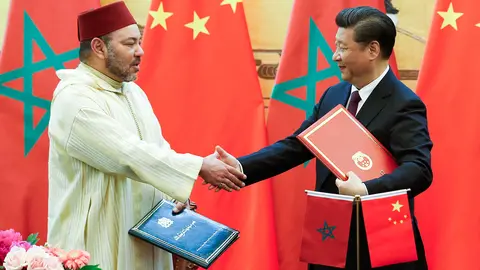
China has formally asked Morocco to negotiate a bilateral free trade agreement, Moroccan Industry and Trade Minister Ryad Mezzour confirmed in a Bloomberg interview published in mid-June. Rabat hasn’t started talks yet, but the request marks a notable moment in a relationship that has quietly become one of the most consequential economic partnerships on the African continent.
The numbers explain why both sides are paying attention. Two-way trade between China and Morocco hit $10.96 billion in 2025, up 21.2% from the year before. The relationship is heavily lopsided: China shipped $9.88 billion in goods to Morocco, while Moroccan exports to China totaled only $1.08 billion. China is already Morocco’s third-largest trading partner overall and its largest in Asia. On May 1, China also extended a zero-tariff regime to 53 African countries, including Morocco, eliminating duties on nearly all products from the continent. A full FTA would go further, locking in preferential access for Moroccan manufacturers into a market of 1.4 billion consumers.
What’s In It for China
Beijing’s interest in Morocco fits a familiar pattern of resource security wrapped in geopolitical ambition. Morocco controls roughly 90% of global argan oil production, but the real prize is underground: the country holds the largest phosphate reserves in the world, by some estimates more than two-thirds of the global total. Phosphate is the backbone of synthetic fertilizer, and China’s own reserves are depleting fast relative to the demands of feeding 1.4 billion people. It is also increasingly used in lithium iron phosphate (LFP) batteries, now the dominant chemistry in China’s EV industry.
Morocco’s resource base extends further including citrus, olive oil, cobalt, and lithium with the latter two essential for EV battery production. Chinese firms have already moved in to capture this supply chain. Battery materials producer BTR New Material Group is building multiple plants in Morocco, and the Mohammed VI Tangier Tech City has signed deals with 42 companies, 34 of them Chinese, representing roughly $3.5 billion in planned investment. Beyond raw materials, an FTA would deepen China’s foothold in a country seen as a strategic gateway between Africa, Europe, and the Atlantic which would fit neatly into Beijing’s broader Belt and Road ambitions.
What’s In It for Morocco
Morocco’s strategy reflects both growing dissatisfaction with Washington and growing interest in Beijing. The Trump administration’s April 2025 “Liberation Day” tariffs placed a 10% levy on Moroccan goods despite the two countries’ two-decade-old FTA. The Supreme Court struck down that tariff framework in February 2026. The relief was short-lived, as the administration subsequently reintroduced a 10% global surcharge under a different legal basis. Although a trade court has since struck it down, collections continue pending appeal. The back-and-forth has strained a relationship Rabat had long treated as a cornerstone of its trade strategy.
China, by contrast, looks like a more stable bet. Chinese capital flows into Morocco have totaled an estimated $6 billion since 2020, concentrated in EV supply chains, green technology, and textiles. A formal FTA would let Moroccan manufacturers diversify away from heavy dependence on European and American demand.
There’s also a harder-edged political dimension. Morocco has spent years working to internationalize recognition of its sovereignty over Western Sahara, a disputed territory that sits on top of substantial phosphate deposits. The EU’s relationship with Morocco regarding Western Sahara has long been contentious. The EU’s own Court of Justice has repeatedly ruled aspects of EU-Morocco trade preferences for the territory unlawful, even as Brussels and Rabat moved in October 2025 to extend those preferences anyway. That legal uncertainty, plus scrutiny from human rights groups over phosphate mining there, has pushed some Western companies to keep their distance. China has shown no such hesitation and a deeper relationship with Beijing could help Morocco cement its acceptance of its position in the territory.
Ripple Effects for the West
For Europe, this raises the prospect of a key North African partner tied to the EU through decades of trade integration increasingly leaning toward Beijing, complicating an already delicate relationship over Western Sahara and competing investment interests.
For the US, the stakes are more about future-proofing than current disruption. Washington’s phosphate imports today come predominantly from Peru, not Morocco, so a shift in Moroccan trade policy wouldn’t immediately upend US fertilizer supply chains. However, as US-Morocco relations begin to deteriorate and Morocco’s center of gravity shifts toward China, American firms that do rely on Moroccan inputs will face slower, less visible costs. That’s the real concern circulating in Washington and Brussels alike: Morocco is one of the more strategically valuable countries in Africa for whoever secures its long-term partnership, and right now China is extending the clearest invitation.
The Phosphate Picture
Morocco’s state phosphate giant, OCP Group, ships the mineral and its fertilizer derivatives worldwide, and the destinations show who depends on it. Bangladesh imported roughly $462 million worth in 2024, Brazil $416 million, India $173 million, the US $58.1 million, and France $45.4 million. India takes the largest share of raw rock phosphate specifically, while Bangladesh and Brazil lead on processed fertilizer. Any disruption to this trade from new tariffs, shifting alliances, or a Chinese FTA that redirects Moroccan output would ripple through fertilizer markets, and by extension global food prices, far beyond Rabat or Beijing.
For now, Morocco is taking its time. No formal negotiations have begun, and Mezzour’s caution suggests Rabat understands this is bigger than a simple trade deal, it indicates which great power Morocco is entrusting with its economic future.
Authored by Brennan Fitzgerald, International Trade Economist at Peacock Tariff Consulting