
Introduction: A Paradigm Shift in Trade Litigation
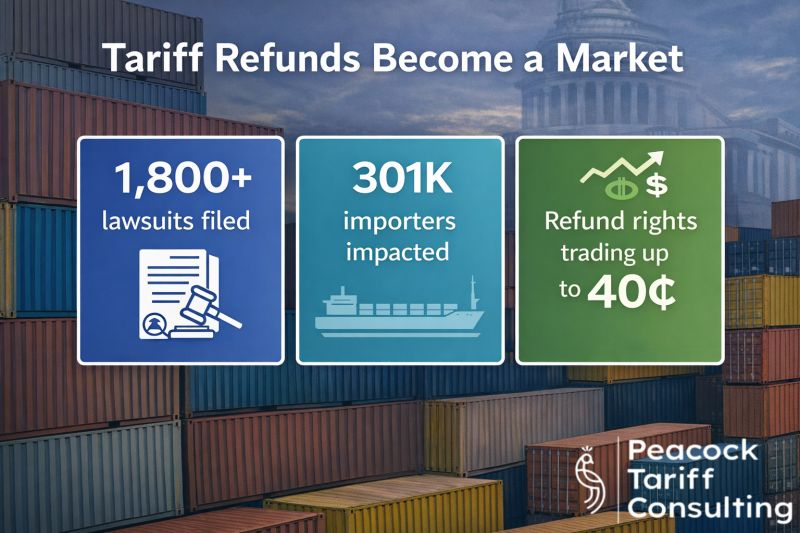
The landscape of US trade policy litigation has undergone a dramatic transformation. What began as isolated challenges to tariff authority has evolved into a massive coordinated legal campaign involving over 1,800 companies seeking to recover billions in duties paid under now-invalid tariffs. This unprecedented wave of litigation represents not merely a legal dispute, but a fundamental shift in how companies view tariff obligations and the financial implications of trade policy.
The catalyst for this surge was the Court of International Trade’s ruling that the International Emergency Economic Powers Act (IEEPA) tariffs were unlawful. This decision unlocked the potential for widespread refund claims, triggering a cascade of legal actions from multinational corporations and smaller importers alike. The refund claims now extend across industries, affecting more than 301,000 importers who faced tariffs that are now deemed invalid.
- 1,800+ companies have filed suits against the US government for tariff refunds
- Over 301,000 importers affected by now-invalid tariff regimes
- Major corporations including Costco, Goodyear, and FedEx are pursuing claims
Understanding the Scale: Who Is Suing and Why
The composition of litigants in the tariff refund race reflects the broad-based impact of IEEPA tariffs across the American economy. Major retailers like Costco recognized that tariff costs were passed through their supply chains, affecting their profitability and competitive position. Tire manufacturers like Goodyear faced direct tariffs on inputs and finished goods, squeezing margins significantly. Logistics providers like FedEx encountered cascading tariffs on equipment and materials that ultimately translated into higher operational costs.
What unites these companies is a recognition that the tariff regime was legally questionable from inception and that the CIT’s ruling provided an opportunity to recover substantial sums. For many companies, the refund potential represents a meaningful boost to earnings, making the investment in litigation worthwhile despite the associated legal costs and management attention required.
- Retail corporations facing consumer price increases due to tariff passthrough
- Manufacturing sector seeking relief on input costs and finished goods
- Logistics and transportation firms bearing tariff impacts on operations
- Import-dependent industries across consumer goods, electronics, and industrial sectors
The Emergence of Refund Rights as a Traded Asset
Perhaps the most striking development in the tariff refund saga is the emergence of a secondary market for refund claims. Companies with uncertain litigation prospects or immediate cash flow needs have begun selling their refund rights to specialized investment firms. These transactions reveal the growing financial significance of tariff claims and the willingness of institutional investors to take on the risks and uncertainties of tariff litigation.
The pricing dynamics of this market are particularly revealing. Refund claim valuations have skyrocketed from approximately 20 cents on the dollar just months ago to approximately 40 cents on the dollar today. This doubling of valuation reflects growing confidence in the likelihood of successful refund outcomes, driven by favorable court rulings and broader legal trends supporting importer claims. For investors, tariff refunds have transformed from a speculative opportunity into a recognized financial asset class.
- Investment firms acquiring tariff refund claims at significant multiples
- Valuation increases from 20 cents to 40 cents per dollar of claimed duties
- Market development driven by improving legal prospects for importers
- Secondary market creating liquidity for companies needing immediate cash recovery
Government Response and Administrative Challenges
The US Customs and Border Protection agency faces unprecedented administrative challenges as it navigates the implications of the CIT’s IEEPA ruling and the cascading refund claims. The government must process thousands of individual entry liquidations, determine refund eligibility, assess interest accrual, and defend its administrative determinations against additional litigation. The sheer volume of claims has strained CBP resources and created substantial uncertainty about timeline and process.
The government’s initial position sought a 90-day extension to manage the administrative burden, but this request was denied by the courts. With mandates released and orders written in broad terms, CBP now must implement refund processes without the benefit of additional time or clarifying guidance. This has created an environment where importers face uncertainty about which claims will be honored, whether interest will be included, and how quickly refunds might be processed.
- CBP managing thousands of pending liquidations and reliquidation requests
- Processing delays expected due to volume and administrative complexity
- Interest calculations uncertain and potentially contentious
- Government defending IEEPA tariffs despite adverse court rulings
Broader Implications for US Trade Policy
The tariff refund race carries implications that extend far beyond the immediate financial recovery for participating companies. It signals to investors and policymakers that tariff regimes lacking strong legal foundations face significant financial and reputational risks. The creation of a secondary market for refund claims also raises questions about the appropriate role of financial engineering in trade policy outcomes.
For future administrations, the costs associated with tariff litigation should factor prominently into trade policy decision-making. When tariffs can be challenged successfully in court and result in billion-dollar refund obligations, the actual cost of tariff policy extends well beyond the intended trade effect. Policymakers must weigh the benefits of tariff protection against the financial exposure created by legal vulnerability.
- Tariff regime sustainability now dependent on legal defensibility
- Financial costs of tariff litigation discouraging ad-hoc policy tools
- Precedent established for challenging executive tariff authority
- Future trade policies facing higher bar for legal justification
Refund Claim Valuation and Investment Considerations
The secondary market for tariff refunds operates on the principle that claim values should reflect the probability-weighted present value of ultimate refund recovery. Investors in refund claims conduct detailed diligence on CBP entry documentation, the strength of individual importer claims, and the likelihood of government payment or continued litigation. The movement from 20 cents to 40 cents on the dollar reflects both improved legal clarity and demonstrated government willingness to process refunds.
Companies selling refund claims face a classic trade-off between receiving immediate liquidity at a discount versus holding claims and capturing full refund value if successful litigation outcomes materialize. The decision to sell depends on individual circumstances, including cash flow needs, confidence in legal prospects, and risk tolerance. For some companies, accepting 40 cents on the dollar provides valuable certainty and cash that can be deployed immediately.
- Claim valuations driven by litigation success probability
- Due diligence processes assessing individual entry strength
- Risk considerations including government appeals and legal challenges
- Time value of money affecting refund realization strategies
Looking Forward: Ongoing Uncertainties
Despite the progress made by importers and the emergence of a functional secondary market, substantial uncertainties remain. The government may continue to challenge refund eligibility on specific entries, disputes may emerge regarding interest calculations, and broader legal questions about executive tariff authority remain subject to appellate review. Companies pursuing refund claims must maintain realistic expectations about ultimate recovery amounts and timelines.
The tariff refund race also raises questions about how future trade disputes should be handled. Should importers have automatic recovery mechanisms when tariffs are deemed unlawful? Should interest accrue to compensate for the time value of capital tied up in duty payments? These policy questions will likely shape the contours of future trade legislation and administrative processes. For now, companies must navigate the existing legal framework and pursue individual claims with appropriate diligence and realistic timelines.
- Continued government litigation defending tariff regimes
- Interest calculation disputes remaining unresolved
- Administrative processing creating ongoing uncertainty
- Need for clearer policy frameworks governing tariff refunds