
Record Trade Volumes Mask Persistent Deficit Dynamics
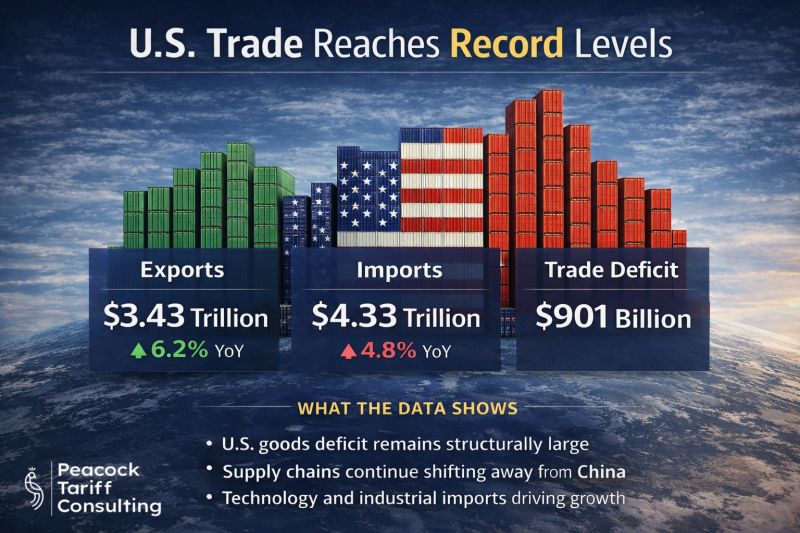
US trade reached record levels in 2025, with exports rising to 3.43 trillion dollars, up 6% year-over-year, while imports climbed to 4.33 trillion dollars. Despite these record volumes, the structural trade deficit persists largely unchanged. The deficit remained near 901 billion dollars, reflecting a fundamental imbalance between what America exports and what America imports. The constancy of the deficit alongside rising trade volumes reveals that tariff policies and trade management strategies have not fundamentally altered the structural economics driving American import demand.
Record trade volumes create the appearance of vigorous trade activity and economic dynamism. However, the persistence of the large trade deficit despite these record volumes indicates that underlying demand structures have not shifted. The United States continues importing substantially more than it exports, a pattern rooted in consumption patterns, investment needs, and the structure of the US economy. Understanding this distinction between trade volume growth and deficit persistence is critical for assessing tariff policy effectiveness.
- US exports reached $3.43 trillion in 2025, up 6%
- Imports reached $4.33 trillion despite tariff policies
- Trade deficit remained near $901 billion
- Deficit unchanged despite policy intervention attempts
Structural Drivers of the American Trade Deficit
The persistence of the American trade deficit reflects deep structural features of the US economy that tariff policies address imperfectly. The United States operates a high-consumption economy with consumption levels exceeding production. Americans purchase imported goods extensively because imported goods provide value-lower prices, broader product selection, or specialized products unavailable domestically. Additionally, the US economy depends on imported energy, raw materials, and intermediate goods required for manufacturing and service delivery. These structural demand patterns drive import volumes regardless of tariff policy.
The US domestic savings rate remains low relative to investment requirements, creating a need for foreign capital and imported goods to support consumption and investment. American consumers and businesses make purchasing decisions based on price, quality, and availability. Tariffs increase prices but do not necessarily increase availability or quality of domestic alternatives. When domestic alternatives do not exist or are substantially more expensive, tariff-driven price increases simply increase consumer costs without reducing import volumes. This dynamic explains why high tariff levels have historically failed to eliminate trade deficits.
- US consumption exceeds domestic production
- Energy and raw material imports structurally required
- Domestic alternatives often unavailable or uncompetitive
- Low savings rate creating foreign capital dependence
The Diversification of Trade Partners
While the overall deficit structure remains unchanged, what has changed is the composition of trading partners and the geographic distribution of imports. US manufacturers and importers have been diversifying supply chains away from concentrated sourcing in China and toward broader supply networks across Asia, Southeast Asia, India, and North America. This supply chain diversification reflects both tariff avoidance strategies and genuine risk reduction efforts to reduce dependence on any single supply source.
The diversification strategy produces two simultaneous effects: first, tariff-affected trade flows shift from high-tariff countries to lower-tariff alternatives; second, total import volumes remain elevated because the underlying demand for imported goods persists. Companies substitute Vietnamese suppliers for Chinese suppliers, Indian manufacturers for Chinese manufacturers, or Mexican producers for Chinese alternatives. However, the total volume of imports remains large because the structural demand for imported goods has not diminished. This explains the persistent large deficit alongside the shift in supply source.
- Supply chains diversifying away from China concentration
- Vietnam, India, Mexico, Southeast Asia gaining import share
- Tariff avoidance driving geographic diversification
- Overall import volumes remaining elevated despite sourcing changes
Manufacturing and Technology Import Persistence
A critical component of the persistent American deficit is the continued large volume of imported technology and manufactured goods. The United States imports substantial quantities of semiconductors, electronics, computer equipment, telecommunications products, and manufactured goods from Asia. These imports reflect both consumer demand for technology products and business demand for technological inputs to support manufacturing and service operations. The global technology supply chain concentrates manufacturing in Asia, and the United States remains dependent on these imports.
Despite efforts to increase domestic semiconductor production through subsidies and protective policies, the US remains dependent on imported semiconductors and electronic products. The global technology supply chain has evolved over decades with manufacturing concentrated in locations offering cost advantages, technical expertise, and established production ecosystems. Shifting these supply chains to the US requires not only tariff incentives but also business investment, workforce development, and infrastructure establishment. The transition remains incomplete, meaning the US continues importing substantial technology volumes.
- Semiconductor and electronics imports remain large
- Consumer demand for technology products supporting import growth
- Business investment in tech inputs driving imports
- Global supply chain concentration difficult to shift rapidly
Deficit Composition and Product Categories
The 901 billion dollar deficit is distributed across numerous product categories, with particular concentration in consumer goods, technology, and manufacturing inputs. Consumer goods imports-apparel, footwear, furniture, household goods-comprise a substantial component of the deficit. Technology imports including semiconductors and electronics represent another major component. Manufacturing inputs including metals, chemicals, and processing materials comprise a third major category. This diversified deficit composition means that eliminating the deficit would require simultaneously addressing demand across multiple sectors.
The composition of the deficit reveals that no single tariff policy or trade intervention can resolve the structural imbalance. Addressing apparel imports would require either reducing consumer demand for clothing or developing substantial domestic apparel manufacturing capacity-both require significant economic adjustment. Addressing technology imports would require shifting semiconductor and electronics manufacturing back to the US-an effort underway but incomplete. Addressing materials and inputs imports would require either reducing manufacturing activity or dramatically expanding domestic extraction and processing. The structural challenge of deficit elimination spans multiple economic sectors.
- Deficit distributed across consumer goods, tech, and inputs
- No single product category dominates deficit
- Addressing deficit requires coordinated multi-sector change
- Consumption patterns deeply embedded in American economy
Looking Forward: The Persistent Deficit Challenge
The 2025 trade data suggests that despite policy efforts, the fundamental structural deficit will persist unless underlying economic drivers change. The American economy continues consuming more than it produces, continues importing energy and raw materials, and continues demanding imported technology and manufactured goods. Tariff policies can alter the geographic distribution of imports and can shift which countries supply American import demand. However, tariff policies cannot easily eliminate the underlying demand for imported goods.
Future deficit trajectories depend on whether underlying structural factors change. If American consumption declines relative to production, if domestic energy production increases sufficiently, if manufacturing capacity expands to reduce import dependence, or if export demand increases substantially, the deficit could contract. However, absent these underlying changes, tariff policies will continue producing modest trade composition shifts while leaving the fundamental deficit largely intact. This reality should inform expectations for tariff policy effectiveness in addressing trade imbalances.
- Structural deficit persistence likely to continue
- Geographic diversification masking persistent demand for imports
- Fundamental economic changes required for deficit reduction
- Tariff policies best understood as compositional rather than eliminative