
On June 3, 2026, the U.S. Department of Agriculture confirmed something it had not seen in nearly sixty years: a living animal on American soil infested with the larvae of the New World screwworm. The host was a three-week-old calf in Zavala County, in the brushland of South Texas about 25 miles from the Mexican border, with the flesh-eating maggots identified in the animal’s umbilical area. By June 6, a second case had been confirmed in a one-month-old calf roughly five and a half miles from the first. USDA was quick to reassure the public that human infections are uncommon and that there is no food-safety risk to the beef supply. Yet within forty-eight hours of the announcement, the more consequential story was no longer epidemiological. It was commercial. Canada had slammed its border shut to Texas livestock, Mexico’s already-closed export channel looked likely to stay closed even longer, and cattle futures were rallying. A parasite the size of a housefly had become, almost overnight, one of the most significant non-tariff trade barriers in North American agriculture.
For anyone who follows trade policy, the episode is a vivid reminder that goods do not stop at borders only because of duties and quotas. Sanitary and phytosanitary (SPS) measures, the rules governments impose to keep pests and diseases out, can halt commerce faster and more completely than any tariff schedule. This brief examines how Canada and other countries have responded to the Texas detection, what those responses mean for the deeply integrated North American cattle and beef market, and why the screwworm story belongs squarely in conversations about trade risk.
A Pest With a Trade History
The New World screwworm, Cochliomyia hominivorax, is not a new adversary. Its name translates roughly to “man-eater,” and its biology is genuinely gruesome: unlike most blowflies, which feed on dead tissue, the screwworm lays its eggs at the edge of open wounds, or even minor ones such as a tick bite, a brand, or a freshly healed navel, and the hatching larvae burrow into living flesh, widening the wound and attracting still more flies. Left untreated, an infested animal can die within one to two weeks. The pest is endemic to parts of South America and the Caribbean and thrives in hot, humid conditions, preferring air temperatures between roughly 25 and 30 degrees Celsius.
The United States declared victory over the screwworm decades ago through one of the most celebrated programs in the history of applied entomology: the sterile insect technique. Scientists breed the flies en masse, sterilize the males with radiation, and release them by the hundreds of millions. Because female screwworms mate only once, a female that pairs with a sterile male produces no offspring, and the wild population collapses. The U.S. was declared free of the screwworm in 1966, the year of the last confirmed Texas case before this one, and a sterile-fly barrier maintained jointly with Panama at the Darien Gap held the pest at bay for generations.
That barrier has been failing. Beginning around 2023, outbreaks pushed northward through Central America and into southern Mexico. Investigators point to a combination of causes: interruptions in sterile-fly production during the COVID-19 pandemic, heavier movement of cattle and people, and the sheer difficulty of maintaining surveillance across remote jungle terrain. By early 2026, the northernmost active case in Mexico sat roughly 200 miles from the U.S. line. The Texas detection in June confirmed what veterinary officials had feared: the geographic buffer was gone.
The Stakes: Why a Calf in Zavala County Moves Markets
The reason the detection rattled markets has everything to do with the economics of the moment. The U.S. cattle herd is at or near its smallest size in more than seventy years, the product of years of drought, high feed costs, and herd liquidation. Beef prices are at record highs, up roughly 57 percent since 2020 and about 3 percent in just the first four months of 2026. Into that tight market arrives a pest that, in a widespread Texas outbreak, the USDA estimates could cost on the order of 1.8 billion dollars in livestock losses, labor, and treatment expenses. Feeder-cattle futures rallied more than 3 percent on the news, as traders priced in the possibility that supplies, already historically thin, could tighten further.
Washington’s response has been aggressive and multi-pronged. USDA’s Animal and Plant Health Inspection Service began releasing sterile flies in the affected area, established a roughly 12-mile quarantine zone around the site, and accelerated investment in new sterile-fly production capacity inside Texas. Texas Governor Greg Abbott issued a disaster proclamation. Agriculture Secretary Brooke Rollins emphasized that no further infestations had been detected beyond the confirmed cases, a message aimed as much at trading partners as at domestic ranchers, because every country watching now has to decide how much American livestock and, potentially, beef it is willing to accept.
This is the hinge on which the trade story turns. An animal-health incident in an exporting country triggers a near-automatic response from importing countries: restrict or suspend the affected trade until the risk is understood and contained. These SPS actions are explicitly permitted under World Trade Organization rules, provided they are based on science and are no more restrictive than necessary. They are, in effect, legal trade barriers that switch on the moment a disease is confirmed, and they can be far blunter instruments than tariffs.
Canada’s Response: A Targeted, Science-Framed Border Closure
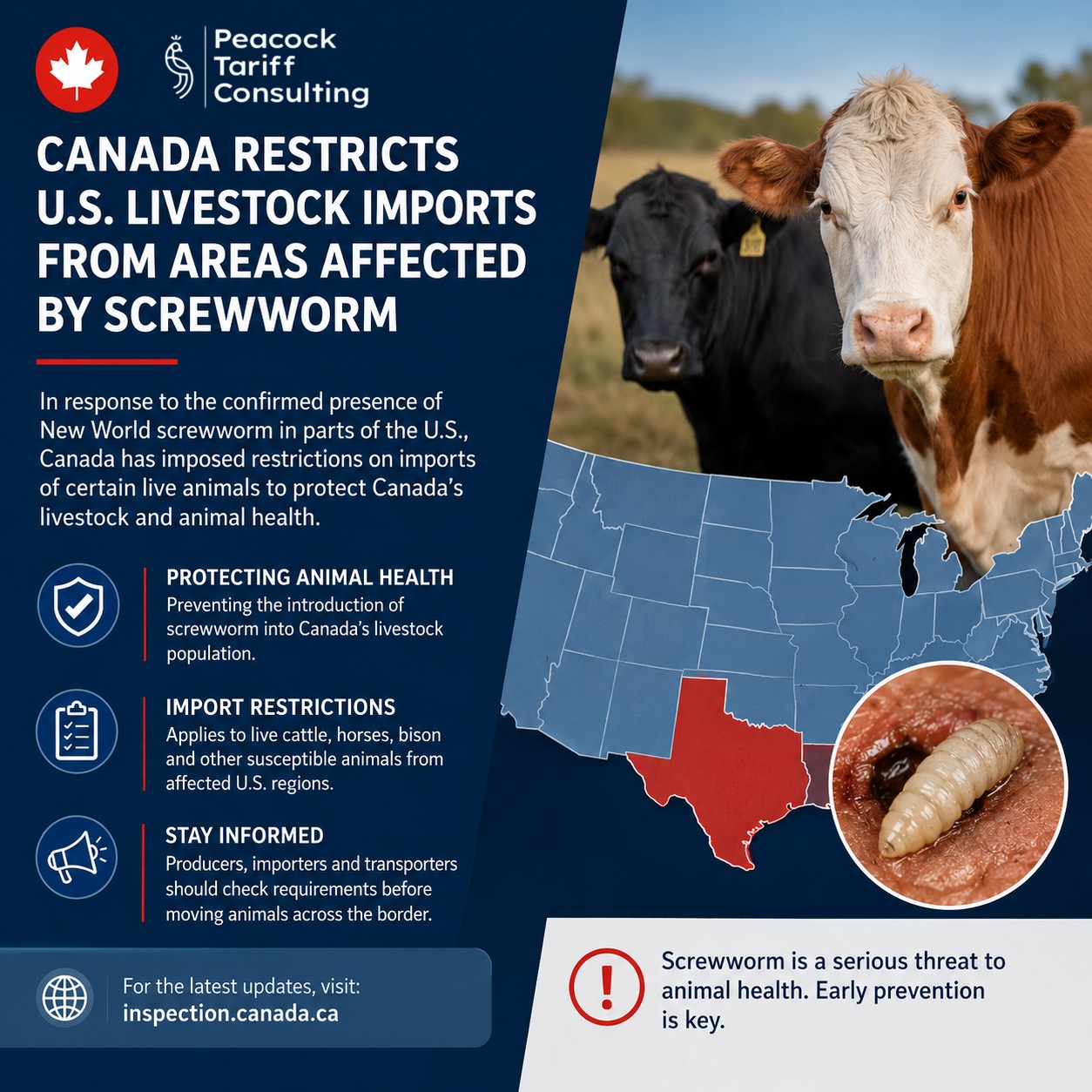
Canada moved within two days. On June 5, the Canadian Food Inspection Agency (CFIA) announced temporary import restrictions on livestock, explicitly including horses, from affected areas of the United States. The core rule is geographically precise rather than blanket: animals that originate from, or were present in, the State of Texas within 21 days before crossing the border will not be accepted into Canada. The CFIA framed the move as a proportionate, science-based precaution and said it would keep working with U.S. counterparts to adjust the measures as the situation develops.
Two features of Canada’s response are worth dwelling on. The first is its restraint. Ottawa did not suspend all U.S. cattle imports; it carved out Texas and built the restriction around a 21-day presence window keyed to the parasite’s life cycle. That targeting matters commercially. The United States and Canada run one of the most integrated live-cattle and beef markets in the world, with animals and carcasses moving across the border in both directions throughout the production chain. A blanket ban would have been economically self-defeating for Canadian feedlots and packers that depend on U.S. animals. By limiting the measure to the affected state, the CFIA signaled that it intends to manage risk without detonating the broader trade relationship.
The second feature is Canada’s climatic confidence. The CFIA was careful to note that Canada’s cold climate is not hospitable to the long-term establishment of the screwworm, though the flies can survive shorter periods during the summer months. New World screwworm is an immediately notifiable disease under Canada’s Health of Animals Act, meaning laboratories and veterinarians are legally required to report suspicions or confirmations to the CFIA. In other words, Canada views itself as facing an introduction-and-traveler risk, an infested animal or pet arriving from the south, rather than an establishment risk of the kind that haunts warmer U.S. states. That assessment shapes the proportionality of its response: enough to keep the pest out during the warm months, not so much as to needlessly sever trade.
Canada also reminded observers that its guard was already up to the south. It does not currently allow imports of cattle, bison, sheep, goats, cervids, and swine from Mexico, and it maintains stringent conditions on horses from Mexico, precautions tied to the same screwworm threat now manifesting in Texas. The Texas measure is thus best read not as a one-off reaction but as the northern extension of a continental containment posture that has been tightening for more than a year.
For the Canadian cattle sector, the timing is delicate. Canadian producers are navigating the tightest North American cattle supplies in roughly 75 years. A wider screwworm spread, or a prolonged disruption to the flow of U.S. and Mexican animals, could push feeder-cattle prices higher and tighten the supply of animals available to Canadian packers. In that sense Canada faces a double-edged exposure: it wants to keep the pest out, but it is also a price-taker in a continental market that becomes more volatile every time the screwworm advances.
Mexico: The Border That Was Already Closed
If Canada’s story is about a border slamming shut, Mexico’s is about a border that never reopened. The screwworm’s march through Mexico led Washington to suspend imports of Mexican cattle, bison, and horses through southern ports starting in May 2025, well before any U.S. animal was infected. Those ports have opened and closed in fits and starts since, but the accelerating spread inside Mexico has repeatedly pushed reopening dates back. The Texas detection only hardens that dynamic: with the pest now confirmed on U.S. soil, the case for reopening the southern border to live Mexican animals becomes politically and epidemiologically harder to make, even though, ironically, the parasite is now on both sides of the line.
The economic consequences for Mexico are substantial. Mexico is a major supplier of feeder cattle to U.S. feedlots, particularly in Texas, and the suspension has choked off that flow for the better part of a year, depriving Texas operations of animals and depriving Mexican ranchers of their largest market. Mexican President Claudia Sheinbaum has publicly expressed hope that talks with Washington would yield an agreement to reopen the border, underscoring how much is at stake for Mexican producers.
Mexico has also become a frontline partner in the eradication effort, which complicates the trade picture in a constructive way. The country is building a roughly 51 million dollar facility in Chiapas to breed sterile screwworm flies, supported by about 21 million dollars from the United States. This is cooperative biosecurity diplomacy: the same two governments locked in a contentious live-animal trade dispute are jointly financing the very tool that could end it. The logic is straightforward, the fastest route back to open borders runs through suppressing the wild fly population, and that requires sterile-fly output measured in the hundreds of millions per week. Production in Panama has been scaled up toward roughly 100 million sterile flies weekly, with Mexican and new U.S. capacity intended to push the regional total toward the half-billion-per-week mark that eradicated the pest from the United States decades ago.
The Wider World: A Template for Restriction
Beyond North America, the immediate reactions have been more muted, but the structural risk for U.S. exporters is real and worth spelling out. The United States is one of the world’s largest beef exporters, with major customers across Asia, including Japan, South Korea, and China, as well as buyers in the Middle East and elsewhere. Many of those markets maintain detailed animal-health import conditions and have shown, in past disease events, a readiness to restrict U.S. product quickly when a pathogen or pest is confirmed.
The precedent most worth recalling is the 2003 discovery of bovine spongiform encephalopathy (BSE, or mad cow disease) in a single Washington State animal. Within days, dozens of countries banned U.S. beef. Japan and South Korea, two of the most valuable markets, kept significant restrictions in place for years, and some age and cut limitations lingered for the better part of a decade. The direct losses to the U.S. beef industry ran into the billions of dollars annually at the peak of the bans. The lesson for the current episode is that the scientific facts of a disease event and its trade consequences are not the same thing. Screwworm poses essentially no food-safety risk, it is a live-animal pest, not a meat-borne pathogen, and cooking is irrelevant to it, yet importing countries may still impose live-animal restrictions, and a few may reach for broader measures out of caution or domestic political pressure.
There are reasons to expect the global reaction to stay proportionate this time. The screwworm is a known quantity with a proven eradication playbook, it is geographically contained so far, and it carries no direct human food-safety dimension that would alarm consumers the way BSE did. The World Organisation for Animal Health (WOAH) provides an internationally recognized framework for classifying countries’ disease status and for the science-based zoning and compartmentalization that allow trade to continue from unaffected regions. That framework is precisely what lets Canada restrict Texas without restricting Montana, and it is the mechanism through which the U.S. will eventually argue for the restoration of normal trade. The credibility of the U.S. eradication response, how quickly it can demonstrate containment and a shrinking case count, will largely determine how long, and how broadly, any foreign restrictions endure.
A Trade-Policy Lens: Why SPS Measures Deserve Tariff-Level Attention
For businesses that plan around trade exposure, the screwworm episode is a case study in a category of risk that often gets less attention than tariffs but can be more disruptive. Three points stand out.
First, SPS measures are faster and more absolute than tariffs. A tariff raises the cost of a traded good; an animal-health suspension can reduce permitted trade to zero overnight, with no phase-in and no grandfathering. Canada’s Texas restriction took effect on a presence-window basis almost immediately upon announcement. For an importer or exporter, the practical exposure is not a few percentage points of margin but the wholesale loss of a sourcing channel or a destination market.
Second, these measures are legally insulated in a way tariffs increasingly are not. Where discretionary tariffs invite retaliation and dispute, SPS restrictions grounded in genuine disease findings sit on firm WTO footing, provided they are science-based and proportionate. That makes them durable. A trading partner cannot easily negotiate them away; they lift only when the underlying animal-health situation is resolved to the satisfaction of the importing authority. Planning around them means planning around veterinary epidemiology, not around the next round of trade talks.
Third, the screwworm shows how a single, integrated production network amplifies a localized shock. North American cattle move fluidly across two borders; a constraint at any node ripples through all of them. The U.S.-Mexico suspension already tightened Texas supply; a prolonged Canadian restriction would tighten it further; and every increment of tightness lands on a market already at multi-decade lows in herd size and record highs in price. Firms exposed to beef and cattle, from packers and feedlots to food-service buyers and retailers, should treat the screwworm’s geographic progress as a live input to their cost and supply forecasts, not as a distant agricultural curiosity.
Reading the Signals: What to Monitor
Because the trade consequences of an animal-health event track the disease’s containment rather than any negotiation, the indicators worth watching are operational and veterinary, not diplomatic. The first is the case count and its geography. A cluster confined to the original quarantine zone in Zavala County supports the narrow, state-specific restrictions Canada has imposed and keeps the door open to a quick unwind. New detections outside the zone, and especially any movement toward the Gulf Coast or Florida, where the climate and wildlife could let the fly establish itself, would justify broader measures and would likely draw in additional U.S. states and additional importing countries.
The second indicator is sterile-fly production and dispersal capacity. The entire eradication strategy rests on flooding the affected zone with sterile males faster than the wild population can reproduce. The pace at which USDA stands up domestic production in Texas, the throughput of the expanded Panama facility, and the timeline for Mexico’s Chiapas plant together determine how quickly the wild population can be driven down. Trading partners read these numbers too; a credible, well-resourced eradication program is the strongest argument the United States can make for the early restoration of normal trade. The third signal is the posture of the major Asian beef buyers. Any move by Japan, South Korea, or China to impose conditions on U.S. product, even precautionary ones, would mark an escalation from a regional live-animal issue to a global trade event, and would be the clearest sign that the screwworm has begun to function as a barrier on the scale of past disease shocks rather than a contained, North American disruption.
Outlook
The near-term trajectory depends on a single variable: containment. If U.S. authorities can show, through sterile-fly saturation and surveillance, that the Texas cases were an isolated incursion rather than the leading edge of establishment, the trade fallout should stay narrow and time-limited. Canada’s measure is explicitly temporary and state-specific, designed to be unwound as conditions allow. Mexico’s reopening, by contrast, is now hostage both to its own outbreak and to the new reality of cases inside Texas, and the timeline there looks longer and less certain.
If, on the other hand, additional cases appear beyond the quarantine zone, or if the pest reaches the warmer, more hospitable regions of the U.S. Gulf Coast and Florida, where wildlife reservoirs could sustain it, the calculus changes. More U.S. states would face restrictions, more trading partners would be drawn in, and the eradication effort would lengthen from months into years. The half-billion-flies-per-week production target exists precisely because the people who beat this pest once know how much capacity it takes to do so again.
For now, the headline facts bear repeating because they frame the trade response: the case is the first confirmed in U.S. livestock in decades, human cases are uncommon, and there is no food-safety risk. Those reassurances are accurate. But they describe the public-health picture, not the commercial one. In the commercial picture, a flesh-eating fly has reopened a question that tariffs alone never could, how resilient the integrated North American livestock market really is, and Canada, Mexico, and a watching world have already begun to answer it with their borders.