
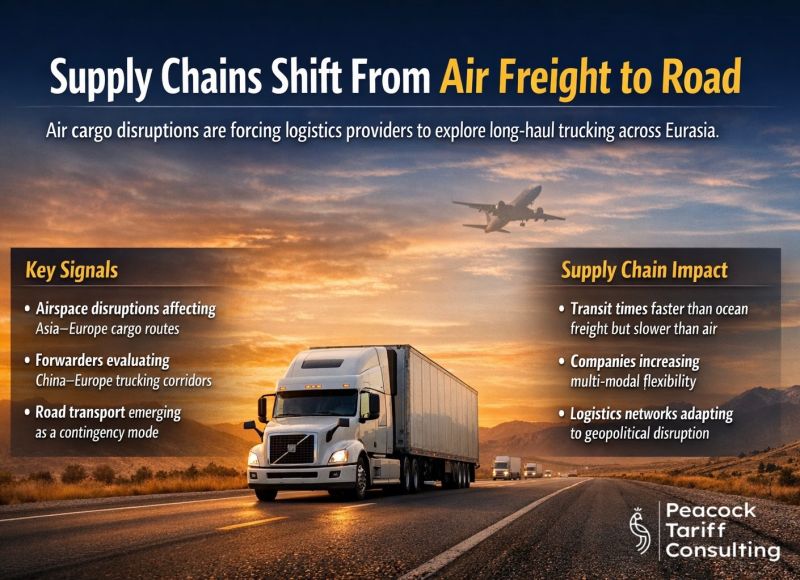
The Disruption of Air Freight Corridors: A Changing Logistics Reality
For decades, air freight has represented the premium option for time-sensitive, high-value cargo requiring rapid movement across continents. A manufacturer needing to deliver critical components from Asian suppliers to European assembly facilities could rely on consistent, predictable air service with transit times of 3-5 days door-to-door. This reliability premium justified air freight costs that often exceeded ocean shipping by a factor of 10 or more.
However, the operating environment for international air cargo has become increasingly unpredictable. Geopolitical tensions, military conflicts, and airspace restrictions are creating chokepoints and route uncertainty that previously did not exist. Traditional northern air corridors over Russia and Central Asia have become increasingly restricted or unavailable. Military operations and territorial disputes in the Middle East affect air routes to Asia. These disruptions force cargo to follow southern routes with longer distances, higher fuel consumption, and extended transit times.
Simultaneously, air freight capacity has become more limited and more expensive. Airlines prioritize passenger services, with cargo typically occupying available belly space only when profitability permits. During periods of supply chain stress when cargo demand peaks, air freight capacity becomes scarce and pricing surges dramatically. For supply chain managers, the once-reliable air freight option is becoming an unreliable, expensive alternative to be used only for true emergencies.
- Traditional air corridors disrupted by geopolitical tensions
- Northern routes over Russia increasingly restricted
- Middle East conflicts affecting southern Asian routes
- Rerouting extends transit times and increases fuel consumption
- Airline capacity prioritizes passenger services over cargo
Ocean Freight: The Traditional Baseline Becomes Inadequate
Ocean freight has historically served as the cost baseline for international logistics. Container vessels moving cargo from China to Rotterdam or Hamburg operate with remarkable cost efficiency, often delivering goods for $500-1,000 per container regardless of cargo type. From a pure cost perspective, ocean shipping is difficult to compete with. Shippers accept long transit times-typically 30-40 days for Asia-to-Europe service-in exchange for minimal per-unit costs.
However, ocean freight also carries significant risks and constraints for modern supply chains. Thirty-day transit times mean that inventory in motion represents substantial capital tied up in logistics. For time-sensitive products, fashion items, electronics with short market windows, or components integrated into complex assembly processes, month-long transit times destroy supply chain responsiveness.
Additionally, ocean freight networks suffer from the same disruptions affecting air routes. Extended voyages around chokepoints, rerouting due to geopolitical restrictions, and port congestion all extend ocean transit times and reduce predictability. The combination of slow service, capital-intensive inventory positioning, and increasing operational uncertainty makes ocean freight inadequate for many supply chains even though it remains cost-effective on a per-unit basis.
- Ocean freight offers minimal per-container costs ($500-1,000)
- Transit times of 30-40 days require substantial inventory working capital
- Time-sensitive products incompatible with ocean freight timelines
- Chokepoint disruptions increasingly affecting maritime routes
- Port congestion extending transit predictability and times
The Unexpected Solution: Long-Haul Trucking as a Logistics Middle Ground
In response to both air freight disruptions and ocean freight inadequacy, logistics providers are increasingly evaluating overland transport routes connecting China and Asia with Europe. These routes, which move cargo overland across Central Asia and either southern Russia or the Caucasus, can deliver goods in 10-14 days depending on routing, border crossings, and seasonal conditions. For many supply chain applications, this represents an optimal middle ground between air freight cost and ocean freight speed.
Long-haul trucking routes connecting Asia and Europe have existed for decades, but they have historically remained niche services used primarily by specialized logistics companies serving a limited customer base. The routing challenges, border crossing requirements, regulatory complexity, and perceived operational uncertainty limited adoption. However, the combination of disrupted air routes, extended ocean transit times, and increasing supply chain volatility is driving mainstream logistics companies to develop expertise in these routes.
The economics of Asia-Europe road transport are compelling. Operating costs for long-haul trucking, particularly when routing through lower-cost regional jurisdictions, are substantially lower than air freight but higher than ocean freight. For 20-foot containers, typical costs range from $3,000-5,000 for complete Asia-to-Europe trucking, compared to $1,500-2,500 for ocean container service or $8,000-15,000 for air cargo. More importantly, the 10-14 day transit time provides genuine speed advantage over ocean freight while remaining economically accessible for moderate-value cargo.
- Long-haul trucking routes: 10-14 day Asia-to-Europe transit
- Operating costs: $3,000-5,000 per 20-foot container
- Occupies cost/speed middle ground between air and ocean
- Significantly faster than ocean at fraction of air freight cost
- Routes cross Central Asia, Russia Caucasus, or Middle East depending on geopolitics
Operational Challenges: Why These Routes Remain Complex
Despite economic attractiveness, Asia-Europe road transport faces substantial operational complexity that limits its adoption. The first challenge involves routing options. Standard routes cross either Russia, Afghanistan, or Central Asian nations-jurisdictions with political risks, regulatory uncertainty, security concerns, and infrastructure variability. Each routing option carries different geopolitical risks, requires different permits, and involves border crossings with unpredictable timing.
Border crossing logistics represent a hidden cost in overland transport. Moving a container through five or six international borders involves documentation, customs clearance, inspection, and regulatory compliance at each crossing. While well-established for regular commerce, border delays can extend transit times significantly. Political tensions between nations can create sudden restrictions or closures that render previously optimal routes unusable. Trucking companies must maintain knowledge of current regulations, permit requirements, and geopolitical conditions across multiple jurisdictions.
Vehicle standards, fuel quality, maintenance infrastructure, and driver availability vary significantly across the regions traversed. Parts availability may be limited in Central Asian transit countries. Emergency repairs required far from major metropolitan areas present operational challenges. Insurability, security of cargo, and driver safety introduce additional complexity compared to established air and ocean routes with mature infrastructure and standardized regulations.
Despite these challenges, the combination of speed advantage over ocean freight and cost advantage over air freight is driving progressive improvement in route reliability, permit streamlining, and specialist operator networks. What was once an exotic, specialized logistics option is becoming a mainstream contingency within supply chain networks.
- Route selection involves geopolitical risk assessment
- Border crossings extend transit times and require documentation
- Vehicle standards and infrastructure consistency varies by region
- Seasonal conditions affect route viability (winter restrictions likely)
- Emergency repair capacity limited outside major trading hubs
- Specialist operators gradually improving process reliability
Multi-Modal Strategy: The New Supply Chain Imperative
The rise of long-haul trucking as a viable Asia-Europe alternative reflects a broader transformation in supply chain strategy. The era of relying on a single primary transport mode-whether air for speed or ocean for cost-is ending. Instead, sophisticated supply chains now operate as multi-modal networks where transport mode selection depends on dynamic conditions including cargo characteristics, urgency, cost optimization, and geopolitical risk factors.
Leading logistics companies are developing proprietary software systems that evaluate real-time conditions across multiple transport modes and select optimal routing for each shipment. When air routes face restrictions or delays, alternative capacity in trucking networks can be activated. When ocean shipping encounters extended transit times due to chokepoint disruptions, air or overland options provide faster alternatives. This flexibility transforms supply chain resilience from a theoretical concept into operational practice.
For supply chain leaders, this transformation requires fundamental organizational changes. Rather than negotiating long-term contracts with single carriers operating single modes, companies must develop relationships with multiple carriers offering multiple modes. Rather than optimizing supply chain design around one primary transport mechanism, companies must build networks that accommodate multiple modes seamlessly. Rather than forecasting based on historical patterns, companies must develop scenario-based planning that incorporates geopolitical volatility.
The competitive advantage in supply chains is increasingly determined by transport flexibility and geopolitical adaptability. Companies that maintain rigid transport mode preferences or single-carrier dependence will find themselves unable to respond when disruptions occur. Companies that build multi-modal networks and maintain carrier relationships across modes will achieve superior responsiveness and cost efficiency.
- Single-mode transport strategy no longer viable
- Multi-modal networks provide flexibility across conditions
- Dynamic mode selection based on real-time conditions
- Software systems evaluating multiple routing options simultaneously
- Carrier relationships require multi-modal capability
- Supply chain design must accommodate mode flexibility
- Scenario planning incorporates geopolitical volatility
Regional Implications: Nearshoring and Network Reconfiguration
The increasing viability of long-haul trucking routes connecting Asia with Europe has interesting implications for manufacturing location decisions. Previously, manufacturing location optimization focused primarily on labor costs and proximity to consumption markets. The assumption was that Asian low-cost manufacturing combined with inexpensive, reliable ocean freight to distant markets was unbeatable from a total-cost perspective.
However, with ocean freight becoming less reliable, air freight more expensive and capacity-constrained, and road freight emerging as a viable middle option, the total-cost calculus for manufacturing location is shifting. Companies now assess not just production cost and baseline freight cost but also supply chain resilience, inventory-in-motion carrying costs, and flexibility to respond to demand changes.
This recalculation is driving renewed interest in nearshoring strategies that move production closer to European consumption markets. Turkish, Eastern European, and North African manufacturing hubs are attracting investment as alternatives to exclusive Asian sourcing. These locations offer good cost structures, proximity to European markets, and transport mode flexibility that reduces reliance on disruption-prone long-distance routes.
The emergence of viable Asia-Europe trucking doesn’t eliminate this nearshoring trend-it coexists with it. Companies are increasingly following hybrid strategies: core production remains in cost-advantaged Asian locations, but components and finished goods move via flexible transport modes. For time-sensitive or high-value products, nearshoring provides access to local production capacity that responds quickly to market changes.
- Manufacturing location decisions incorporating geopolitical transport risk
- Nearshoring gaining economic attractiveness versus Asian sourcing
- Total-cost analysis including inventory-in-motion and supply chain resilience
- Regional hubs in Turkey, Eastern Europe, North Africa attracting investment
- Hybrid strategies combining distant and regional sourcing
- Transport flexibility reducing need for exclusive regional dependence
Future Outlook: Transport Networks in an Uncertain Geopolitical Environment
Looking ahead, expect continued evolution in transport strategy as geopolitical uncertainty persists and supply chain volatility becomes the operating environment rather than the exception. Air freight will likely remain available for true emergencies and ultra-time-sensitive cargo but at increasingly premium pricing and limited availability. Ocean freight will continue to dominate bulk commodity and low-urgency cargo movement but with reduced reliability and predictability.
Long-haul trucking, rail, and other overland transport modes will see progressive development of infrastructure, regulatory harmonization, and specialized service offerings. The routes may shift based on geopolitical conditions-northern routes through Russia becoming more or less available, southern routes through the Middle East fluctuating in safety and reliability-but the fundamental viability of overland transport as a supply chain option will only increase.
For supply chain professionals, the imperative is clear: develop multi-modal transport strategy, build relationships across carrier types and geographies, invest in network flexibility and scenario planning capability. The days of simple, predictable, single-mode supply chains have passed. Success belongs to organizations that build adaptive capacity into their networks and maintain the flexibility to respond as geopolitical and market conditions evolve.
The supply chains of the future will be characterized by dynamic mode selection, geographic diversification, and continuous adaptation to geopolitical risk. Companies that embrace this complexity and build organizational capability to manage it will achieve competitive advantage. Companies that resist and cling to simplified, rigid supply chain strategies will struggle with disruption, cost overruns, and missed market opportunities.
- Air freight remaining available but at premium cost and limited capacity
- Ocean freight continuing dominance for non-time-sensitive cargo
- Overland transport infrastructure and services continuously improving
- Geopolitical conditions determining available routing options
- Successful supply chains demonstrating multi-modal flexibility
- Adaptive capacity and scenario planning as competitive differentiators
- Dynamic resource allocation as core supply chain competency