
Tag: Protest
-
When to file drawback vs refund (CAPE, protest, PSC). Decision matrix by entry type and import circumstances.
-
Voluntary tender vs prior disclosure for compliance gap remediation. Different pathways, different penalty implications.
-

IEEPA Tariffs: The Foundation and What Importers Paid The International Emergency Economic Powers Act (IEEPA) grants the President authority to impose tariffs and trade restrictions during periods of national emergency. In recent years, IEEPA has been invoked multiple times to implement tariffs on goods from various countries, affecting billions of dollars in imports and impacting…
-
The ACE System Constraint: Why CBP Rejects Protest Claim Submissions CBP’s rejection of Post-Summary Correction (PSC) submissions for IEEPA-affected entries traces directly to Automated Commercial Environment (ACE) system limitations. The ACE system was not configured to accept or process entry submissions that remove IEEPA tariff components from the duty calculation. This is not a policy…
-
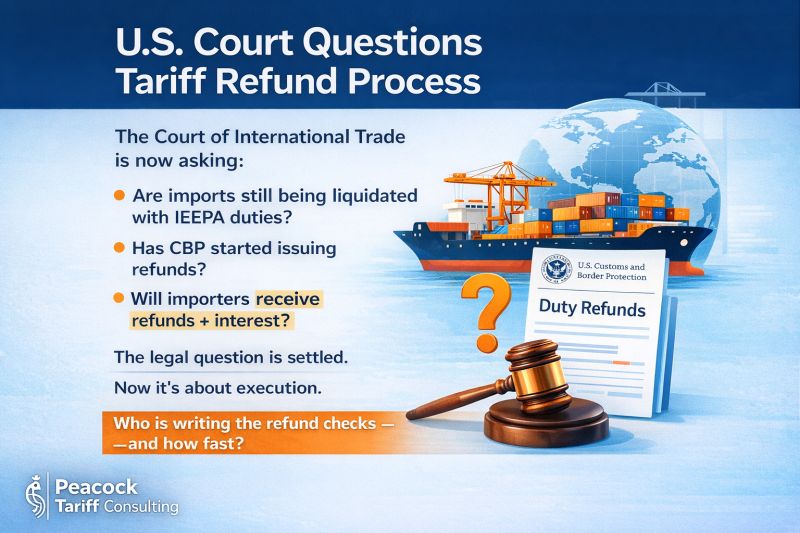
The Supreme Court Settled One Question; The CIT Must Answer Others The Supreme Court’s decision on tariff refunds established a foundational principle: importers are owed refunds for duties collected under the International Emergency Economic Powers Act (IEEPA). However, settling the legal principle of refund eligibility does not resolve the practical complexities of execution. The Court…
-
Customs broker engagement. Engagement letter, POA scope, fee structure, post-entry authorities, reporting requirements.
-
Tariff classification services pillar. Classification opinions, binding rulings, audit defense, ongoing classification programs.
-
Introduction: A Historic Refund Window Opens The U.S. Supreme Court’s landmark decision striking down the Trump administration’s IEEPA‑based tariffs has triggered one of the largest potential refund events in modern U.S. trade history. Billions of dollars in duties collected across thousands of importers were deemed unlawfully imposed, and the Court of International Trade has now…
-
IEEPA Refund Developments Client Alert – March 2, 2026 We are providing an update on obtaining IEEPA tariff refunds that follows our February 21, 2026 client alert concerning the Supreme Court decision. Since that alert, various importers have attempted to file Post Summary Corrections (PSCs) for unliquidated entries, and the U.S. Customs and Border Protection (CBP) has…
-

Effective February 6, 2026 Federal Register 91 FR 21 (Jan. 2, 2026) U.S. Customs and Border Protection (CBP) has issued an interim final rule that fundamentally reshapes how importers receive refunds. Beginning February 6, 2026, CBP will issue all refunds electronically, with only narrow hardship exceptions. This rule amends 19 CFR Parts 24, 141, 159,…